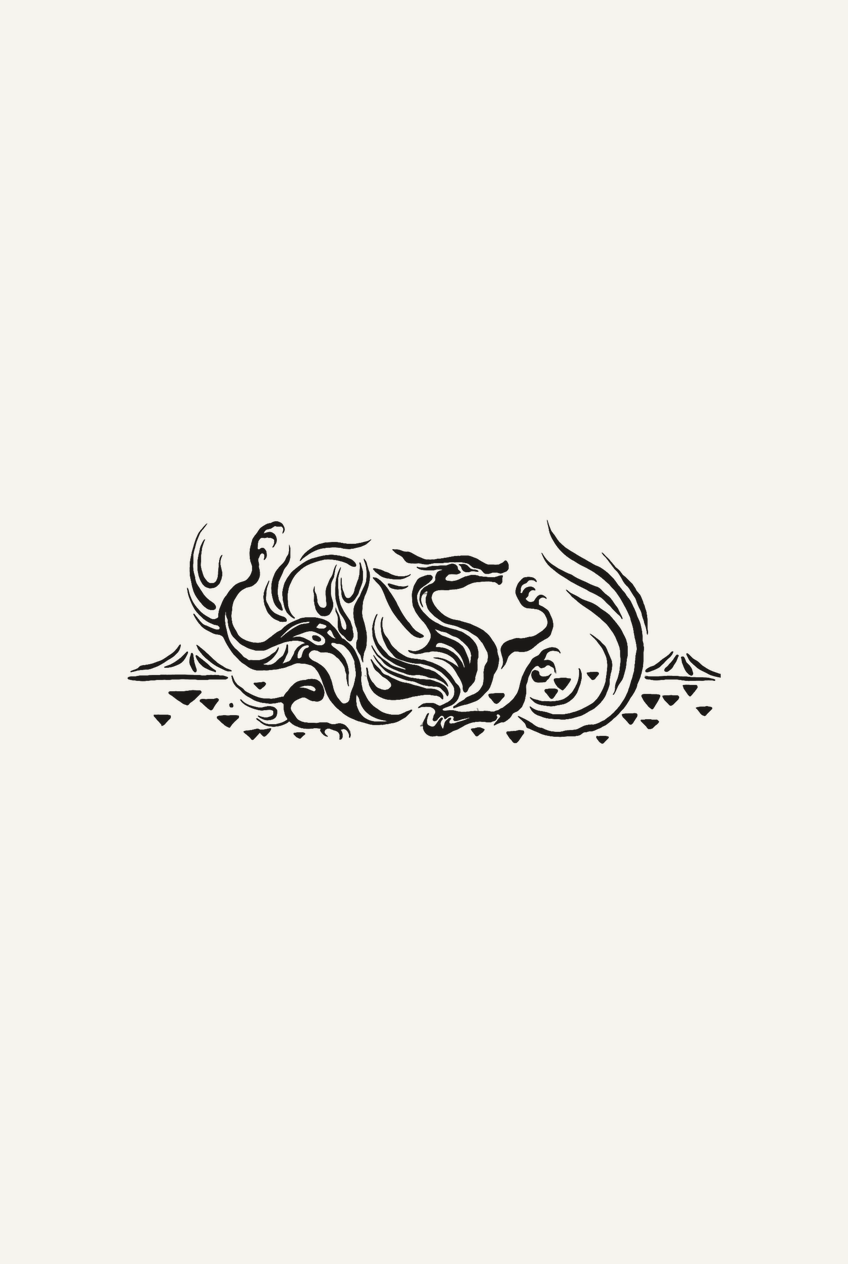
朱獳 · Zhū Rú
When Fear Has a Name
Series: Mythical Beasts & Sacred Animals · Design #30
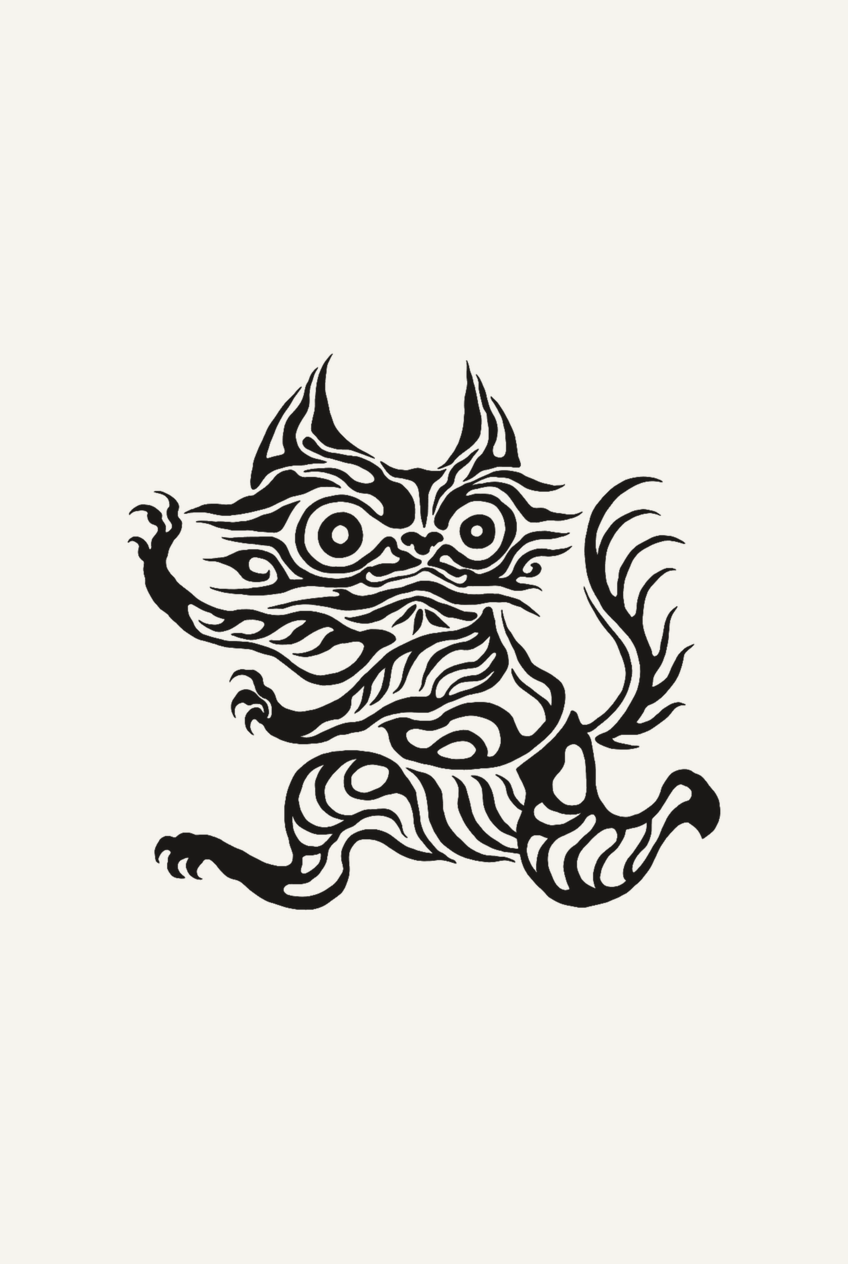
Style: Fox-formed beast crouched in a look-back, a great curled fish-fin rising behind it like a wave, plume tail swept up, hill outlines at both flanks, a scatter of small triangles along the ground · black-grey · landscape composition · scalable 12–16 cm
Form: 图案
The Name
*zhū rú* — the fish-finned fox of Geng Mountain, and the most precise forecaster in the classic. It does not bring plague, famine, or flood. Its record reads: 见则其国有恐 — when it appears, the state will know fear. Not disaster — the *feeling* of disaster. And the strangest clause: 其鸣自訆 — it cries its own name. Fear, before it arrives, announces itself.
朱獳(zhū rú)——耿山的鱼鳍之狐,整部经典里最精确的预报员。它不带来瘟疫、饥荒或洪水。它的记载是:见则其国有恐——它一现身,这个邦国就将知道恐惧。不是灾难——是灾难的*感觉*。最怪的一句:其鸣自訆——它叫自己的名字。恐惧在抵达之前,先自报家门。
Source & Provenance
The *Shanhaijing*, *Dong Shan Jing* chapter (compiled c. 4th–2nd century BC), Geng Mountain entry: 「有兽焉,其状如狐而鱼翼,其名曰朱獳,其鸣自訆,见则其国有恐。」 — fox-shaped with fish fins, crying its own name; its appearance marks coming fear for the state. Geng Mountain itself is recorded as barren, rich in water-jade (水碧) and great snakes — an ecology of cold, gleaming, coiled things, of which this beast is the voice. Inking note: the recorded coloring is honored in form; this design is inked in black-grey.
《山海经·东山经》(约成书于前 4—前 2 世纪)耿山条:「有兽焉,其状如狐而鱼翼,其名曰朱獳,其鸣自訆,见则其国有恐。」形如狐而生鱼鳍,叫自己的名字;它一现身,邦国将有恐惧之厄。耿山本身被记为草木不生,多产水碧与大蛇——一种冷冽、幽光、盘曲的生态,这只兽是它的嗓音。墨线转写:所记色彩以形制记之,本设计为黑灰墨线稿。
Design Inspiration
Every form decision on this design points to a recorded source, element by element. ① The fox head in a look-back — 其状如狐, the recorded fox drawn mid-glance: the posture of the watcher who has seen something before you have, the look you will copy involuntarily. ② The great curled fish-fin — 鱼翼, the recorded fin enlarged into a breaking wave behind the body: fear drawn as swell, something assembling offshore. ③ The hill outlines and ground triangles — 其国, the state rendered as landscape: hill-lines at the flanks, and a scatter of small triangles along the ground reading as a land shaken loose — the realm when the fear arrives. ④ The crying mouth — 其鸣自訆, the self-naming cry drawn open: the announcement, made in its own voice, that fear is coming and even has a name.
本版每一处形制决定都有出处可查,逐条对账。① 回望的狐首——「其状如狐」,所记的狐画在回望的半途:先于你看见东西的观望者,那副你不由自主要跟着学样的表情。② 身后巨卷的鱼鳍——「鱼翼」,所记的鳍放大成体后一道正在卷起的浪:恐惧画成涌,正在海上集结的东西。③ 两侧山廓与地面碎三角——「其国」,邦国被译作风景:两翼的山廓,沿地面散开的小三角读作震松的土地——恐惧抵达时的邦国。④ 张开的口——「其鸣自訆」,自报家门的啼叫画成开口:以它自己的声音宣告——恐惧要来,而且它有名字。
The Story
Notice what the entry does not say. Every other omen-beast promises an event: drought, flood, war, locusts. Zhuru promises a mood. 见则其国有恐 — the state will know fear — and then the record stops, with nothing else attached. No plague follows, no invasion is named. The ancients, who catalogued disasters with agricultural precision, chose to file *fear itself* as a state-level event, complete with its own herald animal. That is an astonishing piece of psychological observation. They knew what every court, every market, every group chat knows now: the feeling arrives before the event, spreads faster than the event, and often outlives it. The fear is the disaster's advance team — and sometimes it is the only thing that actually shows up.
And then the clause that turns warning into ritual: 其鸣自訆 — it calls its own name. In the classic's logic, where most beasts cry and some are named for their cry, this one performs its own identification. Which is exactly how surviving fear works: the moment you can name the thing coming, it has announced itself, and the announcement is the beginning of the answer. Terror that stays nameless runs the house. Terror with a name stands at the door, declared.
So what does it mean to wear it? This is a design for people who have lived through the season when the fear arrived ahead of its event — and learned the only working countermeasure: name it early, out loud, in your own voice. Wearing Zhuru is carrying the herald's face as a reminder: the feeling is not the fact. 见兽鸣名,惧有先声;知其先声者,不乱。
注意这条记载没说什么。其他每只征兆之兽都许诺一个事件:旱、洪、兵、蝗。朱獳许诺的是一种情绪。见则其国有恐——邦国将知道恐惧——然后记载就停了,什么也没附着。没有瘟疫随后,没有入侵被点名。以农事级精度给灾难编目的古人,选择把*恐惧本身*作为邦国级事件归档,还给它配了通报兽。这是一段惊人的心理观察。他们早就懂了每个朝廷、每个市场、每个群聊今天才懂的事:感觉先于事件抵达,比事件传得快,还常常比事件活得久。恐惧是灾难的先遣队——有时候它是唯一真正到场的东西。
然后是那个把预警变成仪式的分句:其鸣自訆——它叫自己的名字。在经典的逻辑里,众兽啼叫、有的以叫声得名,而这只兽完成的是自我指认。这正是「活过恐惧」的机理:你能在到来的东西面前叫出名字的那一刻,它已经自报了家门,而宣告就是答案的开头。没有名字的恐怖才当家做主。有名字的恐怖,站在门口,被登记在案。
所以纹它,纹的是什么?这是给「经历过恐惧先于事件抵达的那个季节」的人的设计——并且学会了唯一有效的对策:早早地、出声地、用自己的声音把它叫出来。纹朱獳,是把通报兽的脸随身携带:感觉不是事实。见兽鸣名,惧有先声;知其先声者,不乱。
What It Means
Fear, granted a name and a face in advance. The wave drawn before it breaks, the hills standing while it swells. The classic's most honest forecaster — it never promises the disaster, only the feeling, so that the feeling can never take you by surprise.
被提前授予名字与面孔的恐惧。浪在破碎之前先被画出,山在涌起时仍然站立。整部经典最诚实的预报员——它从不许诺灾难,只许诺感觉,于是那感觉再也无法偷袭你。
Where It Sits
Built horizontal and watchful: 12–16 cm along the forearm or outer thigh, the look-back following the limb's twist; a 10 cm variant sits on the shoulder. The curled fin is the design's swell — keep its crest clear of joints so the wave never appears to break at the elbow.
天生的横幅守望构图:12—16 厘米顺小臂或大腿外侧,回望随肢体的扭转走;10 厘米变体收肩头。卷起的鳍是全图的浪涌——鳍尖避开关节,别让浪看起来在肘部碎掉。
Before You Ink
This design belongs to ink only. The fin's long curves need unbroken line-weight — black keeps the swell ominous; greyscale makes it wispy. Minimum size 10 cm: below that the fox's glance loses its direction and the triangles merge into noise. Keep it off the inner arm — friction fattens the fine hill-lines first, and the landscape must stay standing.
此图只宜墨线。鳍的长曲线需要不间断的线宽——黑让涌保持不祥,灰阶会把它弄虚。最小尺寸 10 厘米:再小,狐的回望失去方向,碎三角连成噪点。避开手臂内侧——摩擦最先增粗细山廓线,而那片风景必须始终站立。
Every character on this card was selected and checked stroke by stroke by a native reader of Chinese.