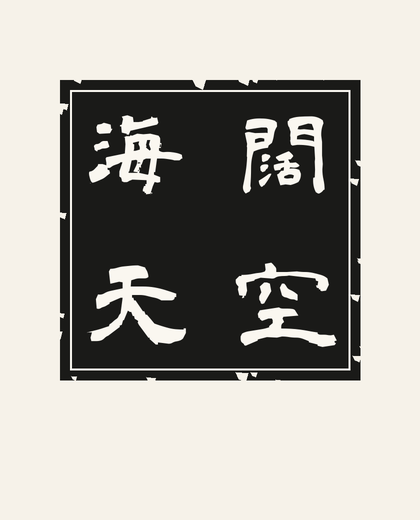
海阔天空 · Hǎi Kuò Tiān Kōng
Broad as the Sea, High as the Sky
系列: 吉语成语 · Design #66
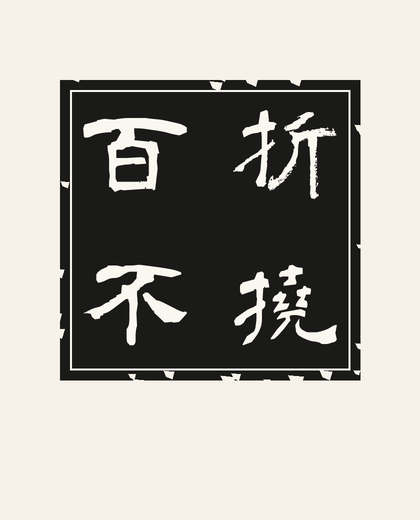
笔法: Four characters in a 2×2 square, read left-to-right top row then bottom · Han-seal filled-white (bǎiwén) stamp — black ground, reversed white glyphs, weathered border · clerical script (lishu), traditional form 海闊天空 · medium-to-large scale
形态: 四字方阵大字,横排左上起;汉印满白文,黑底白字、残边;青柳隶繁形
名字
海阔天空(hǎi kuò tiān kōng)——海宽阔,天高远。海是海;闊(阔)是宽;天是天;空是空、开阔。四个字画出一片没有边界的空间——用来形容心被放开、争执被放下、前面没有墙的未来。这是少见的成语:字面图像和比喻意思几乎是同一件事。
*Hǎi kuò tiān kōng* — the sea broad, the sky high. 海 is sea; 闊 (阔) is broad; 天 is sky; 空 is empty / open. Four characters that picture an unbounded space — used for a mind set free, a dispute let go, a future with no wall in front of it. It is one of the few Chinese idioms whose literal image and figurative meaning are almost the same thing.
出处
常见出处有两说,这里并列,不替你择一。一说本于北周庾信《道士步虚词》:麟洲一海阔,玄圃半天高。另一说出自唐代玄览题竹:大海从鱼跃,长空任鸟飞(见《诗话总龟》引)。四字成辞「海阔天空」是后来凝定的,今天已完全成语化。墨线转写:本设计以传统母题的经典线条造型为底,转写为纹身墨线。
Two lines are commonly cited, and both are given here rather than choosing one. The phrase is often traced to the Northern Zhou poet Yu Xin (庾信), *Dào Shì Bù Xū Cí* (道士步虚词): 麟洲一海阔,玄圃半天高 — "the isle of the qilin, a sea broad; the dark garden, half the sky high." Another attribution points to the Tang monk Xuanlan (玄览), who wrote on bamboo: 大海从鱼跃,长空任鸟飞 — "in the great sea, let the fish leap; in the long sky, let the birds fly" (quoted in *Shī Huà Zǒng Guī* 诗话总龟). The four-character form 海阔天空 crystallized later and is now thoroughly idiomatic. Inking note: this design adapts the classic line construction of the traditional motif and re-inks it as tattoo linework.
设计灵感
本设计每一处形制决定都有出处可查,逐条对账。① 四字 2×2 方阵、横着读——现代从左往右的次序,让海外读者不必懂古典惯例也能读顺。② 隶书、繁形「海闊天空」——汉石经的语域;繁体「闊」保留完整字形,不用简体「阔」。③ 满白文处理——字从黑地里刻出来;这句话讲的开阔,正好回响在墨里留下的空间中。④ 四字等重、间距舒展——设计要显得开,不能挤,因为这个词整个意思就是"有余地"。⑤ 残边——手工盖出的印,边缘不完美;再开阔的天,也是透过人的框看到的。
Every form decision points to a recorded source, element by element. ① Four characters in a 2×2 square, read across — the modern left-to-right order, so an overseas reader can follow the phrase without the classical convention. ② Clerical script, traditional form 海闊天空 — the Han-stone register; the traditional 闊 keeps the full glyph rather than the simplified 阔. ③ The filled-white treatment — the characters cut from the dark field; the open space of the phrase is echoed by the space left visible in the ink. ④ Equal weight and generous spacing — the design should feel open, not compressed, because the word's whole meaning is room. ⑤ Weathered border — a hand-set seal, imperfect at the edge; even an open sky is seen through a human frame.
来历
这幅图像自己把话说完了。一片看不到边的海;一个空着的天。中国作家一再回到它,因为要说"当一件一直逼近你的事突然松开"是什么感觉,这是最短的说法——一场争执放下、一份工作辞掉、一次终于给出的原谅。
两处候选出处都说明这种感觉有多老。在庾信那里,海天是神仙岛屿的环境——一个字面意义上更大的世界。在唐代僧人的竹上,同样的开阔变成了许可:鱼可以跃,鸟可以飞,各自在本性里、在一个容得下它的元素中做该做的事。这个成语把两者都继承了:空间,以及在空间里活动的自由。
它不是"一切都会好"的意思。「海阔天空」通常是决定之后说的,不是之前——在你放下一件事之后,发现世界并没有在它的边缘终止。它描述的是从另一边看到的景象。
纹这四个字,是留住那道景:不是想要更大的生活,是记下那一刻——你以为永远的墙,原来是一道门。
The image does all the work. A sea with no visible edge; a sky with nothing in it. Chinese writers kept returning to it because it is the shortest way to say what a person feels when a thing that has been closing in suddenly opens — an argument dropped, a job left, a forgiveness finally given.
The two candidate sources show how old the feeling is. In Yu Xin, the sea and sky are the surroundings of immortal islands — a literally larger world. In the Tang monk's bamboo, the same largeness becomes permission: the fish may leap, the bird may fly, each simply doing what its nature does in an element with room for it. The idiom inherits both: space, and the freedom to move inside it.
What it does not mean is "everything will be fine." 海阔天空 is usually said after a decision, not before — after you have let something go, and discovered that the world did not end at its edge. It is a description of the view from the other side.
To wear it is to keep that view: not a wish for a bigger life, but the record of a moment when the wall you thought was permanent turned out to be a door.
释义
逼仄之后的空间——海阔,天空。这个成语同时带着无边的景象和在其中活动的自由;它通常在放下之后说出,描述的是从另一边看到的景。给那些发现墙原来是门的人。
Room after constriction — the sea broad, the sky open. The idiom carries both an unbounded view and the freedom to move within it; it is usually said after letting go, as a description of the view from the other side. For people who have discovered that a wall was a door.
位置
2×2 方阵需要宽而平的面。上背与大腿外侧 12–16 厘米;肩胛 12–14 厘米;胸口 13–16 厘米。四字同面等大、间距舒展——设计要像这个词的意思一样开阔。最小 12 厘米。
A 2×2 square needs a broad, flat field. Upper back and outer thigh at 12–16 cm; shoulder blade at 12–14 cm; chest at 13–16 cm. Keep all four characters on one plane at equal size, with generous spacing — the design should feel as open as the word means. Minimum 12 cm.
纹之前
负形印——用随卡附的白底黑线转印页;黑底封面是成品印,不是转印稿。② 繁体「海闊天空」——简体「阔」会切断古典语域。③ 读序——本版每行从左往右读,别让师傅改成从右往左。④ 间距要舒展——四字挤在一起,与词义相悖。⑤ 只用墨,最小 12 厘米。 ⑥ 只纹一体——本款隶书,勿在方阵里混入篆书字。
Negative-form seal — use the supplied white-ground black-line transfer sheet; the black cover is the finished stamp, not the stencil. ② Traditional form 海闊天空 — the simplified 阔 breaks the classical register. ③ Read order — this version reads left-to-right across each row; do not let a studio rearrange it right-to-left. ④ Keep the spacing generous — crowding the four characters contradicts the meaning. ⑤ Ink only. Minimum 12 cm. ⑥ One script only — clerical version; do not mix seal-script characters into the square.
本卡每一个汉字都由中文母语者选定并逐笔核对。