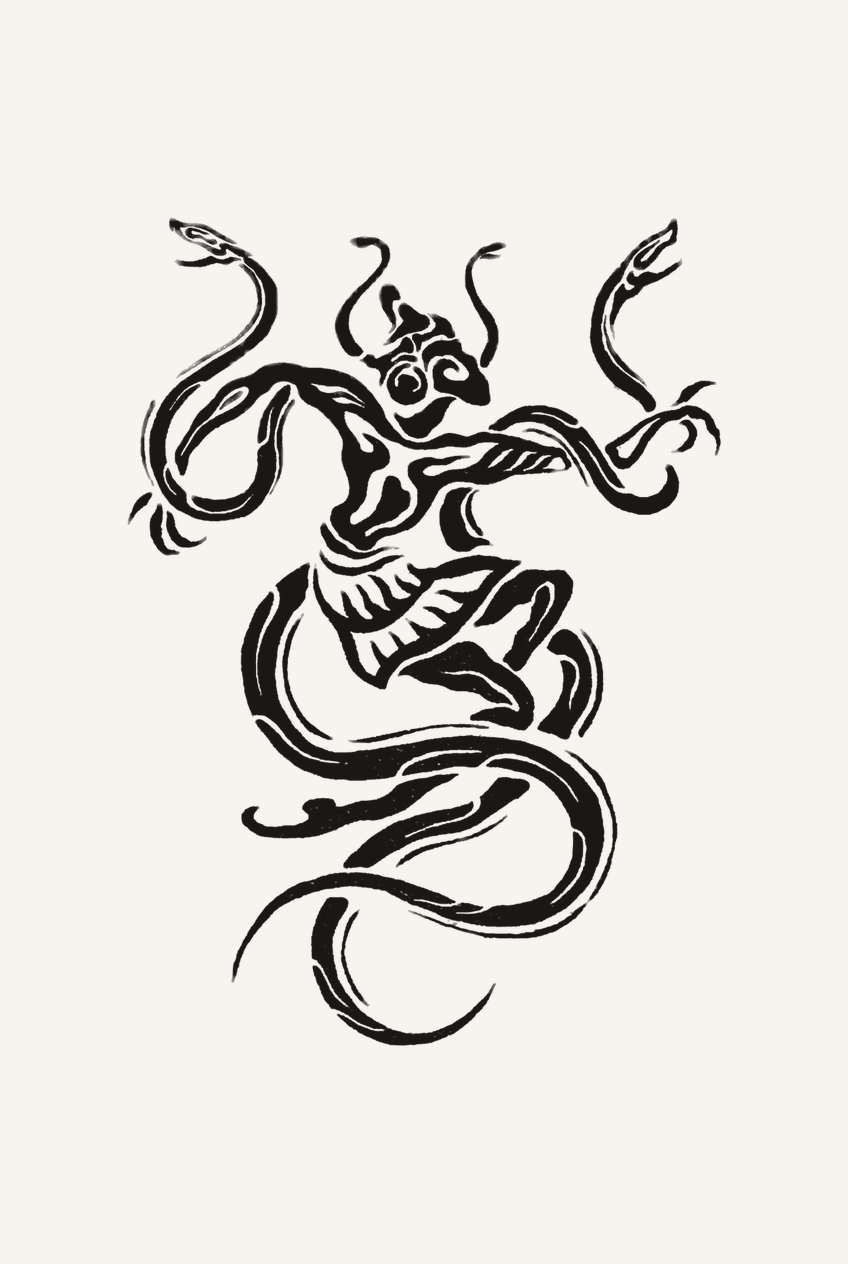
雨师妾 · Yǔ Shī Qiè
The Snake-Bearer of the Rain Priests
系列: 神兽灵禽 · Design #38
笔法: Dark-skinned figure with serpents in both hands and both ears · bold brushwork · vertical composition · scalable 14–18 cm
形态: 两手操蛇、耳贯青赤二蛇的雨师侍者
名字
雨师妾(yǔ shī qiè)——雨师们的侍者。在《山海经》的近海地理里,就在十日洗浴的汤谷之北,住着一位黑肤的身影,她对待蛇的方式如同旁人使用工具:两手各操一蛇,左耳贯青蛇,右耳贯赤蛇。不是弄蛇者——是同行。雨与蛇,协同工作。
*yǔ shī qiè* — the one who attends the Masters of Rain. In the coastwise geography of the *Shanhaijing*, just north of the valley where ten suns bathe, lives a dark-skinned figure who handles snakes the way other people handle tools: a serpent in each hand, a blue snake through the left ear, a red snake through the right. Not a snake-charmer — a colleague. Rain and serpent, working together.
出处
《山海经·海外东经》(约成书于前 4—前 2 世纪):「雨师妾在其北。其为人黑,两手各操一蛇,左耳有青蛇,右耳有赤蛇。一曰在十日北,为人黑身人面,各操一龟。」形制参考:《山海经》文本记载;汉代艺术中「珥蛇」神祇的形象。墨线转写:本设计以传统母题的经典线条造型为底,转写为纹身墨线。
The *Shanhaijing*, *Haiwai Dong Jing* chapter (compiled c. 4th–2nd century BC): 「雨师妾在其北。其为人黑,两手各操一蛇,左耳有青蛇,右耳有赤蛇。一曰在十日北,为人黑身人面,各操一龟。」 — the Yushiqie dwell to the north; their people are dark; each holds a snake in either hand, with a blue snake through the left ear and a red snake through the right. Historical form reference: the *Shanhaijing* textual record; Han-dynasty depictions of serpent-earring (ershe) divinities. Inking note: this design adapts the classic line construction of the traditional motif and re-inks it as tattoo linework.
设计灵感
本版每一处形制决定都有出处可查,逐条对账。① 双手之蛇——「两手各操一蛇」,画作两道活的弧线盘上小臂,蛇头朝外。② 耳蛇——「左耳有青蛇,右耳有赤蛇」,两条细线各贯一耳,是这件设计最古老的信号。③ 黑身——「其为人黑」,保留为设计中最重的墨块,身影以纸色衬出。④ 立姿之静——不画风暴:唤雨者的力量在于静止,蛇在掌握中安伏。
Every form decision on this design points to a recorded source, element by element. ① The serpent in each hand — 两手各操一蛇, drawn as two living arcs coiling up the forearms, heads outward. ② The ear serpents — 左耳青蛇,右耳赤蛇, two slim lines passing through each ear, the design's most ancient signal. ③ The dark body — 其为人黑, kept as the densest ink-mass in the design, the figure silhouetted against paper. ④ The standing calm — no storm drawn: the rain-caller's power shows in stillness, the serpents quiet in the grip.
来历
在《山海经》所描述的世界东缘,越过黑齿之国与十日在扶桑树上洗浴的汤谷,地理笔记不加渲染地记下了一个身影:雨师妾在其北——雨师们的侍者,就住在这里以北。其人肤色深黑。两手各握一条蛇。一条青蛇悬在左耳,一条赤蛇悬在右耳。
笔记没有解释为什么蛇与雨属于彼此——因为在最初的读者那里,这无需解释。在早期中国乃至更广的东亚信仰里,蛇是水域边缘的生灵:洪水之前浮出河面,气压转变时开始活动,住在雨住的地方。一个被画成「佩戴着活蛇」的形象——平静地,既当首饰也当工具——意思是:此人与水循环是直呼其名的老交情。贯耳的青红一对是点睛之笔:雨云与雨光的两种颜色,被当作首饰戴着,一边一只,分列脸的两侧。
再注意这段记录暗示的姿态。这不是与蛇的搏斗,也不是对蛇的崇拜。操——是持、是操持。关系是职业性的。古代世界不缺号令风暴的神;却很少费心去想象让整场行动顺利运转的那些幕僚。雨师妾就是这样的幕僚:站在天气旁边的那位安静的专业者,蛇伏在手中,等季节转身。
作为纹身,它属于与强大之物平静共事的人——心理咨询师、兽医、操作着一套失手就会伤到自己之系统的工程师,以及一切「危险的力量在他们手中会安伏下来」的人。两蛇,两耳,两手皆有持有:带牙齿的从容。
Near the eastern edge of the world described by the *Shanhaijing*, past the country of black teeth and the valley where ten suns bathe in the fusang tree, the geography notebook records a figure without fanfare: 雨师妾在其北 — the Yushiqie, attendants of the rain masters, live just north of here. Their skin is dark. They hold a snake in each hand. A blue serpent hangs from the left ear, a red one from the right.
What the notebook does not explain is why snakes and rain belong together — because to its original readers, no explanation was needed. In early Chinese and wider East Asian belief, serpents are creatures of the water margins: they surface from rivers before floods, they move when the air pressure turns, they live where rain lives. To be shown wearing living snakes — calmly, as jewelry and as tools — is to be shown as someone on first-name terms with the water cycle. The blue-and-red pair through the ears is the masterstroke: the colours of rain-cloud and storm-light, worn as ornaments, one on each side of the face.
And note the posture the record implies. This is not a battle with the serpents, and not worship of them either. 操 — to hold, to handle. The relationship is professional. The ancient world was full of gods who commanded storms; it rarely bothered to imagine the staff who kept the whole operation running. The *Yushiqie* is that staff: the quiet professional standing next to the weather, serpents resting in hand, waiting for the season to turn.
As a tattoo, this is for people who work with powerful things calmly — therapists, veterinarians, engineers of systems that could hurt them if mishandled, anyone whose skill is that dangerous forces settle down in their grip. Two snakes, two ears, hands full: composure with teeth in it.
释义
与力量同行的从容:危险的力量也会托付信任的那种职业性平静。也是所有「在风暴旁边工作、而不必成为风暴」之人的徽章。
Composure in the company of power: the professional calm of someone dangerous forces trust. Also the emblem of everyone who works beside the storm without needing to be the storm.
位置
立姿人物适合 14–18 厘米落在小臂外侧——双蛇随臂长盘绕——或 12–15 厘米沿小腿下行。贯耳双线在 14 厘米以上才易读。以 12–13 厘米居中于胸口同样成立,手与蛇的墨块足以撑起整件设计。
The standing figure suits 14–18 cm on the outer forearm — serpents coiling with the arm's length — or 12–15 cm down the calf. The two ear-lines read best above 14 cm. It also centers cleanly on the chest at 12–13 cm, the hands-and-serpents mass carrying the design.
纹之前
双蛇不是一蛇——「两手各操一蛇」是数目;一条蛇就失去了成对之意。应读出两只不同的动物,一臂一条。② 耳蛇是谱系签名(「左耳青蛇,右耳赤蛇」):贯耳的两条细线——若取色,按经文左青右红。③ 人物的黑色体块应保持实墨,而非重灰面——要密度,不要纹理。④ 只宜墨线:经典的黑身配青赤二蛇是很有力的落针选色;本转印稿为纯线描。⑤ 不小于 12 厘米——再小贯耳线会缠成一团。小臂位置日晒最多,补色周期会更早。
Two snakes, not one — 两手各操一蛇 is the count; a single serpent loses the pairing. They should read as two distinct animals, one per arm. ② The ear serpents are the canon signature (左耳青蛇,右耳赤蛇): two slim lines through the ears — if you take the colour option, keep blue left and red right, per the record. ③ The figure's dark mass should stay solid ink, not heavy shading — density, not texture. ④ Ink-only by design: the canonical black body with blue/red serpents is a strong at-the-needle colour option; the stencil is pure linework. ⑤ Minimum 12 cm — below that the ear-lines tangle. Forearm placements see the most sun; expect earlier touch-ups there.
本卡每一个汉字都由中文母语者选定并逐笔核对。