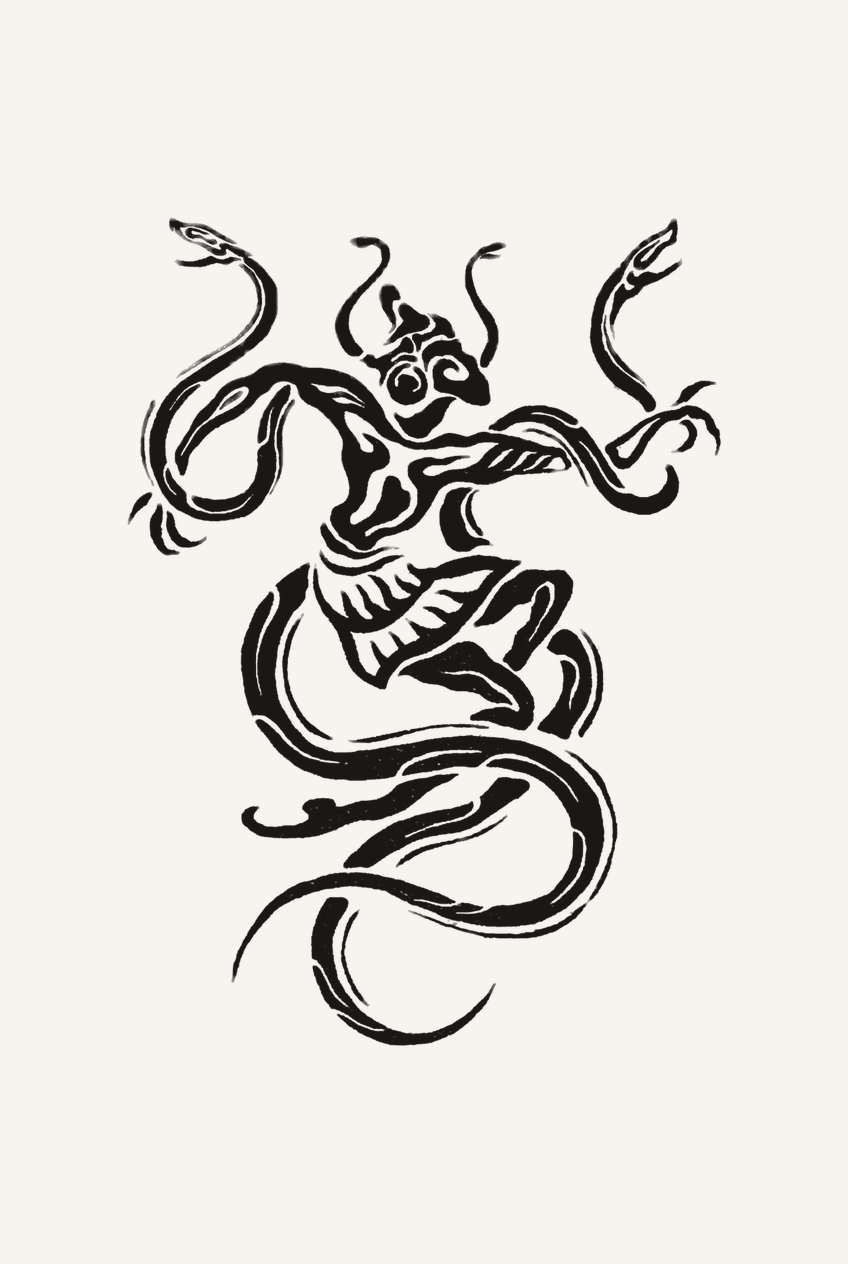
雨师妾 · Yǔ Shī Qiè
The Snake-Bearer of the Rain Priests
Series: Mythical Beasts & Sacred Animals · Design #38
Style: Dark-skinned figure with serpents in both hands and both ears · bold brushwork · vertical composition · scalable 14–18 cm
Form: 图案
The Name
*yǔ shī qiè* — the one who attends the Masters of Rain. In the coastwise geography of the *Shanhaijing*, just north of the valley where ten suns bathe, lives a dark-skinned figure who handles snakes the way other people handle tools: a serpent in each hand, a blue snake through the left ear, a red snake through the right. Not a snake-charmer — a colleague. Rain and serpent, working together.
雨师妾(yǔ shī qiè)——雨师们的侍者。在《山海经》的近海地理里,就在十日洗浴的汤谷之北,住着一位黑肤的身影,她对待蛇的方式如同旁人使用工具:两手各操一蛇,左耳贯青蛇,右耳贯赤蛇。不是弄蛇者——是同行。雨与蛇,协同工作。
Source & Provenance
The *Shanhaijing*, *Haiwai Dong Jing* chapter (compiled c. 4th–2nd century BC): 「雨师妾在其北。其为人黑,两手各操一蛇,左耳有青蛇,右耳有赤蛇。一曰在十日北,为人黑身人面,各操一龟。」 — the Yushiqie dwell to the north; their people are dark; each holds a snake in either hand, with a blue snake through the left ear and a red snake through the right. Historical form reference: the *Shanhaijing* textual record; Han-dynasty depictions of serpent-earring (ershe) divinities. Inking note: this design adapts the classic line construction of the traditional motif and re-inks it as tattoo linework.
《山海经·海外东经》(约成书于前 4—前 2 世纪):「雨师妾在其北。其为人黑,两手各操一蛇,左耳有青蛇,右耳有赤蛇。一曰在十日北,为人黑身人面,各操一龟。」形制参考:《山海经》文本记载;汉代艺术中「珥蛇」神祇的形象。墨线转写:本设计以传统母题的经典线条造型为底,转写为纹身墨线。
Design Inspiration
Every form decision on this design points to a recorded source, element by element. ① The serpent in each hand — 两手各操一蛇, drawn as two living arcs coiling up the forearms, heads outward. ② The ear serpents — 左耳青蛇,右耳赤蛇, two slim lines passing through each ear, the design's most ancient signal. ③ The dark body — 其为人黑, kept as the densest ink-mass in the design, the figure silhouetted against paper. ④ The standing calm — no storm drawn: the rain-caller's power shows in stillness, the serpents quiet in the grip.
本版每一处形制决定都有出处可查,逐条对账。① 双手之蛇——「两手各操一蛇」,画作两道活的弧线盘上小臂,蛇头朝外。② 耳蛇——「左耳有青蛇,右耳有赤蛇」,两条细线各贯一耳,是这件设计最古老的信号。③ 黑身——「其为人黑」,保留为设计中最重的墨块,身影以纸色衬出。④ 立姿之静——不画风暴:唤雨者的力量在于静止,蛇在掌握中安伏。
The Story
Near the eastern edge of the world described by the *Shanhaijing*, past the country of black teeth and the valley where ten suns bathe in the fusang tree, the geography notebook records a figure without fanfare: 雨师妾在其北 — the Yushiqie, attendants of the rain masters, live just north of here. Their skin is dark. They hold a snake in each hand. A blue serpent hangs from the left ear, a red one from the right.
What the notebook does not explain is why snakes and rain belong together — because to its original readers, no explanation was needed. In early Chinese and wider East Asian belief, serpents are creatures of the water margins: they surface from rivers before floods, they move when the air pressure turns, they live where rain lives. To be shown wearing living snakes — calmly, as jewelry and as tools — is to be shown as someone on first-name terms with the water cycle. The blue-and-red pair through the ears is the masterstroke: the colours of rain-cloud and storm-light, worn as ornaments, one on each side of the face.
And note the posture the record implies. This is not a battle with the serpents, and not worship of them either. 操 — to hold, to handle. The relationship is professional. The ancient world was full of gods who commanded storms; it rarely bothered to imagine the staff who kept the whole operation running. The *Yushiqie* is that staff: the quiet professional standing next to the weather, serpents resting in hand, waiting for the season to turn.
As a tattoo, this is for people who work with powerful things calmly — therapists, veterinarians, engineers of systems that could hurt them if mishandled, anyone whose skill is that dangerous forces settle down in their grip. Two snakes, two ears, hands full: composure with teeth in it.
在《山海经》所描述的世界东缘,越过黑齿之国与十日在扶桑树上洗浴的汤谷,地理笔记不加渲染地记下了一个身影:雨师妾在其北——雨师们的侍者,就住在这里以北。其人肤色深黑。两手各握一条蛇。一条青蛇悬在左耳,一条赤蛇悬在右耳。
笔记没有解释为什么蛇与雨属于彼此——因为在最初的读者那里,这无需解释。在早期中国乃至更广的东亚信仰里,蛇是水域边缘的生灵:洪水之前浮出河面,气压转变时开始活动,住在雨住的地方。一个被画成「佩戴着活蛇」的形象——平静地,既当首饰也当工具——意思是:此人与水循环是直呼其名的老交情。贯耳的青红一对是点睛之笔:雨云与雨光的两种颜色,被当作首饰戴着,一边一只,分列脸的两侧。
再注意这段记录暗示的姿态。这不是与蛇的搏斗,也不是对蛇的崇拜。操——是持、是操持。关系是职业性的。古代世界不缺号令风暴的神;却很少费心去想象让整场行动顺利运转的那些幕僚。雨师妾就是这样的幕僚:站在天气旁边的那位安静的专业者,蛇伏在手中,等季节转身。
作为纹身,它属于与强大之物平静共事的人——心理咨询师、兽医、操作着一套失手就会伤到自己之系统的工程师,以及一切「危险的力量在他们手中会安伏下来」的人。两蛇,两耳,两手皆有持有:带牙齿的从容。
What It Means
Composure in the company of power: the professional calm of someone dangerous forces trust. Also the emblem of everyone who works beside the storm without needing to be the storm.
与力量同行的从容:危险的力量也会托付信任的那种职业性平静。也是所有「在风暴旁边工作、而不必成为风暴」之人的徽章。
Where It Sits
The standing figure suits 14–18 cm on the outer forearm — serpents coiling with the arm's length — or 12–15 cm down the calf. The two ear-lines read best above 14 cm. It also centers cleanly on the chest at 12–13 cm, the hands-and-serpents mass carrying the design.
立姿人物适合 14–18 厘米落在小臂外侧——双蛇随臂长盘绕——或 12–15 厘米沿小腿下行。贯耳双线在 14 厘米以上才易读。以 12–13 厘米居中于胸口同样成立,手与蛇的墨块足以撑起整件设计。
Before You Ink
Two snakes, not one — 两手各操一蛇 is the count; a single serpent loses the pairing. They should read as two distinct animals, one per arm. ② The ear serpents are the canon signature (左耳青蛇,右耳赤蛇): two slim lines through the ears — if you take the colour option, keep blue left and red right, per the record. ③ The figure's dark mass should stay solid ink, not heavy shading — density, not texture. ④ Ink-only by design: the canonical black body with blue/red serpents is a strong at-the-needle colour option; the stencil is pure linework. ⑤ Minimum 12 cm — below that the ear-lines tangle. Forearm placements see the most sun; expect earlier touch-ups there.
双蛇不是一蛇——「两手各操一蛇」是数目;一条蛇就失去了成对之意。应读出两只不同的动物,一臂一条。② 耳蛇是谱系签名(「左耳青蛇,右耳赤蛇」):贯耳的两条细线——若取色,按经文左青右红。③ 人物的黑色体块应保持实墨,而非重灰面——要密度,不要纹理。④ 只宜墨线:经典的黑身配青赤二蛇是很有力的落针选色;本转印稿为纯线描。⑤ 不小于 12 厘米——再小贯耳线会缠成一团。小臂位置日晒最多,补色周期会更早。
Every character on this card was selected and checked stroke by stroke by a native reader of Chinese.