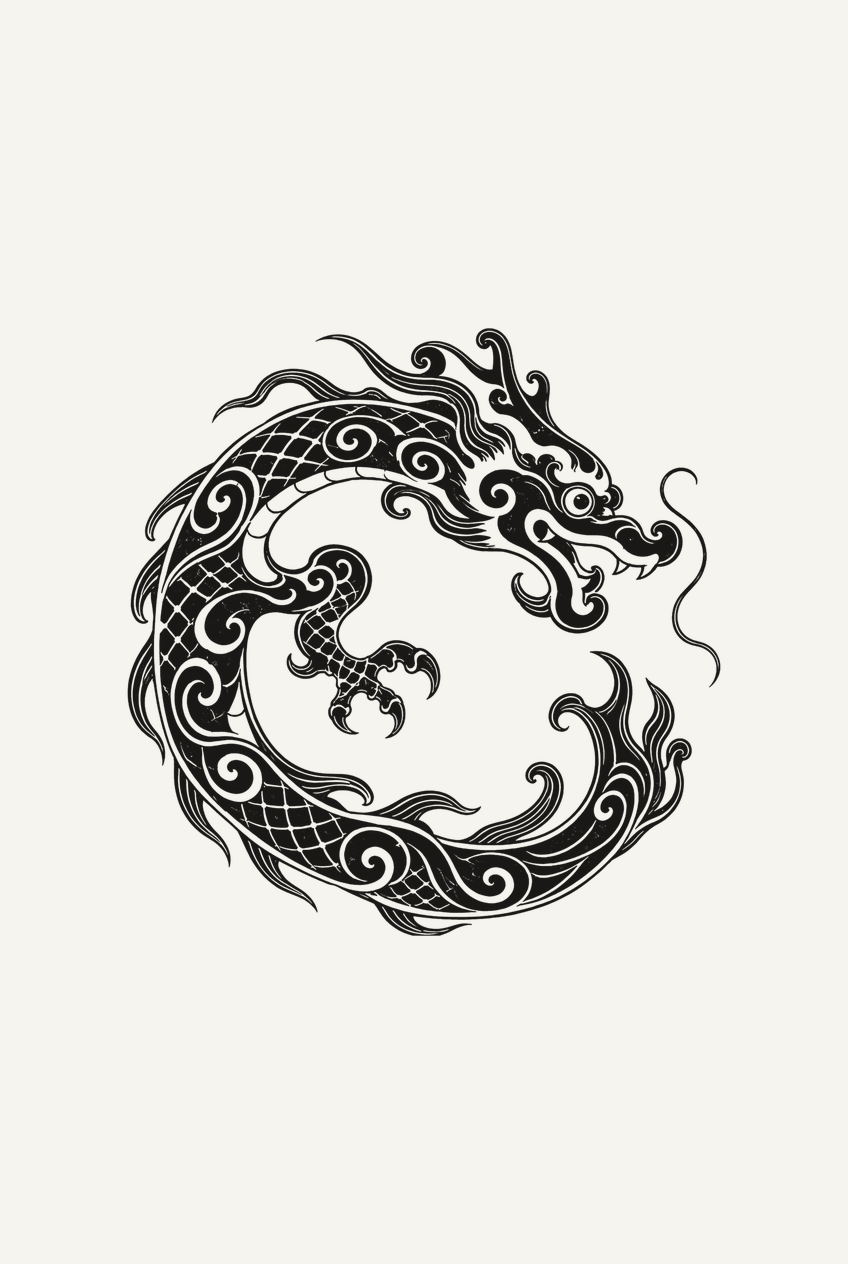
蟠龙 · Pán Lóng
The Coiled Dragon
Series: Dragons of China · Design #09
Style: coiled round-dragon · full-body curl with head turned back · traditional bold line
Form: 图案
The Name
*Pán lóng* — the coiled dragon. 蟠 means "to coil, to wind in a closed circle": a dragon that does not stretch across the sky but gathers itself into a single knot of power. It is one of the oldest ways Chinese art has ever drawn a dragon — older than the flying dragon, older than the cloud dragon. When a bronze bowl three thousand years old wanted to say "power held in reserve," it bent a dragon into a circle and put it at the center of the vessel. This design is that gesture, redrawn for skin.
蟠龙——盘曲成环的龙。「蟠」就是盘绕、收拢成团:它不横贯长天,而是把全身的力收成一个结。这是中国艺术画龙最古老的姿态之一——比飞龙早,比云龙早。三千年前的一件青铜盘想说「蓄而不发的力」,就把一条龙盘成一圈,放在器物正中。本设计就是那个手势,为皮肤重画了一遍。
Source & Provenance
The coiled dragon is documented by objects, not just words: a bronze *pan* (water basin) from the tomb of Fu Hao, consort of King Wu Ding of Shang, c. 1200 BC, carries a coiled dragon at its center — the earliest fully-formed coiled dragon in Chinese art, excavated at Anyang in 1976 and now in the National Museum of China. The word itself: *蟠* as "coiled" is glossed in early lexica, and Han-dynasty texts already speak of 蟠龙 among auspicious creatures. Imperial use is late but loud: coiled dragons fill Ming-Qing throne-room ceilings — the dragons of the Forbidden City's caisson domes coil because a ceiling is a place to hold power, not to fly. Inking note: this design adapts the classic line construction of the traditional motif and re-inks it as tattoo linework.
蟠龙的证据是器物,不止是文字:商王武丁配偶妇好墓出土的青铜蟠龙纹盘(约公元前 1200 年),盘心一条蟠龙——中国艺术里最早的成熟蟠龙形,1976 年安阳出土,现藏中国国家博物馆。字义上,「蟠」训盘曲,见早期字书;汉代文献已把蟠龙列在祥瑞之属。帝制时代用得晚但声音大:明清金銮宝殿的藻井顶上全是蟠龙——藻井是「蓄」权力的地方,不是飞的地方,所以龙要盘。墨线转写:本设计以传统母题的经典线条造型为底,转写为纹身墨线。
Design Inspiration
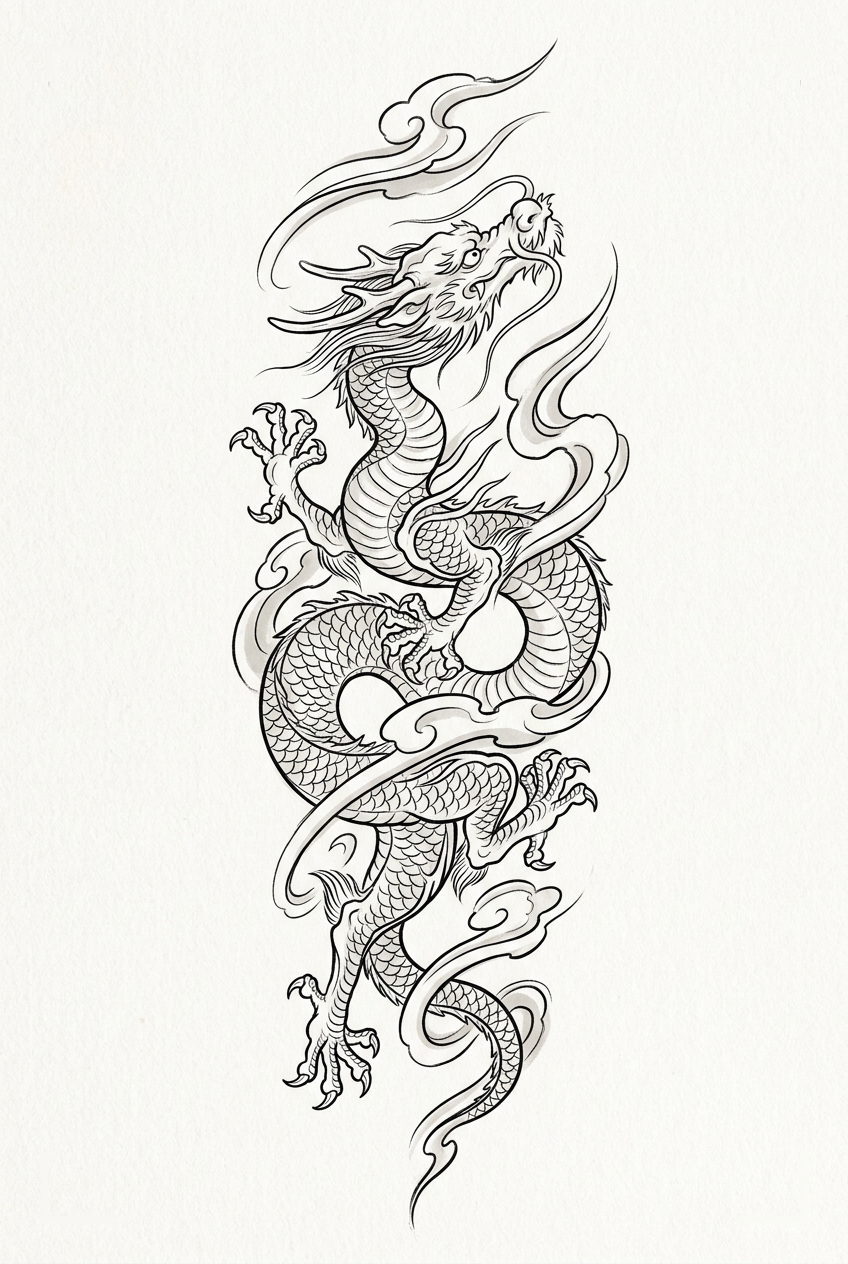
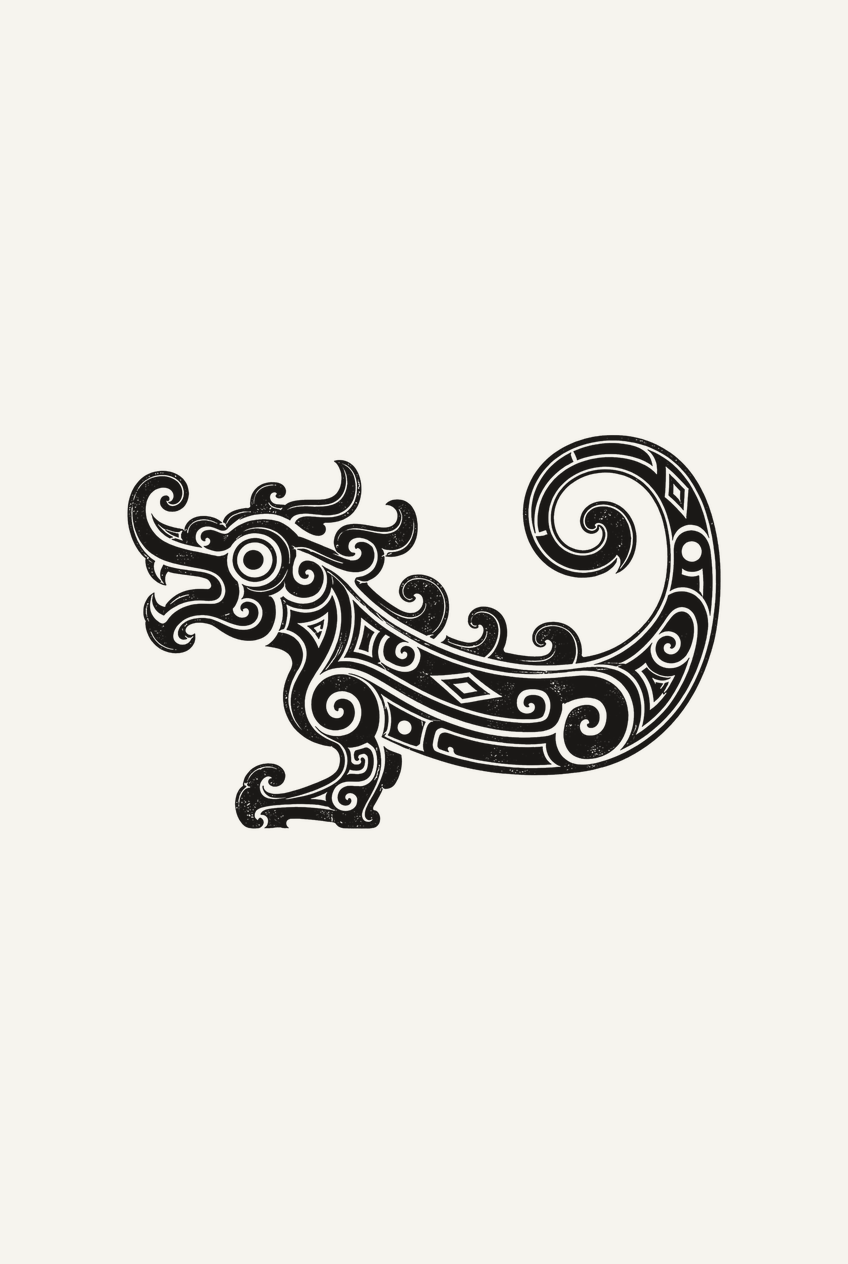
Every form decision points to a recorded source, element by element. ① The closed-loop body — the Shang bronze coiled-dragon convention: power gathered, not spent. ② The head turned back — visible on the Fu Hao basin's central dragon and on Ming ceiling coiled dragons alike. ③ Four claws — the Ming-Qing civil-use count; five is reserved for the emperor's own regalia (the rule this series' 辰龙 card documents). ④ Scales in regular rows — bronze-casting rhythm carried into ink.
本设计的每一处形制决定都有出处可查,逐条对账。① 闭合环形身躯——商代青铜蟠龙定式:力聚而不发。② 龙首回望——妇好盘心龙与明清藻井蟠龙同一姿态。③ 四爪——明清民间可用之数;五爪归帝王仪制(本系列「辰龙」卡有专条考据)。④ 鳞片成行——青铜铸范的节律带进墨线。
The Story
The dragon that fills the sky is the dragon of storms and imperial processions. The coiled dragon is the one before that — the dragon holding its ground. In 1976, archaeologists opening the tomb of Fu Hao at Anyang found her bronze basin with a dragon coiled at dead center: body wound into a near-circle, jaws turned back over its own shoulder, occupying the whole floor of the vessel the way a signature occupies a page. Fu Hao was a warlord in her own right — general, priestess, keeper of her own thirteen-thousand-strong army — and the dragon at the bottom of her ritual bowl coiled because a bowl holds things. Water, wine, power in reserve.
The posture never died. Scroll it forward three thousand years and the same animal is coiled in the ceiling of the Hall of Supreme Harmony: the great caisson dome above the throne, dragon wound around the well of light, head hanging toward the emperor below. A flying dragon is going somewhere. A coiled dragon is *stationed*. Chinese has the distinction built into the word — 蟠 is coiled the way a spring is coiled, and everyone who has ever held a compressed spring knows what that means. This is why the motif belongs on the body: a tattoo on a shoulder blade or over the heart sits where the coiled dragon sits in Chinese art — at the still center of something that can move.
满天的龙是行云布雨的龙。蟠龙是之前的那一条——按兵不动的龙。1976 年,安阳妇好墓的考古队在青铜盘底看见一条蟠龙:身躯盘成近圆,颌部回勾过自己的肩,占满整个盘底,像签名占满一页纸。妇好本人就是统帅——将军、祭司、一支一万三千人军队的主人——她那只礼盘底下的龙盘着,因为盘是「盛」东西的:盛水,盛酒,盛蓄势待发。
这个姿势三千年没死。把它往后卷三千年,同一条龙盘在太和殿的顶上:御座正上方的藻井穹顶,龙身绕着井口的光,头垂向底下的皇帝。飞龙是要去哪里;蟠龙是驻扎在这里。汉语把这个区别写进了字里——蟠,是弹簧盘紧的那种盘,而握过压紧的弹簧的人都知道那意味着什么。这正是这个题材属于身体的原因:肩胛或胸口上的纹身,坐的正是蟠龙在中国艺术里坐的位置——一件随时能动的东西的静中心。
What It Means
Power held in reserve. The dragon doesn't have to uncoil to prove itself — the coil *is* the proof. For people whose strength is quiet by choice: the loaded silence before an answer, the year the plan stayed folded, the muscle you never show. 蟠龙 says the spring is wound. It does not say when it releases.
力蓄而不发。蟠龙不必张开自己来证明什么——盘着,就是证明。给力量安静的人:回答之前那一段装满的沉默,计划折起来的那一年,从不展示的肌肉。蟠龙说的是:弦已上紧。它不说什么时候放。
Where It Sits
The closed loop wants a curved, sheltered plane: shoulder cap, upper arm, shoulder blade — anywhere the round body can wrap with the limb or chest. 15–20 cm reads well; below 10 cm the scales crowd. The head-turn lands best on the outer deltoid or over the heart, where a viewer catches it from an angle — the dragon looks back at exactly the person looking in.
闭合的环形要一块有弧度、有遮蔽的面:肩头、大臂外侧、肩胛——环身随肢体或胸廓收拢。15–20 厘米读感最好;小于 10 厘米鳞片会挤。回望的龙首落在三角肌外侧或心口上方最佳——旁观者从侧面才看见它,而龙回望的,恰好是看它的那个人。
Before You Ink
Know your claw count. This design is four-clawed on purpose — the Ming-Qing rule this series documents elsewhere; if your artist offers five, you've drifted into imperial regalia territory. ② The loop must close. Ask your artist to keep the body's circle unbroken — an open coil stops being 蟠龙 and becomes a common dragon. ③ Only ink. This is a bronze-casting form: black-grey only; color flattens the metal. ④ Minimum size. 12 cm across the loop, on a flat-to-curved plane (shoulder, upper arm, shoulder blade); inside the forearm the circle fights the limb. ⑤ Placement logic. The head should face outward or upward from the body — a coiled dragon looking into your armpit wastes the whole gesture.
数清爪子。 本设计四爪是有意的——明清民间用数,本系列他卡有考;纹身师若给你加到五爪,就越进了帝王仪制。② 环必须闭合。 要求纹身师保持躯体的圆不破口——开了口的环就不是蟠龙,是一条普通龙。③ 只用墨。 这是青铜铸范的形:只宜黑灰;上彩会把铜器拍平。④ 最小尺寸。 环径 12 厘米起,落在平到微曲的面(肩、大臂、肩胛);小臂内侧的圆会和肢体打架。⑤ 方位逻辑。 龙首朝外或朝上——一条看着你腋窝的蟠龙,浪费了整个回望。
Every character on this card was selected and checked stroke by stroke by a native reader of Chinese.