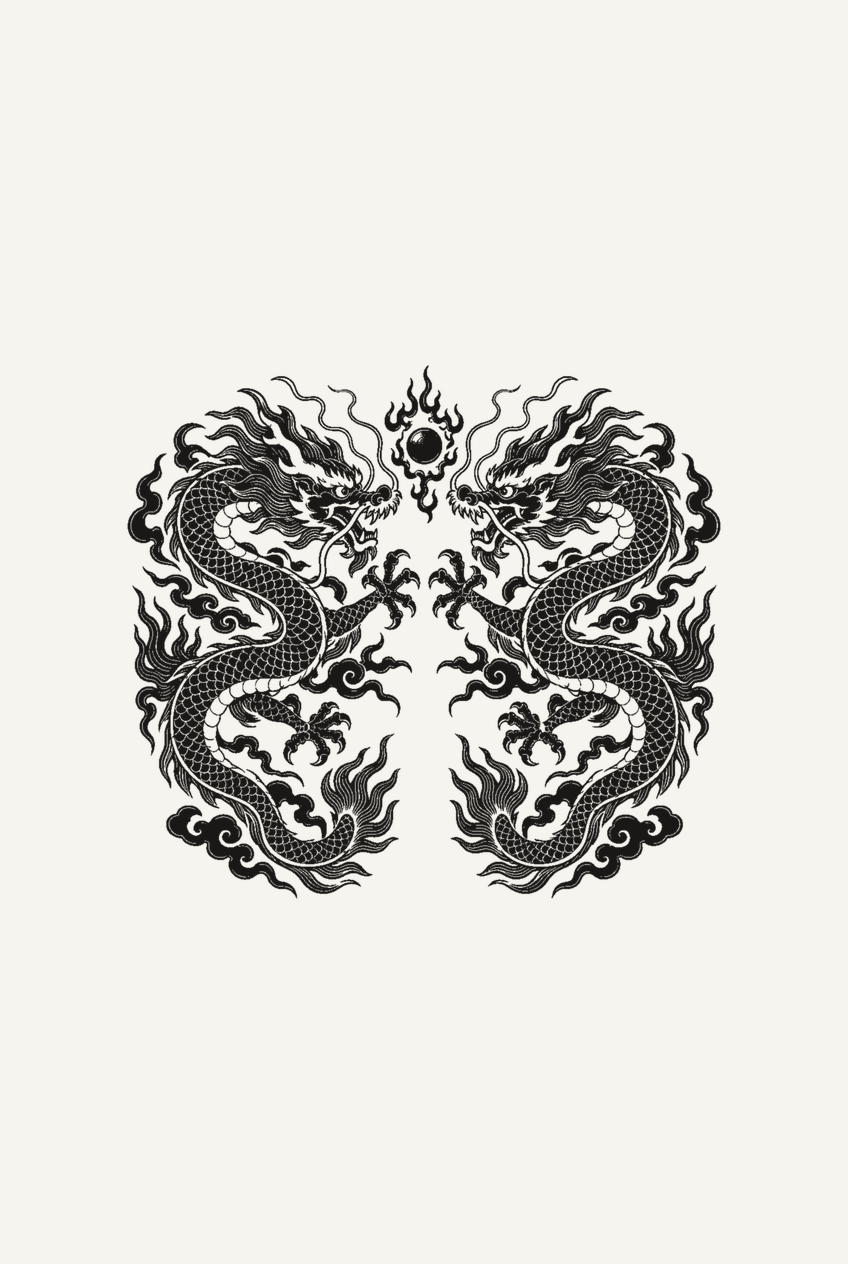
双龙戏珠 · Shuāng Lóng Xì Zhū
Two Dragons and the Flaming Pearl
Series: Dragons of China · Design #08
Style: mirrored pair flanking a flaming pearl · symmetric composition · traditional bold line
Form: 图案
The Name
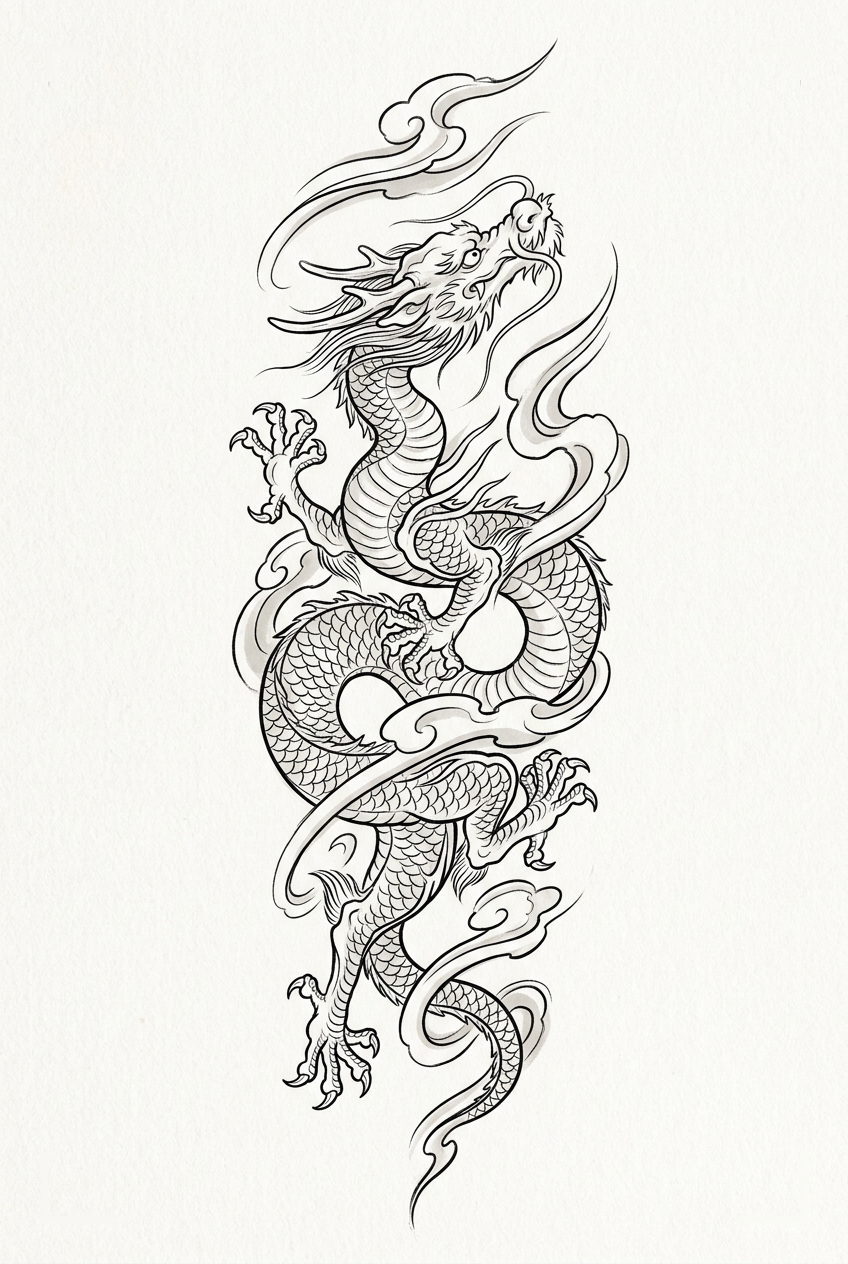
*Shuāng lóng xì zhū* — two dragons playing with a pearl. Two dragons, face to face, one pearl between them: the most widely recognized dragon composition in China, running down temple eaves, porcelain, wedding quilts, and stone bridges for a thousand years. The dragons are rivals in posture but partners in grammar — the design only works because neither seizes the pearl; both reach. 团龙 is one dragon addressing you; 双龙戏珠 is two dragons and a question between them.
双龙戏珠——两条龙,相对,中间一颗珠。这是中国流传最广的龙构图:一千年来,它顺着庙檐、瓷器、喜被、石桥一路流传。两条龙姿态上是对手,语法上是搭档——这个构图成立的前提是:谁都不夺珠,都在够。团龙是一条龙面对你;双龙戏珠是两条龙和一个悬在它们之间的问句。
Source & Provenance
The pearl has a doctrine: the flaming orb traces to the Buddhist *cintāmaṇi* (摩尼珠) — the wish-granting jewel carried into Chinese art with Buddhism, documented on Buddhist banners and cave paintings from the Tang onward. The pairing has objects: paired dragons flanking a pearl or jewel appear on Tang-Song ceramics and crystallize as a fixed motif 明清 in temple ridge-tiles, stone carvings, and imperial kiln wares — the Beijing Nine-Dragon Wall's九龙 (1756) shows the same logic scaled to nine. Folk etymology supplies the reading everyone knows: the dragons guard or contest the pearl of wisdom or thunder; scholarship is more cautious — the pearl likely began as a solar or lunar disc between two celestial guardians. Inking note: this design adapts the classic line construction of the traditional motif and re-inks it as tattoo linework.
珠有教义:火珠源自佛教摩尼珠——随佛教进入中国艺术,唐以后的经幡与窟壁画可为实证。对龙有器物:唐宋器物上已见双龙夹珠相对,至明清在庙脊、石雕、官窑瓷上凝成定式——北京九龙壁(1756)把同一逻辑放大到九条。民间解读人人都知道:双龙护珠或争珠,珠是智慧或雷霆;学界更谨慎——那颗珠起初多半是日月之盘,悬在两天官之间。墨线转写:本设计以传统母题的经典线条造型为底,转写为纹身墨线。
Design Inspiration
Every form decision points to a recorded source, element by element. ① The mirrored pair — the fixed明清 convention: left and right dragons answer each other limb for limb. ② The flaming pearl — the cintāmaṇi lineage: round, haloed, borne between the jaws or above the heads. ③ The reach, not the seize — both dragons approach the pearl without closing on it; the composition's tension lives in that gap. ④ Four claws each — the series' standing Ming-Qing count.
本设计的每一处形制决定都有出处可查,逐条对账。① 镜像双龙——明清定式:左右两龙逐肢相对。② 火珠——摩尼珠谱系:浑圆、带焰晕,衔于颌间或擎于首上。③ 够而不夺——两龙都向珠靠近、都不合口;构图的张力全在那一口没咬上的空隙里。④ 各自四爪——本系列通行的明清用数。
The Story
A Buddhist sutra says the cintāmaṇi grants every wish — which is exactly why the artists of Tang China gave it guardians. The jewel first appears flanked by protective deities, then by lions, and then, somewhere in the art of the first millennium's second half, by dragons. Dragons made sense: they already ruled cloud and rain, and a wish-granting pearl in a rainy country is, first of all, water. Two of them made better sense: one dragon and a jewel is ownership; two dragons and a jewel is *standing*.
The composition spread because it carries a rare honesty about desire. The pearl sits exactly at the center, where neither mouth can close. The dragons reach — necks arched, claws extended, eyes locked — and reach, and the picture holds forever at the moment before the seizure. Temples put it on the ridge because a roofline deserves a lesson about wanting. Kilns put it on wedding porcelain because every marriage is two people and one shared thing. Stone bridges put it underfoot because everyone crossing should think, briefly, about the space between two hungers.
The folk reading says the dragons *guard* the pearl; the scholarly reading says the pearl was first the sun or moon between two sky-serpents — day and night, forever facing each other across one light. Either way the grammar is the same: the treasure stays whole precisely because it stays shared.
佛经说摩尼珠有求必应——这恰恰是唐代画师给它配守护者的原因。珠最早由护法神夹侍,然后是狮子,再往后,在一千年后半叶的某处艺术里,换成了龙。龙说得通:它们本就司云雨,而在一个多雨的国度,有求必应的珠首先是水。两条龙更说得通:一龙一珠是占有;两龙一珠是制衡。
这个构图流传开来,因为它对欲望说过一句少见的老实话。珠悬在正中——两张嘴都合不拢的位置。双龙伸过来——颈弓起,爪探出,目光锁死——再伸,而画面永远停在那个夺下之前的一瞬。庙把它放在屋脊,因为一条屋脊正需要一堂关于欲求的功课。窑口把它放在喜瓷上,因为婚姻就是两个人和一件共享之物。石桥把它刻在脚下,因为每个过桥的人都该想一想:两种渴望之间,留着的那段距离。
民间的读法说双龙护珠;学界的读法说珠本是日月,悬在两条天蛇之间——昼与夜,隔着一道光永远相对。两种读法语法一致:宝物之所以完好,恰恰因为它始终是共享的。
What It Means
The shared thing that stays whole because no one closes their fist. Partnership without seizure: two forces, one center, the agreement that keeps the center alive. For partners, siblings, cofounders, and anyone holding something valuable with someone else — the design is the moment of mutual restraint, worn where you'll see it before every negotiation.
因为谁都不握拳,所以共享之物完好。不夺取的伙伴关系:两股力,一个中心,以及让中心一直活着的那份约定。给伴侣、手足、合伙人,和所有与别人共守一样重要东西的人——这个设计就是那克制的一瞬,穿戴在每次谈判之前你都会看见的位置。
Where It Sits
The mirrored pair wants width: center chest (16–20 cm), the spine between the shoulder blades, or the full inner forearm with the pearl at the wrist. It reads poorly on narrow planes — a compressed pair loses the gap between the two reaches, and the gap *is* the design. Secondary option: one dragon on each shoulder, pearl on the sternum — the composition worn at architectural scale, the body as the temple ridge.
镜像双龙要宽度:胸口正中(16–20 厘米)、后背两肩胛之间沿脊柱、或整条小臂内侧而珠在腕口。窄面读感差——被压扁的双龙会丢掉两段「够」之间的空隙,而空隙就是设计本身。备选:一龙一肩、珠在胸骨——建筑级穿法,身体做屋脊。
Before You Ink
Symmetry is the contract. Left and right must mirror limb for limb — insist on the stencil mirror check; a lazy pair reads as two unrelated dragons. ② Nobody bites the pearl. If either mouth closes, the tension dies; the reach is the meaning. ③ The pearl stays round. It is the only circle in the design — protect it from flame-decoration creep. ④ Only ink. Roof-ridge and kiln contexts are stone and glaze — black-grey carries it. ⑤ Minimum size. 12 cm across the pair, on chest, upper back, or forearm; below that the two profiles fuse.
对称即契约。 左右必须逐肢镜像——转印稿上坚持做镜像检查;偷懒的一对会被看成两条不相干的龙。② 谁都不许咬住珠。 任何一张嘴合上,张力就死了;「够着」才是含义。③ 珠要圆。 它是全设计唯一的正圆——别让火纹装饰慢慢吃掉它。④ 只用墨。 屋脊与窑口的语境是石头和釉——黑灰足矣。⑤ 最小尺寸。 双龙横向 12 厘米起,落胸口、后背上部或前臂;再小,两道侧影就会粘在一起。
Every character on this card was selected and checked stroke by stroke by a native reader of Chinese.