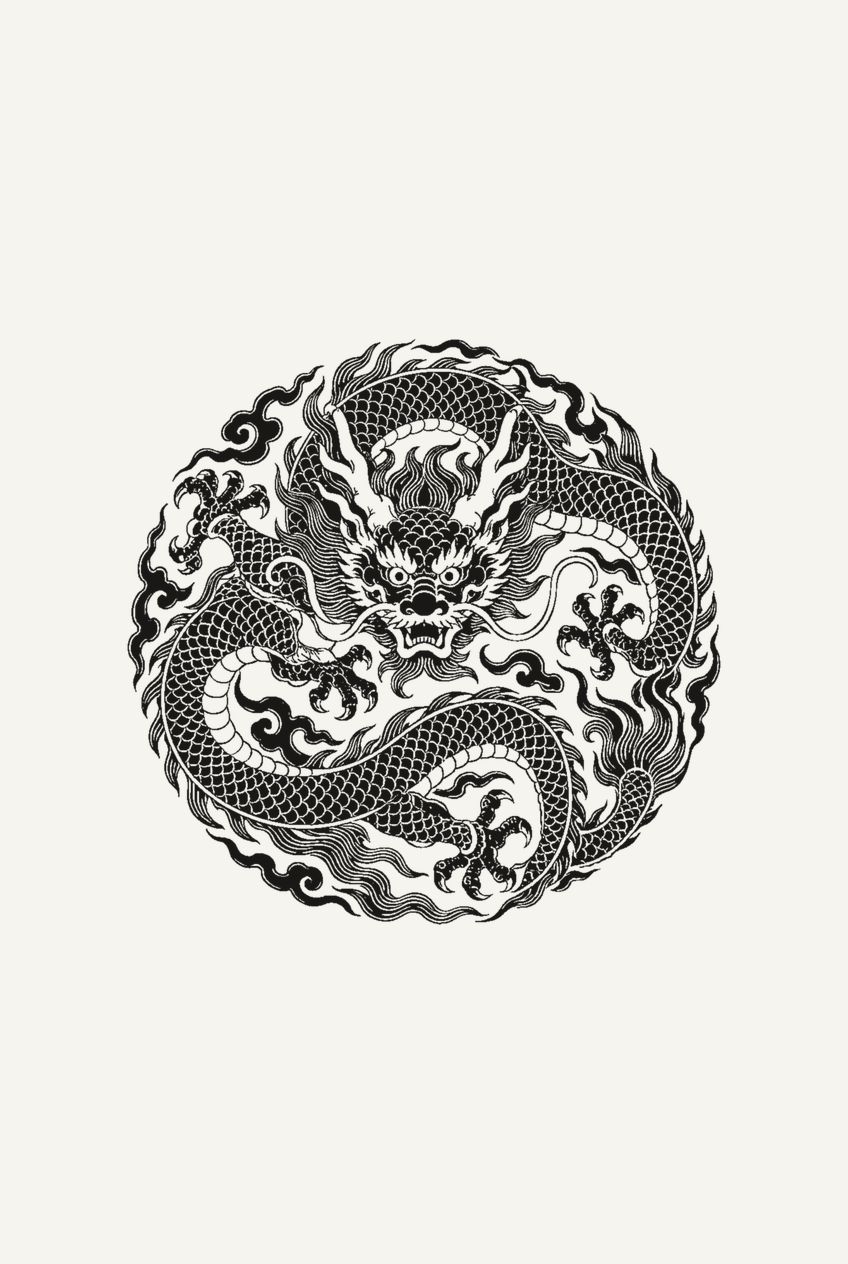
团龙 · Tuán Lóng
The Roundel Dragon
Series: Dragons of China · Design #10
Style: dragon within a circular roundel · symmetric front-facing composition · traditional bold line
Form: 图案
The Name
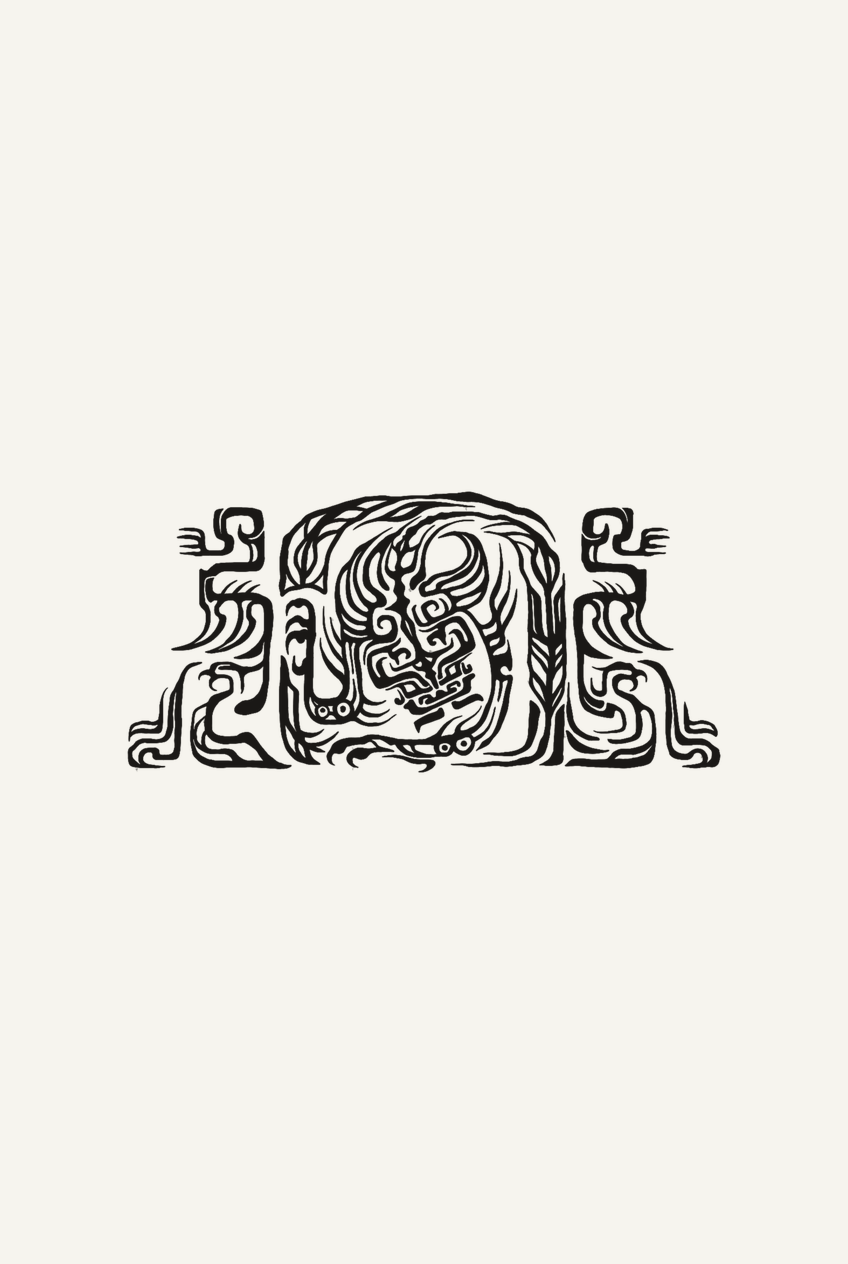
*Tuán lóng* — the roundel dragon. 团 means "round, gathered into a circle": not a dragon that coils its own body (that is the 蟠龙 of the previous design) but a dragon *framed* — set inside a circular field, centered, symmetrical, front-facing. It is the most formal dragon in Chinese art: the one that appears on the chest of imperial robes and the center of palace ceilings, always facing you, never in flight. If the flying dragon is a story, the roundel dragon is a seal.
团龙——团窠圆里的龙。「团」是圆形、聚拢成团:它不是自己盘起身体的龙(那是上一件的蟠龙),而是被框进圆里的龙——居中、对称、正面朝前。这是中国艺术里最正式的一条龙:它出现在帝王礼服的胸口、宫殿穹顶的正中,永远面向你,永远不在飞。如果说飞龙是一段故事,团龙就是一方印。
Source & Provenance
The roundel format comes from the Tang dynasty: *tuán kē* (团窠, "round nest") compositions — circular framed medallions — dominated Tang silk design from the seventh century onward, documented by excavated textiles from the Astana cemetery Turfan. Onto that stage, the dragon stepped in the imperial era: roundel dragons are fixed regalia by the Ming — the *Great Ming Statutes* (大明会典) specify roundel dragons on imperial robes, and an embroidered twelve-symbol *gun* robe with round dragons, excavated from the Wanli Emperor's tomb at Dingling in 1957–58, is the physical proof. The Qing *Great Qing Statutes* carry the rule forward: four round dragons on the emperor's court robe. Inking note: this design adapts the classic line construction of the traditional motif and re-inks it as tattoo linework.
团窠的格式来自唐代:团窠——圆形框章式构图——自七世纪起主导唐代丝绸纹样,吐鲁番阿斯塔那墓群出土织物可为实证。龙走上这个舞台是在帝制时代:团龙在明代定为仪制——《大明会典》规定御用礼服用团龙;1957–58 年明定陵出土万历帝缂丝十二章衮服,上织团龙,是实物铁证。清《大清会典》沿用其制:皇帝朝服团龙四团。墨线转写:本设计以传统母题的经典线条造型为底,转写为纹身墨线。
Design Inspiration
Every form decision points to a recorded source, element by element. ① The circular frame — Tang 团窠 medallion convention, seven centuries of silk before the dragon ever entered it. ② Front-facing symmetry — the regalia posture: a robe chest demands a dragon that faces its wearer's audience. ③ Four claws — same Ming-Qing count as the series' 蟠龙 card. ④ Medallion balance — limbs and tail fill the circle without breaking it, the robe-embroidery rule.
本设计的每一处形制决定都有出处可查,逐条对账。① 圆形框章——唐代团窠定式,比龙入窠早七百年的丝绸传统。② 正面朝前——仪制姿态:礼服的胸口,要一条面对观看者的龙。③ 四爪——与本系列「蟠龙」卡同一条明清用数。④ 团花式均衡——四肢与尾填满圆而不破圆,织绣的规矩。
The Story
The Tang dynasty fell in love with the circle. On silks excavated from desert tombs at Turfan, the pattern repeats over and over: a medallion, round as a coin, framing flowers, birds, hunting scenes — the 团窠, carried west out of Persia by the Silk Road and made so thoroughly Chinese that by the ninth century no one remembered it was an import. For three hundred years the circle framed almost everything *except* the dragon.
Then the empire decided the dragon should sit still. Ming robe statutes put round dragons on the chest and shoulders of the emperor's formal wear — and when archaeologists opened the Dingling tomb in 1957, the Wanli Emperor lay in a *gun* robe with the round dragons still woven into it, four hundred years untouched. The logic of the roundel is the logic of the throne: a flying dragon is power in motion, which is the common man's idea of power; a *framed* dragon is power that no longer needs to move, which is the throne's idea. The circle is not a cage — in Chinese dressing terms it is a spotlight. Everything inside it faces you because everything inside it answers to you.
A roundel dragon on the body keeps that full-frontal grammar: it belongs where a person meets the world head-on — center chest, center back — the same positions the robe reserved for it.
唐朝爱上了圆。吐鲁番沙漠墓葬出土的丝织物上,同一个图式反复出现:一枚铜钱般圆的框章,框里是花、是鸟、是狩猎——团窠。它经丝绸之路从波斯一路西来,又被汉化得如此彻底,九世纪时已没人记得它是舶来品。三百年里,这个圆框几乎框过一切——唯独没框过龙。
然后,帝国决定龙应该坐定。明代礼服仪制把团龙放进皇帝正装的胸与肩——1957 年定陵开启时,万历帝身上的衮服团龙还在,四百年未损。团窠的逻辑就是御座的逻辑:飞龙是运动中的权力,那是常人对权力的想象;被框定的龙是不必再动的权力,那是御座对权力的定义。圆不是笼子——用衣冠的语言说,它是聚光灯。框里的一切面向你,因为框里的一切对你负责。
把团龙纹在身上,保留的是这套正面直视的语法:它属于人正面迎接世界的地方——胸口正中、后背正中——正是衣制当年给它留的位置。
What It Means
Authority that doesn't perform. The flying dragon announces; the roundel dragon simply *is*, facing you, complete in a circle it never leaves. For people who've stopped proving themselves: the settled strength that needs no motion, the identity you can wear centered and front-facing because it holds from every angle.
不必表演的权威。飞龙在宣告;团龙只是在,面向你,在它从不离开的圆里自足。给不再需要自证的人:安定的、无需动作的力量,可以居中正面穿戴的身份——因为它从每个角度都立得住。
Where It Sits
The medallion wants the body's two front pages: center chest (14–16 cm) or upper back between the shoulder blades (16–20 cm) — the exact positions imperial robes gave the round dragon. Secondary placements: the shoulder cap, wrapping like a robe epaulet. Below 10 cm the frame strangles the dragon. Keep it on a plane the viewer meets straight-on; a roundel on the curve of a calf half-hides its symmetry, and symmetry is the entire point.
团章要身体的两张正页:胸口正中(14–16 厘米)或后背两肩胛之间(16–20 厘米)——正是衣制当年给团龙的位置。次要位置:肩头,像礼服肩章那样环住。小于 10 厘米,框会勒住龙。留在正对观看者的面上;小腿弧面上的团章会半藏它的对称,而对称正是全部要点。
Before You Ink
Roundel versus coil. A 团龙 is framed by the circle; a 蟠龙 *is* the circle. If your artist lets the body merge into the frame, you've redrawn the other design — keep the dragon and the medallion distinct. ② Symmetry is non-negotiable. Front-facing means left and right answer each other; insist on the mirror check in the stencil. ③ Only ink. The robe context is woven silk and gilt thread — black-grey carries it; color turns regalia into costume. ④ Minimum size. 12 cm diameter, on chest or upper back; the medallion dies on narrow planes like the forearm. ⑤ One is enough. In robe statutes the round dragons repeat in fours — on a body, a single centered roundel says more than a scattered set.
团与蟠之别。 团龙被圆框住;蟠龙就是那个圆。纹身师若让龙身融进框线,就成了另一件设计——龙与团章要分立。② 对称不容商量。 正面即左右互答;转印稿上一定要求做镜像检查。③ 只用墨。 衣制的语境是织金与缂丝——黑灰足矣;上彩会把仪制变成戏服。④ 最小尺寸。 径 12 厘米起,落胸口或后背上部;前臂这类窄面养不活团章。⑤ 一件就够。 衣制里团龙四团成套;在身体上,一枚居中的团章,胜过撒了一身的一套。
Every character on this card was selected and checked stroke by stroke by a native reader of Chinese.