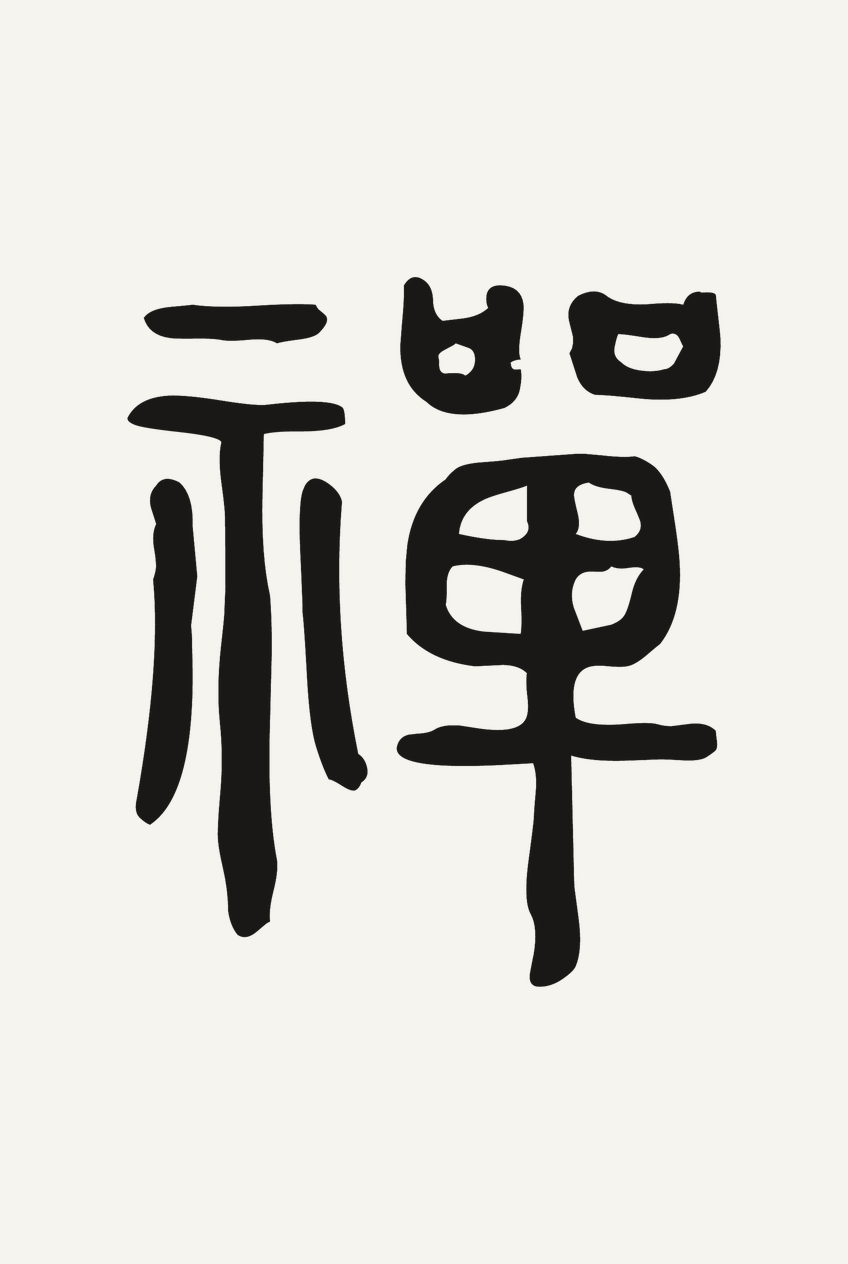
爱 · Ài
Love
Series: Single-Character Zen · Design #50
Style: single character, large · clerical script (lishu, traditional form 愛) · small-to-medium
Form: 文字
The Name
*Ài* — love. In the traditional form, the character keeps its heart where you can see it: a hand (爫) sheltering a roof (冖), a heart (心) tucked underneath, and feet (夊) below — because in this language, love is not a feeling you hold; it is a heart you carry somewhere. The simplified form replaces that heart with a single horizontal stroke. This design takes the traditional form — not to argue about scripts, but because a tattoo puts the character on your body, and here, the heart should be visible.
愛——简体把它写成「爱」,中间那颗心被一横换掉。本设计取繁形:不是要评两种写法的高下,而是纹在身上的字,心要看得见。看繁形的构造:一只手(爫)护着屋顶(冖),屋檐下面藏着一颗心(心),底下是脚(夊)——在这个字里,爱不是持有的感受,是一颗被带去某处的心。
Source & Provenance
Component reading follows the seal-to-clerical transmission of the glyph (爫 / 冖 / 心 / 夊). The verb is anchored in the classics: *Analects, Yan Yuan* — Fan Chi asked about humaneness, and Confucius answered with a verb: 爱人 — "love people." *Mencius, Li Lou II*: 仁者爱人 — "the humane love people." Inking note: this design adapts the classic line construction of the traditional motif and re-inks it as tattoo linework.
部件读法依小篆—隶书传承字形(爫/冖/心/夊)。动词的锚在经典里:《论语·颜渊》——樊迟问仁,孔子用一个动词回答:爱人。《孟子·离娄下》:「仁者爱人。」墨线转写:本设计以传统母题的经典线条造型为底,转写为纹身墨线。
Design Inspiration
Every form decision points to a recorded source, element by element. ① One character, large — a single word that needs no annotation. ② Clerical script, traditional form 愛 — the level strokes hold the roof steady; the long flat Pressing-stroke (捺) under the heart is what carries it. ③ Small-to-medium scale — 4–6 cm. ④ Black ink only — one word, one ink.
本设计的每一处形制决定都有出处可查,逐条对账。① 单字大字——一个不需要注解的词。② 隶书、繁形「愛」——平正的横画把屋顶架稳,心底下那笔长捺是托住它的手。③ 中小尺寸——4–6 厘米。④ 只用墨——一个词,一种墨。
The Story
When Fan Chi asked about humaneness, Confucius did not give him a definition — he gave him a verb with an object: love people. Two thousand years of commentary later, that two-character answer still hasn't been improved on. The character itself agrees: in the traditional form, the heart is not the whole of it. The heart sits sheltered under a roof, and underneath are feet. Love, this character insists, is something you then have to walk.
樊迟问仁,孔子没有给他定义——给了他一个带宾语的动词:爱人。两千年注疏过去,这两个字的答案至今没有被超过。这个字自己也同意:在繁形里,心不是全部。心被安置在屋顶下,底下还有脚。爱,按这个字的说法,是要接着走下去的东西。
What It Means
For the ones who treat love as a practice, not a possession. The oldest Chinese answer to "what is goodness" was a verb — this is that verb, kept whole.
给把爱当作实践而不是占有的人。中文里对「什么是仁」最古老的回答是个动词——这就是那个动词,完整地保留着。
Where It Sits
Inner wrist, below the collarbone, side of the ribcage; 4–6 cm; below 3 cm the 心 component closes up.
腕内侧、锁骨下方、肋侧;4–6 厘米;低于 3 厘米「心」的部件会闭死。
Before You Ink
One character is the whole design. ② Traditional form 愛 — the heart stays visible. ③ Minimum 4 cm. ④ The heart must read as a heart — check the stencil at full size before the needle starts. ⑤ This design is the traditional form only; if you want the simplified 爱, ask separately — the two are different designs.
一个字就是全部设计。 ② 繁形「愛」——心保持可见。 ③ 4 厘米起。 ④ 「心」要读得出是心——下针前按实际尺寸检查转印。⑤ 本设计只有繁形;要简体「爱」请单独提出——那是另一件设计。
Every character on this card was selected and checked stroke by stroke by a native reader of Chinese.