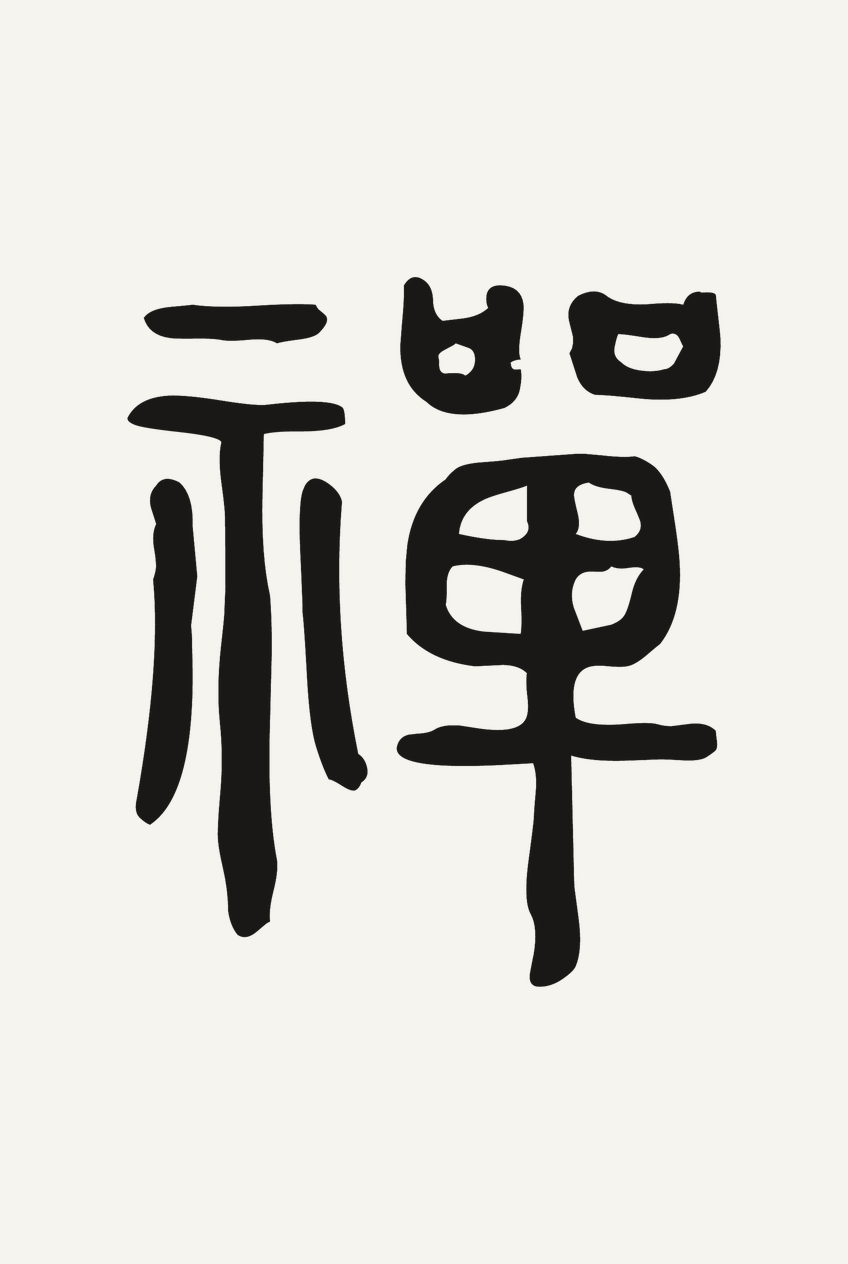
禅 · Chán
Zen
Series: Single-Character Zen · Design #03
Style: single character, large · small-seal script (zhuanshu) · traditional form 禪 · medium-to-large
Form: 文字
The Name
*Chán* — Zen. The character is a phonetic loan: when the meditation schools of India reached China, 禅那 (dhyāna, "absorption") was shortened to one character, and that character became the name of a school, a practice, an aesthetic — and, by the twentieth century, an English word. Zen is one of the few Japanese loanwords English uses daily; the character it ultimately comes from is this one. A tattoo of 禅 is the word in its birth form.
禅——Zen。这个字是音译的外来者:印度的禅修学派抵达中国时,禅那(dhyāna,「入定」)被缩成一个字,这个字后来成了一个宗派的名字、一种功夫、一种美学——到二十世纪,还成了一个英文词。Zen 是英语日常在用的少数日语借词之一;它最终追溯到的那个汉字,就是这一个。纹「禅」,纹的是这个词的出生形态。
Source & Provenance
The character's doctrinal life begins with the transliteration of Sanskrit *dhyāna* in early Chinese Buddhist translations (Han–Six Dynasties era). The school it names — Chan, from Bodhidharma's legend through Huineng's Platform Sutra (七世纪–八世纪) — taught that enlightenment is direct and wordless: 不立文字,教外别传 — "no reliance on words, a transmission outside the scriptures." The irony is the point: the tradition named by a single character claims to outrun all characters. Inking note: this design adapts the classic line construction of the traditional motif and re-inks it as tattoo linework.
这个字的教义生命始于汉魏六朝佛经翻译对梵文 dhyāna 的音译。以它命名的宗派——禅宗,从菩提达摩的传说到慧能《坛经》(七至八世纪)——主张顿悟直指、不落言诠:不立文字,教外别传。讽刺即是妙处:由一个字命名的宗派,宣称自己超越所有字。墨线转写:本设计以传统母题的经典线条造型为底,转写为纹身墨线。
Design Inspiration
Every form decision points to a recorded source, element by element. ① One character, alone, large — the hanging of a single 禅 character is the most iconic format of Zen calligraphy in both China and Japan: the monogram of the school. ② Small-seal script, traditional form 禪 — the seal form carries the character's antiquity and its mystery; the 示 (altar) radical and the single phonetic above read as an image before they read as a word. ③ Medium-to-large scale — one character must occupy, not decorate; small it becomes a logo. ④ Black ink only — Zen calligraphy is ink, brush, emptiness; nothing else is admissible.
本设计的每一处形制决定都有出处可查,逐条对账。① 一字、独处、够大——单个「禅」字的悬挂是中日禅书最有标志性的格式:这一宗的独体签名。② 小篆、繁形「禪」——篆形带着这个字的古老与神秘;「示」(祭坛)旁与上部的声符,在读成字之前先读成图像。③ 中到大尺寸——一个字要占据,不是点缀;小了就成了商标。④ 只用墨——禅书是墨、笔、空;其余一律不容。
The Story
The legend says Bodhidharma arrived at the Shaolin temple around 500 AD, was refused an audience by Emperor Wu of Liang — whose patronage of Buddhism was immense and whose merit-points arithmetic Bodhidharma dismissed in two sentences — and then sat facing a wall for nine years. The Platform Sutra, the only Chinese text schools call a sutra, tells of Huineng, an illiterate laborer who heard one line of the Diamond Sutra and understood: enlightenment is not earned by rank or by literacy. It is a sudden seeing, available to anyone who stops grasping.
The school that grew from these stories changed what Chinese art could do. Chan monochrome ink painting — one branch, one empty boat, six persimmons — taught the world that a painting could be mostly silence. Chan tea became the Japanese tea ceremony. Chan gardens became rock-and-raked-gravel. And the word itself crossed the ocean: in English, "zen" now means a state of calm competence, used by people who have never heard of Bodhidharma — the character's meaning escaping its own history, exactly as the school would predict.
The practice underneath the stories is simpler and harder than the myths: sit. Watch the mind until the mind stops producing commentary. The character on the skin is not a decoration of that practice; it is its name tag.
传说菩提达摩约公元 500 年抵达少林,被梁武帝拒之门外——武帝供佛无边、功德账算得精细,达摩两句话就把这本账驳倒——随后他面壁九年。《坛经》——唯一一部被称作「经」的中国文本——讲的是不识字的雇工惠能:听人诵一句《金刚经》就懂了——觉悟不由地位换、不由识字量换。是突然的看见,谁放下抓取,谁就够得着。
由这些故事长成的宗派,改写了整个中国艺术的可能。禅的水墨画——一枝梅、一只空舟、六颗柿子——教会世人一幅画可以主要由沉默构成。禅茶变成了日本茶道。禅园变成了枯山水。而这个词本身渡了海:在英文里,"zen"如今指一种平静的胜任状态,被从未听说过菩提达摩的人日常使用——字义逃出了它自己的历史,正如这个宗派会预言的那样。
故事底下的功夫,比神话简单,也比神话难:坐。看着念头,直到念头不再生产解说。皮肤上这个字不是那门功夫的装饰;它是那门功夫的名牌。
What It Means
The word for the seeing that needs no words. Wear it as a marker of a practice, an orientation, or a debt owed to stillness — it reads across three languages and a thousand years, and it promises nothing, which is the most Zen thing about it.
那种无须言语的看见的名字。作为一门功夫的路标、一种取向、或欠安静的一笔债戴上——它横跨三种语言与一千年,什么都不许诺;而「什么都不许诺」正是它最禅的地方。
Where It Sits
One character wants one plane: the nape, the inner wrist, the sternum, the upper arm — anywhere a single square glyph can sit centered and uncluttered. At 6–8 cm it reads as a seal; at 10–15 cm it reads as a statement. Avoid joints that fold the glyph.
一个字要一个平面:后颈、腕内侧、胸骨、大臂——任何能让一个方字居中且干净的位置。6–8 厘米读作印;10–15 厘米读作宣言。避开会折叠字形的关节。
Before You Ink
One character means one statement. No adding characters "for balance" — the emptiness around 禅 is part of the design. ② Traditional form 禪. The seal form is the school's antiquity; simplified 禅 loses the altar radical's full architecture. ③ Seal script does not fade. Its even line is its authority — black, unbroken. ④ Size matters. Below 5 cm the seal's wound-wire detail clogs. ⑤ It names a practice. The character promises nothing — which is why it never disappoints. Wear it as a direction, not a trophy.
一字即一宣言。 别为「平衡」加字——「禅」四周的空,是设计的一部分。② 繁形「禪」。 篆形带着这一宗的古意;简体禅会丢掉「示」旁完整的建筑。③ 篆书不褪。 匀称的线就是它的权威——黑、不断。④ 尺寸要紧。 低于 5 厘米,篆书绕线的细节会糊。⑤ 它是一门功夫的名字。 这个字什么都不许诺——所以它从不让人失望。当方向戴,别当奖杯戴。
Every character on this card was selected and checked stroke by stroke by a native reader of Chinese.



