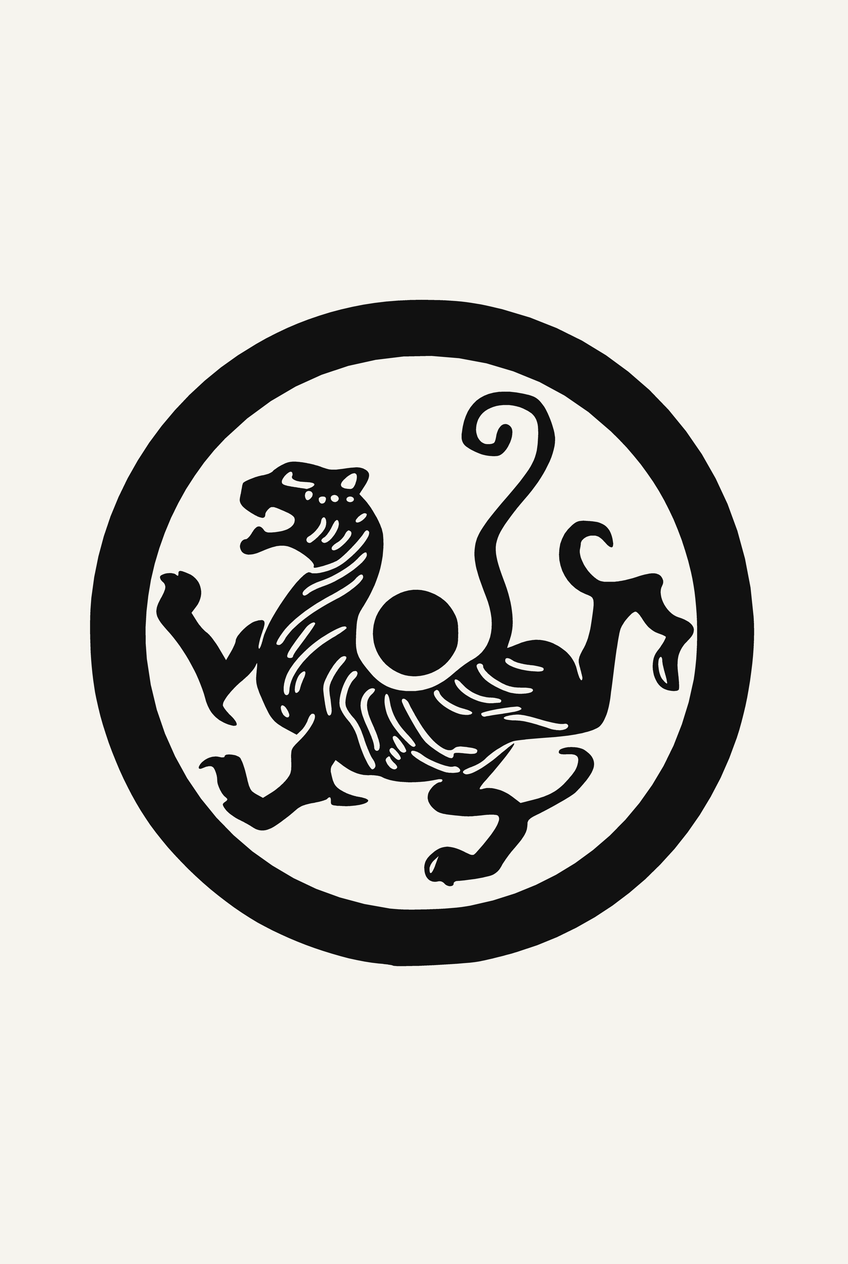
白虎 · Bái Hǔ
The White Tiger of the West
Series: Pattern Symbols · Design #26
Style: circular roof-tile medallion · solid black with carved white lines · medium-to-large
Form: 图案
The Name
*Bái hǔ* — the White Tiger, the guardian of the West. In the Han ordering of the heavens, the seven lunar mansions of the western sky were read as one great striped cat — white, the color of metal and of autumn, the season when things are cut back and gathered in. This design is that tiger as the tile-makers of Chang'an cast him: inside the heavy ring of a Han roof-tile end, jaw open, tail high.
白虎——西方之神。汉人排天上的星,西方七宿连读,是一只巨大的条纹猫科——白色,属金,属秋,是万物被削减、被收仓的那个季节的颜色。本设计就是长安制瓦人铸出来的他:在汉代瓦当的粗环之内,开口,扬尾。
Source & Provenance
The motif is the four-divinities roof-tile (四神瓦当) of the Western Han: the round end-cap of the pantile, molded in relief with one of the four directional beasts. The Sanfu Huangtu fixes the set — Azure Dragon east, White Tiger west, Vermilion Bird south, Dark Warrior north — "the four spirits of heaven, set to govern the four quarters," each with a season, an element, a color. The White Tiger presided over the west, metal, autumn, and in Han state religion received the autumn offerings; tiles bearing him have been excavated from the Han Chang'an city site. This tile face keeps the grammar of those examples: the heavy outer ring, the plain round boss at center, the striding tiger with raised tail and striped flanks. Inking note: this design adapts the classic line construction of the traditional motif and re-inks it as tattoo linework.
母题是西汉的四神瓦当:筒瓦端头的圆面,模印四方位神兽之一。《三辅黄图》定下这一组——青龙东、白虎西、朱雀南、玄武北,「天之四灵,以正四方」,各主一季、一行、一色。白虎主西方、金、秋,汉代国家祀典在秋月向他献祭;汉长安城遗址出土的瓦当中即有模印白虎者。本瓦当面保留出土品的语法:粗外环、当心素圆乳钉、扬尾迈步而条紋在身的虎。墨线转写:本设计以传统母题的经典线条造型为底,转写为纹身墨线。
Design Inspiration
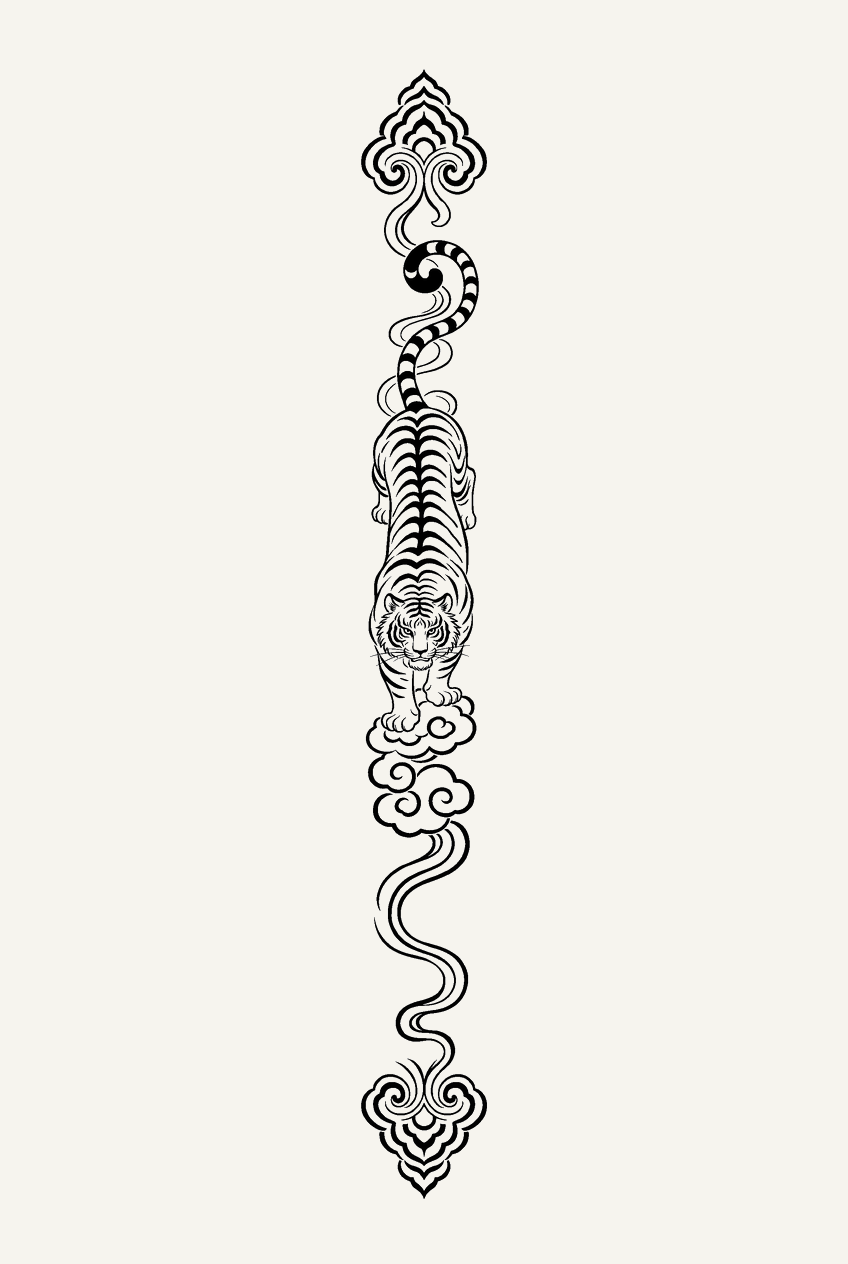
Every form decision points to a recorded source, element by element. ① The heavy ring — the tile's own rim, the boundary the relief could not cross. ② The solid center boss — the round tile nut kept plain in the beast tiles. ③ The striding tiger, jaw open, tail curled high — the pose the excavated Han examples give him: every limb engaged, the tail making its own full stroke of the ring, the flank crossed by carved stripe-lines. ④ Solid black with carved white lines — the rubbing's own language: the black is the beast, the white stripes are the mold's relief reading through.
本设计的每一处形制决定都有出处可查,逐条对账。① 粗外环——瓦当自己的边,浮雕出不去的界。② 当心素圆乳钉——兽面瓦里保留下来的当心圆。③ 迈步开口扬卷尾的虎——出土汉瓦给他的姿势:四肢都在用力,尾巴自己在环里划出一整笔,身侧由白雕线交叉成纹。④ 实黑加白雕线——拓片自己的语言:黑是虎身,白纹是范上浮雕透过来的线。
The Story
Of the four guardians, the White Tiger is the one with a soldier's temper. The west was where the sun went down; autumn was when the armies moved — campaigns ended before the roads froze, and the year's killing, of animals and of enemies, happened under his season. Han generals went to war wearing his name; the tiger tally — the split token that authorized an army to march — was his instrument. Yet the same beast watched over the crib: the Han hung tiger figures on doors at the year's turn to eat the things that came for children, and the striped cat that took the west was as much a doorkeeper as a war god.
That double life is what the tile holds. He strides, jaw open — but the ring around him is a wall, and nothing inside it is running away. The carvers gave the ferocity to the head and the calm to the body: stripes in even carved lines, a tail that curls instead of lashing, paws placed, not thrown. It is the look of an animal strong enough that it never has to prove it. The white of his name was not paint — it was the west's own color, the pale metal light of an autumn evening, which is why the tile asks for no color at all: he was born black-and-white.
四神里,白虎是那位带兵气的。西边是太阳落下去的地方;秋天是军队开拔的季节——大战赶在道路封冻前收尾,一年的杀伐,无论对牲畜还是对敌人,都发生在他的季节里。汉家将军出征要佩他的名;调兵的虎符——那枚一分为二、合在一起才能动兵的信物——就是他的器物。可同一只兽也守着摇篮:岁末汉人在门上挂虎形,让它吃掉冲孩子来的东西;这位坐镇西方的条纹猫,是门神,和战神,是一体。
瓦当装下的正是这双重身份。他迈步,开口——但他周身的环是一堵墙,墙内没有东西在逃。造瓦人把凶悍交给头,把安定交给身体:条纹是均匀的白雕线,尾巴卷而不抽,爪是踏下去的,不是甩出去的。那是一种强到不必证明自己强大的动物的神情。他名字里的白不是颜料——那是西方自己的颜色,秋夜金属般的淡光,所以这块瓦当根本不要求上色:他生来就是黑与白。
What It Means
The strength that ends things cleanly. West, autumn, metal — the White Tiger is the guardian of the cut: the season ending, the harvest brought in, the decision made and not reopened. He is for people who have done the hard part — left the place, closed the account, made the call — and want the mark to say it was done on purpose. He is not a threat. He is the quiet of a field after the work is finished.
把事情干干净净收尾的力气。西方、秋、金——白虎是掌「斩断」的神:一个季节的结束、收成入仓、决定做出而不重开。他给的是已经做完难的那一步的人——离开了那个地方、了结了那笔账、拍板了那个决定——要一个记号来说明:这是有意的。他不是威胁。他是活干完之后,田野上的那点安静。
Where It Sits
The full medallion sits best where it can be seen being worn: the outer shoulder, the upper arm, the calf — places where the ring reads as a seal and the tiger's stride rides the limb's curve. Placed large on the chest or back, keep the ring; it is what keeps the force aimed inward. Medium-to-large.
完整瓦当放在「看得见佩戴」的地方最合适:肩头外侧、上臂、小腿——这些位置上环读作印,虎的步态沿着肢体的弧线走。放在胸、背等大面积处也请保留环——正是它把力气收在圈里。中到大。
Before You Ink
The ring is yours to keep or lose. The heavy outer circle is the tile's rim — keep it and you wear the complete medallion, a bold round frame that reads clean on shoulder, upper arm or calf; have your artist remove it and the tiger walks alone. Both are correct; decide by placement, not by habit. ② The center boss stays. The solid round dot is the tile's heart — removing it empties the design. ③ The tail makes its own stroke. The high curled tail fills the ring's upper quarter; do not let it be shortened for convenience. ④ Only ink. Black mass and white carved stripe-lines are the rubbing's two tones — no color needed. ⑤ Mind the fine lines. The white stripes need at least 10 cm of finished size to hold their rhythm.
环,由你决定去留。 粗外环是瓦当的边——保留它,你带走的是完整的瓦当:肩头、上臂、小腿上一圈干脆的圆框;让纹身师去掉它,虎就独自迈步。两种都对,按部位定,不按习惯定。② 当心乳钉不能省。 当心那枚实心圆点是瓦当的心——去掉它,整件设计就空了。③ 尾巴自己会划线。 高扬的卷尾填满了环的上四分之一,不要为了省事把它截短。④ 只用墨。 墨面与白雕条纹就是拓片的两色——不必上色。⑤ 细线要留量。 白色条纹至少要 10 厘米的成品尺寸才撑得住节奏。
Every character on this card was selected and checked stroke by stroke by a native reader of Chinese.