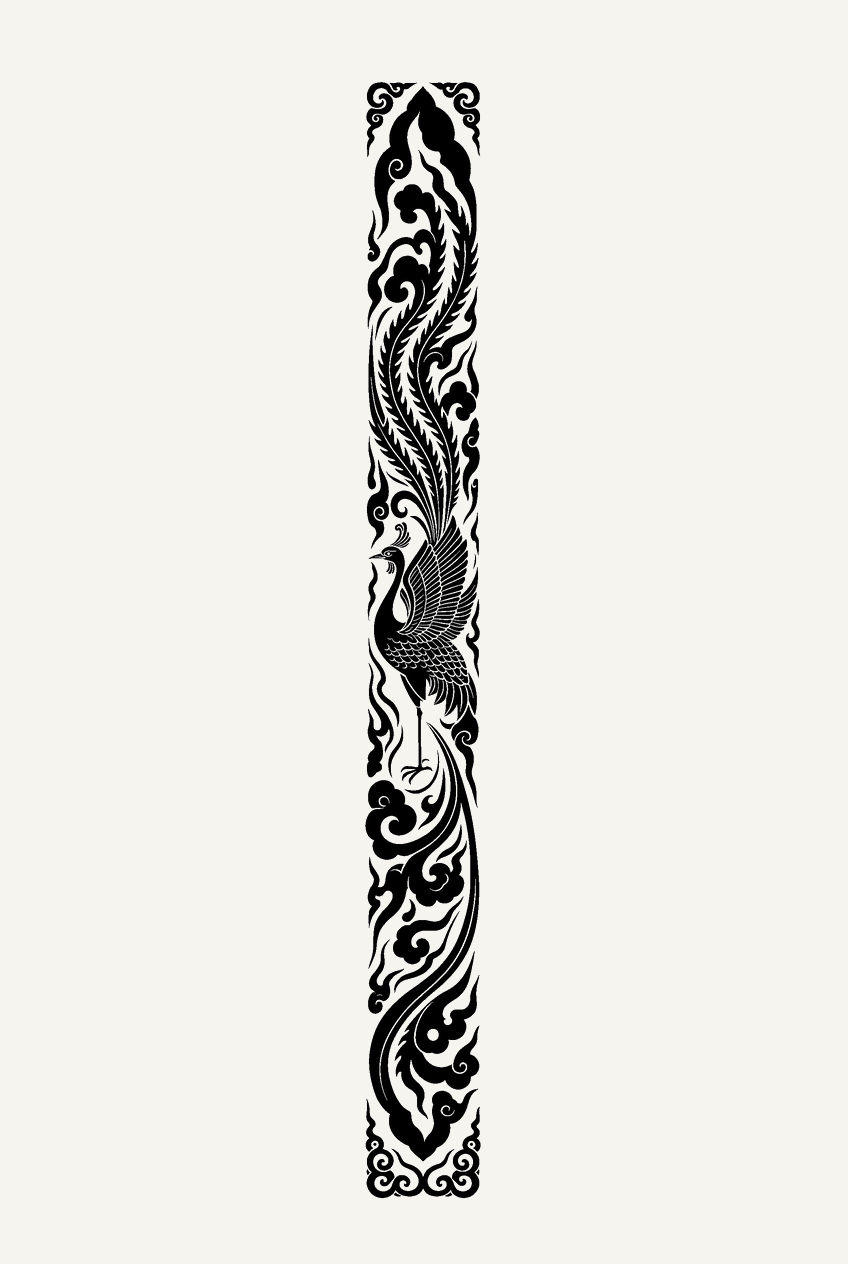
凤凰带 · Fèng Huáng Dài
The Sovereign Bird
Series: Symbols & Patterns · Design #18
Style: Full phoenix vertical band · the bird rendered whole, head to tail-plume, with cloud and pearl registers · black-and-white block contrast · full arm-band or leg-band wrap · scalable 14–20 cm
Form: 图案
The Name
fèng huáng dài — the phoenix at full length. Most designs show a part: a wing, a tail-curl, a head. This one gives the whole bird, top to bottom of the band — crest, arched neck, spread wing, the long streaming tail that is the phoenix's signature. The old texts were specific about the creature. The *Shanhaijing* describes the bird of Mount Danxue: 「见则天下大安宁」 — "when it appears, the world is at great peace." Not a war bird. A legitimacy bird: it lands where the rule is right.
凤凰带(fèng huáng dài)——完整长度的凤凰。大多数设计只给局部:一只翅、一段尾卷、一个头。这一条给整只鸟,从带到带的顶端到底端——冠、弓起的颈、张开的翅、还有凤凰的签名:那条长长的、流动的尾。古书对这种鸟写得具体。《山海经》记丹穴之山有鸟:「见则天下大安宁。」不是战鸟,是「合法性之鸟」:它落在哪里,哪里的治理就是对的。
Source & Provenance
The phoenix in Chinese art, head to tail: the Warring States *Person, Dragon and Phoenix* silk painting (c. 300 BC, Hunan Provincial Museum) already shows the long arched-neck bird with streaming plumes; Han tile-ends and Tang textiles standardized the crest-and-tail anatomy; Ming-Qing court art fixed the full-body phoenix with cloud scrolls and the flaming pearl as its companion set. The *Shanhaijing* passage on the bird of Mount Danxue is the locus classicus for its meaning. Historical form reference: full-length phoenix compositions of Ming-Qing silk and porcelain. Inking note: this design adapts the classic line construction of the traditional motif and re-inks it as tattoo linework.
凤凰在中国艺术里的全身像:战国《人物龙凤帛画》(约公元前 300 年,湖南省博物馆藏)里已有长颈拖羽、身形如弓的凤;汉代瓦当与唐代织物定型了冠与尾的解剖;明清宫廷艺术把「全凤 + 流云 + 火珠」固定成配套。《山海经》丹穴之凤那段,是它意义层面的出处正本。形制参考:明清丝织与瓷器上的通身凤凰构图。墨线转写:本设计以传统母题的经典线条造型为底,转写为纹身墨线。
Design Inspiration
Every form decision on this design points to a recorded source, element by element. ① The full-length body — crest, neck, wing, legs, and the great streaming tail running the band's length, the Ming-Qing whole-bird anatomy. ② The S-curve stance — the arched neck answering the curved tail, the posture fixed in the Warring States silk painting. ③ The cloud and pearl registers — the companion set of court phoenix art. ④ The solid black body — the bird as one black mass with white plume-lines carved through, woodcut weight for a court motif.
本版每一处形制决定都有出处可查,逐条对账。① 通身结构——冠、颈、翅、足与贯穿带长的巨大流尾,明清全凤的解剖。② S 形站姿——弓颈对卷尾,战国帛画里定下的姿态。③ 流云与火珠段——宫廷凤凰艺术的标配随从。④ 实黑身——凤作一大块黑、白羽线从中刻出,宫廷母题压上木刻的分量。
The Story
The phoenix is the only creature in the Chinese bestiary whose appearance is itself an audit. Dragons can be provoked. Tigers can be cornered. But the fenghuang comes when it chooses — and the texts agree on what its choice means. It appeared for the Yellow Emperor. It appeared when Shun played his music. The *Shanhaijing* lists its body parts as a syllabus: the head is virtue, the wing is duty, the back is propriety, the chest is humaneness, the belly is trust. An animal you could pass an exam on.
That is why the bird became the emblem of the empress, the partner-mark to the dragon: not a rival power but a different kind of authority — the kind that arrives already correct. Painters chased it for two thousand years and never saw one; the result is the most beautiful creature never photographed, assembled out of every bird the artists loved.
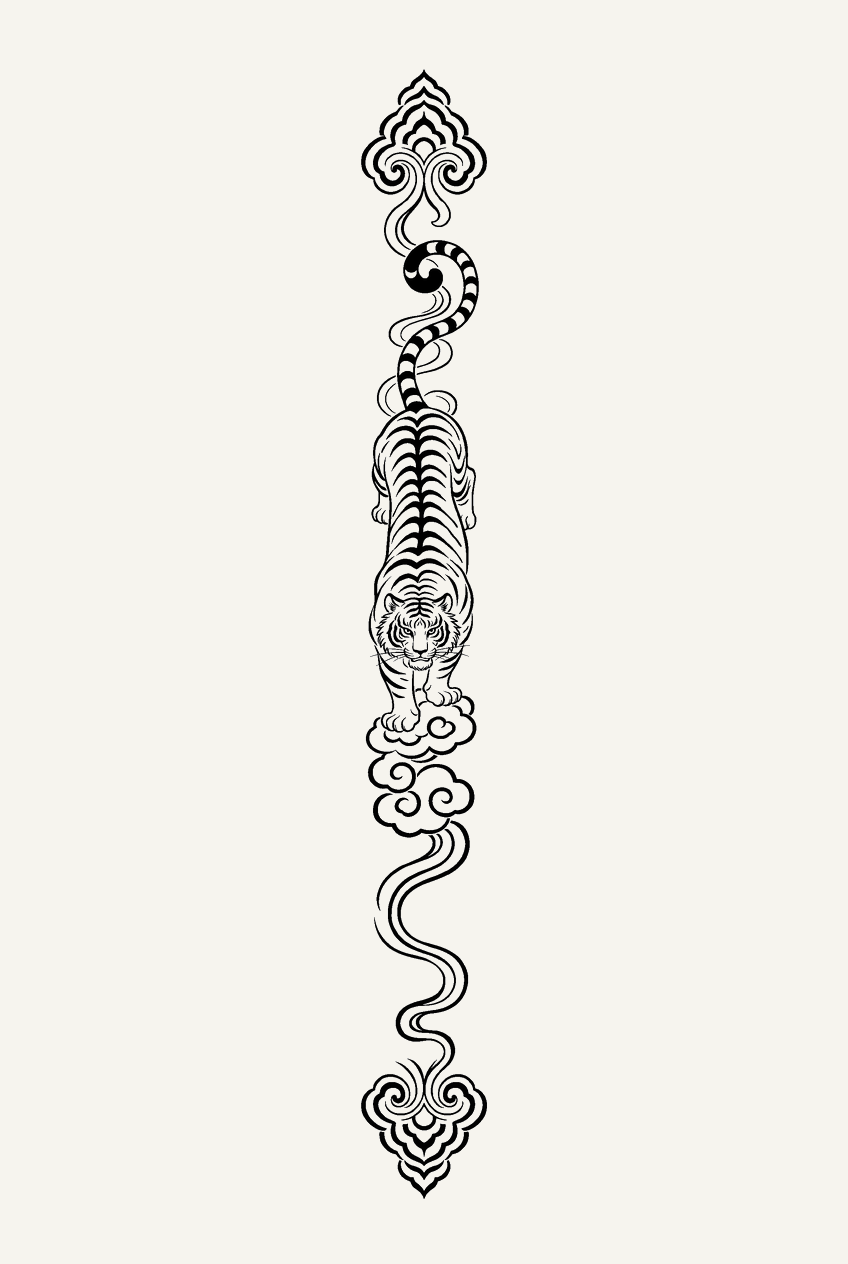
This band is that assembly at full length. The bird runs the whole strip — head high, tail falling in a plume that ends at the band's edge — flanked by cloud and pearl. Worn as a ring on the arm, the phoenix closes its own circle: the bird of arrival, permanently arrived.
凤凰是中式异兽谱里唯一「出现即审查」的生物。龙可以被激怒,虎可以被逼进绝路;但凤凰自己挑时间来——而古书对它「挑哪一次来」的意思意见一致。它为黄帝出现过。它为舜的乐声出现过。《山海经》把它身上的零件排成了课程表:头是德,翅是义,背是礼,胸是仁,腹是信。一只经得起考试的动物。
正因如此,它成了皇后的徽记、与龙相配的那一半:不是竞争的权力,是另一种权威——一种「抵达时已经是对的」的权威。画家追了它两千年,谁也没见过真的;结果就是这只从未被拍照的最美的生物,由艺术家们爱过的每一只鸟拼装而成。
这条带就是那次拼装的全长版。凤凰贯穿整条——头昂起,尾羽垂到带的边缘——流云与火珠在侧。绕臂成环,凤凰合上自己的圆:这只「降临」的鸟,永久地降临了。
What It Means
Arrival with legitimacy. The phoenix is the mark of a position that does not need to shout — worth that is recognized, not claimed. Virtue as anatomy: the old text's five-body-part reading still works as a checklist for how to hold power gently.
名正言顺的抵达。凤凰是「无需喊叫的位置」的标记——被承认的价值,而不是自我声索的价值。德性即解剖:古文那条五段读法,至今仍是一份「如何温柔持有力量」的检查清单。
Where It Sits
Full arm band on the upper arm, 4–6 cm wide, the bird's body wrapping the limb with tail completing the circle. As a leg band it suits the calf; the tail plume should run down the outer line. Head at the front of the wrap, tail meeting it at the inner seam.
上臂整圈臂环,宽 4–6 厘米,凤身环肢、尾羽收圆。小腿腿环同样合适;尾羽沿外线垂下。凤头在环绕起点,尾羽在内侧缝口与它相接。
Before You Ink
A full-body bird needs anatomy discipline: the neck-wing-tail S-curve must hold on a curved surface — template before lining. ② Tail plumes are the detail engine: below 4 cm band width they merge into a black ribbon. ③ The seam must fall in the tail plume's taper, never across the head or wing. ④ Ink-only by design: the black body with white plume-lines carries the design. ⑤ Shoulder-adjacent placements move a lot; expect the first touch-up inside a year.
通身鸟需要解剖功力:颈-翅-尾的 S 曲线在弧面上要站得住——先转印再上线。② 尾羽是细节发动机:带宽不足 4 厘米,它们会并成一条黑带。③ 缝口必须落在尾羽收细处,绝不许跨头或跨翅。④ 只宜墨线:黑身白羽线就是设计本体。⑤ 靠近肩的位置活动大——一年内安排首次补色。
Every character on this card was selected and checked stroke by stroke by a native reader of Chinese.