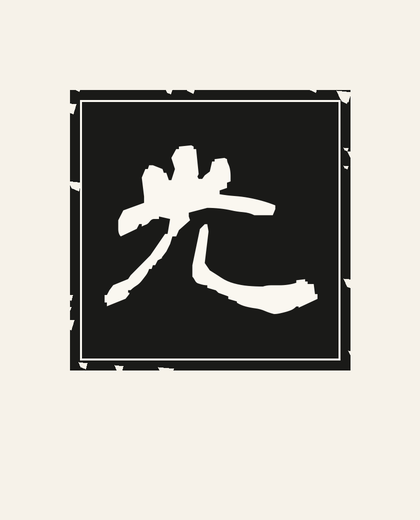
光 · Guāng
Light
Series: Single-Character Zen · Design #52
Style: Single character · Han-seal filled-white (bǎiwén) stamp — black ground, reversed white glyph, weathered border · clerical script (lishu) · medium scale
Form: 文字
The Name
*Guāng* — light, brightness, the glow a flame throws. In its small-seal shape, a person stands with fire held above them: 火 on top of 人. Not lightning from the sky, not the sun at noon — a fire someone is carrying. The character has kept that human figure inside it for three thousand years.
光(guāng)——光、亮,火照出来的那片明。小篆里是一个人举着火在头上:火在人上。不是天上劈下来的电,不是正午的太阳——是一把被人举着的火。这个字把那个人形留在身体里,留了三千年。
Source & Provenance
Etymology: *Shuōwén Jiězì* (Xu Shen, Eastern Han), 火部: 光,明也。从火在人上,光明意也 — "guang is brightness; it follows fire-above-person, the idea of light." The bronze and seal forms do show a kneeling or standing figure bearing a flame. The character's own etymology is therefore a small scene, not an abstraction: someone lifting a light so that it can be seen further. No third-party source image was used for this design. Inking note: this design adapts the classic line construction of the traditional motif and re-inks it as tattoo linework.
字源:《说文解字》(东汉·许慎)火部:光,明也。从火在人上,光明意也。金文、篆书里确实是个人形,头顶举着一簇火。所以这个字本身的字源就是一个小场景,不是抽象概念——有人把光举起来,让它可以被更远地看见。本设计未使用任何第三方源图像。墨线转写:本设计以传统母题的经典线条造型为底,转写为纹身墨线。
Design Inspiration
Every form decision points to a recorded source, element by element. ① The filled-white seal — the black field is the dark a light has to break into; the white glyph is what remains visible. ② Clerical script — the Han-stone script, whose level strokes carry the steadiness of a held flame rather than a flicker. ③ The weathered border — pressure unevenly made, the mark of a real impression. ④ The open counters — 光's upper fire and lower 儿 are kept clear, so even at small size the figure-under-flame still reads.
本设计每一处形制决定都有出处可查,逐条对账。① 满白文印——黑地是光要破开的暗,白字是留下来的可见之物。② 隶书——汉石经的书体,横平笔画托住的是持火不晃的稳,不是摇曳。③ 残边——用力不匀留下的印痕,是真盖过印的凭据。④ 通透的留白——「光」上头的火、底下的儿都留得开,小尺寸下"人举火"的形仍读得出。
The Story
The Chinese did not imagine light as something that simply arrives. Their oldest picture of it has a person in it — someone holding fire up over their head, so the circle around them can see. Light, in that grammar, is something carried. It has a bearer.
That small fact changes the feeling of the word. 光 is not glory that lands on the fortunate. It is the light you make by holding something up — a lamp in a dark room, an example in a hard year, the plain act of making yourself visible when it would be easier to stay hidden. The *Shuōwén* is characteristically literal about it: fire, above a person, brightness.
The Buddhist inheritance deepened the word without replacing it: 光 shows up in names for the Buddha's radiance, in 光明 (brightness), in the wish that someone's path be lit. But the human figure never left. Even in the most elevated uses, there is still somebody carrying the flame.
To wear 光 is to take that old scene onto the skin: not *I am luminous*, but *I am holding the light up.* A quieter claim, and a harder one.
中国人没有把光想成凭空到来的东西。最古的那个字形里就有个人——有人把火举过头顶,让周围的人能看见。照这个语法,光是被捧着的东西,它有捧着它的人。
这一点小事实改变了整个字的气质。「光」不是落在幸运者头上的荣耀。它是你把某样东西举起来之后才有的光——暗屋里的一盏灯,难熬那一年里的一个样子,在本可以藏着的时候让自己被看见。《说文》照例说得很直白:火在人上,光明意也。
佛教的传入加深了这个词,却没有替换它:光出现在佛光的名目里、出现在「光明」里、出现在愿人前路有光的祝词里。但那个人形始终没走。哪怕在最高的用法里,也还是有人在举着火。
纹「光」,就是把那幅古老的场景带上皮肤:不是*我很耀眼*,而是*我把光举着*。一个更安静、也更难的承诺。
What It Means
Light that is carried, not merely received. The character keeps the fire-above-person scene inside it: brightness as an act of holding something up for others to see. For the person who has been the lamp in a room, or is learning to be.
被捧着的光,不只是照到身上的光。这个字把"火在人上"的场景留在里面:明亮是把一样东西举起来给别人看的行为。给做过暗室里那盏灯的人,或正在学着做的人。
Where It Sits
A single character at 4–8 cm sits cleanly on the back of the neck, the outer forearm, or below the collarbone — spots where the seal's square field stays flat. At 3–4 cm it fits the inner wrist; at 8–10 cm on the upper back the seven strokes of 光 keep their spacing and the border its weather.
单字 4–8 厘米,放在后颈、小臂外侧或锁骨下都干净——这些位置方形印面不变形。3–4 厘米适合手腕内侧;放到上背做到 8–10 厘米时,「光」的七笔间距与残边都保得住。
Before You Ink
Negative-form seal. Use the supplied white-ground black-line transfer sheet; the black cover is the finished seal, not the stencil. ② Never freehand a Chinese character — the upper fire and lower legs must balance. ③ Keep the border broken. ④ Ink only; color subtracts. ⑤ Minimum 4 cm so the space between the top strokes stays open. ⑥ Do not combine scripts. This is the clerical-script version only; do not mix a seal-script 光 into the same tattoo.
负形印。 用随卡附的白底黑线转印页;黑底封面是成品印章,不是转印稿。② 切勿徒手写汉字——上头的火与底下的儿要守住平衡。③ 残边保留破口。 ④ 只用墨,上色减分。 ⑤ 最小 4 厘米,让上部笔画间的空隙保持通透。⑥ 不要混用书体。 本款仅隶书一版,勿把篆书「光」纹进同一处。
Every character on this card was selected and checked stroke by stroke by a native reader of Chinese.



