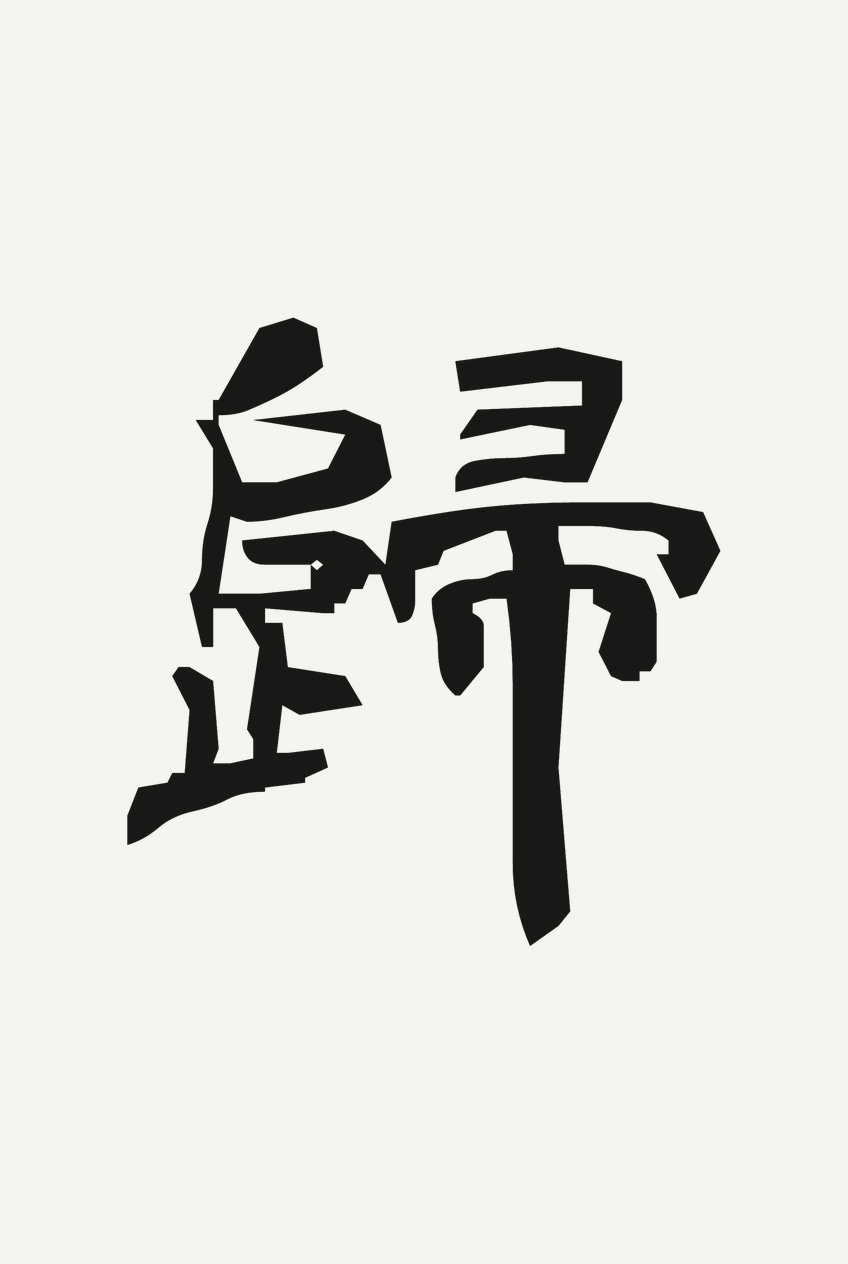
归 · Guī
Return
Series: Single-Character Zen · Design #49
Style: single character · clerical script (lishu, traditional form 歸) · small-to-medium
Form: 文字
The Name
Tao Yuanming resigned his magistracy after eighty days — the famous field was going to weed, and he was done bowing for a salary — and wrote the resignation letter that Chinese poetry still orbits: 歸去來兮,田園將蕪胡不歸 — go home; the garden is going wild; why not return. The Shuowen traces the character further back: 歸,女嫁也 — its oldest sense is a woman going to her true household. Return, in this graph, was never retreat. It is going to where you are registered.
陶渊明做了八十天县令就辞了官——田快荒了,而他不想再为俸禄折腰——写下那封此后所有汉语诗歌都在环绕的辞职信:歸去來兮,田園將蕪胡不歸——回去吧;园子快荒了,为什么不归。《说文》把这个字追得更远:歸,女嫁也——它最古的义项,是女子前往她真正的家。在这个字形里,归从来不是撤退。是回到你被登记的地方。
Source & Provenance
Tao Yuanming, "Return Home" preface and rhapsody (歸去來兮辭, 405 AD): 歸去來兮,田園將蕪胡不歸 — original text; Shuowen: 歸,女嫁也 for the etymology. Both on record. Inking note: this design adapts the classic line construction of the traditional motif and re-inks it as tattoo linework.
陶渊明《归去来兮辞》(405 年):歸去來兮,田園將蕪胡不歸——原文实录;字源据《说文》「歸,女嫁也」。两者都有案可查。墨线转写:本设计以传统母题的经典线条造型为底,转写为纹身墨线。
Design Inspiration
Every form decision points to a recorded source, element by element. ① One character, one column — the left side is the road out; the right side, the broom and the door: the whole homeward trip inside one graph. ② Clerical script, traditional form 歸 — 止 (the foot) at top-left: the character begins with walking. ③ Small-to-medium scale — 4–6 cm. ④ Black ink only — the road home is one line long.
本设计的每一处形制决定都有出处可查,逐条对账。① 单字一列——左半是出门的那条路;右半,是扫帚与门:整段回家的路装在一个字形里。② 隶书、繁形「歸」——左上角是止(脚):这个字以行走起笔。③ 小到中尺寸——4–6 厘米。④ 只用墨——回家的路只有一条线那么长。
The Story
The rhapsody is not modest about its joy: the boat rocks and sails fast, the wind blows and the robe lifts — 舟遙遙以輕颺,風飄飄而吹衣 — and he asks the road for the dawn. What he resigned was a post in the civil service; what he returned to was three rooms, some mulberries, and the first truly private literature ever written in Chinese. 歸 became the genre-name for every later retirement, every exile's dream, every end-of-career garden. The character carries a strange comfort for the migrant age: every return in it is also an arrival.
那篇辞并不掩饰它的快乐:舟遥遥以轻颺,风飘飘而吹衣——船摇得轻快,风把衣襟吹起来——他向道路打听天亮。他辞掉的是官府的一个职位;他回去的是三间屋子、几棵桑树,以及汉语里第一份真正属于私人的文学。归,从此成为后来每一次退休、每一个流放者的梦、每一段职业生涯尽头的园子的文体之名。这个字给迁徙时代藏了一点奇怪的安慰:它里面的每一次归,同时也是一次抵达。
What It Means
For the ones who know where their garden is: the hometown, the craft, the family, the self before the compromise. Also for those still on the road — the character does not require the arrival to be scheduled.
给知道自己园子在哪儿的人:家乡、手艺、家人、妥协之前的那个自己。也给还在路上的人——这个字并不要求抵达已经排进日程。
Where It Sits
One character: inner wrist, nape, sternum; 4–6 cm; minimum 4 cm for the 止 and the broom strokes.
单字:腕内侧、后颈、胸骨;4–6 厘米;「止」与帚部笔画不糊需 4 厘米起。
Before You Ink
One character is the whole design. ② Traditional form 歸. ③ Minimum 4 cm. ④ It is directional — unlike 放下, it names the place; make sure you know yours. ⑤ The oldest sense is a wedding — 歸 originally meant going to one's true household; the return was always also a beginning.
一个字就是全部设计。 ② 繁形「歸」。 ③ 4 厘米起。 ④ 它有方向——不像「放下」,它点名了地方;先确认你的那个地方。⑤ 它最古的义项是一场婚礼——歸本义是去往真正的家;归,从来同时也是开始。
Every character on this card was selected and checked stroke by stroke by a native reader of Chinese.



