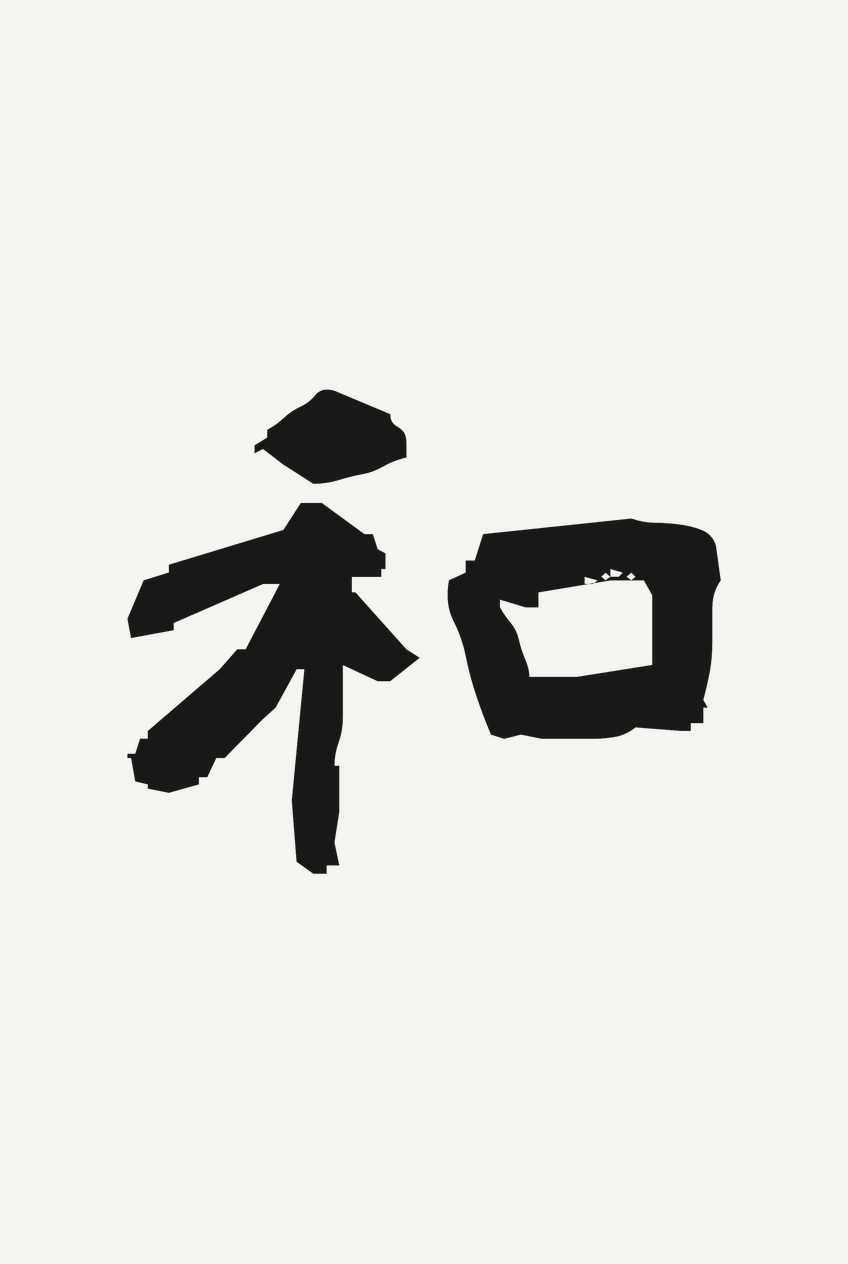
和 · Hé
Harmony
Series: Single-Character Zen · Design #24
Style: single character, large · clerical script (lishu) · same form 和 · small-to-medium
Form: 文字
The Name
*Hé* — harmony: grain (禾) beside a mouth (口). The etymology is a full political theory in one character — a mouth that is fed, and the agreement that follows: no state has ever been harmonious on empty plates. 和 is not the absence of difference; it is difference, organized: the soup metaphor of the Zuo Tradition, the tuned strings of the lute. As a tattoo, it is the single most classical way to say: peace, with structure.
和——和:禾苗挨着口。字源是一整部政治理论压进一个字——一张被喂饱的嘴,以及随之而来的契约:没有一个空着盘子的邦国是和谐的。和不是差异的缺席;是被组织起来的差异:《左传》的羹汤之喻,调准的琴弦。纹下它,是用最古典的方式说一句话:和平,且有其结构。
Source & Provenance
《说文》: 和, 相應也 — "harmony: things responding to one another." The Zuo Tradition (昭公二十年) supplies the canonical gloss through Yan Ying's soup: 水火醯醢鹽梅, each ingredient keeping its nature, cooking the fish into one dish — 和如羹焉. The Doctrine of the Mean raises it to cosmic stakes: 致中和,天地位焉,萬物育焉 — "reach harmony, and heaven and earth take their places, the ten thousand things are nurtured." Inking note: this design adapts the classic line construction of the traditional motif and re-inks it as tattoo linework.
《说文》:和,相應也。《左传·昭公二十年》借晏婴的羹汤给出正解:水火醯醢鹽梅——各保其性,把鱼煮成一盘菜——和如羹焉。《中庸》把它抬到宇宙量级:致中和,天地位焉,萬物育焉。墨线转写:本设计以传统母题的经典线条造型为底,转写为纹身墨线。
Design Inspiration
Every form decision points to a recorded source, element by element. ① One character, alone, large — a definition this large wants a single wall. ② Clerical script, same form 和 — the grain radical's drooping head and the mouth's square seat: agriculture and agreement in one frame; lishu's level hand suits a character about settlement. ③ Small-to-medium scale — 8 cm wrist, 12 cm forearm. ④ Black ink only — harmony in one voice.
本设计的每一处形制决定都有出处可查,逐条对账。① 一字、独处、够大——这么大的定义想要一整面墙。② 隶书、同形「和」——禾旁低垂的穗与口部的方正底座:农业与契约同框;隶书的水平手法正合一个关于「安顿」的字。③ 小到中尺寸——腕上 8 厘米,小臂 12 厘米。④ 只用墨——和,同一个声部。
The Story
Yan Ying's soup is the character's founding scene. His lord asked why he disliked his flatterer, and the minister answered from the kitchen: your favorite courtier is a man who only ever adds water — agrees with every word — and a dish of water agreeing with water is not food. Harmony, 和, is what the ingredients achieve: each keeps its own nature, and the dish exists. The Doctrine of the Mean then took the kitchen to the cosmos: when 中 (the balanced center) and 和 (responsive harmony) are attained, heaven and earth take their seats and the ten thousand things are nurtured. One character spans soup and cosmology without dropping either.
This is why 和 survived every century of translation trouble. It is not "peace" (that is 安), not "sameness" (that is 同 — explicitly its opposite: 君子和而不同). It is the third thing: difference held in tune. The character worn alone is a compact course in how to enter a room — with the grain radical on one side (the field, the work, the feeding) and the mouth on the other (speech, response, agreement). Between them, the whole discipline: come fed, speak measured, keep your nature, and make the dish possible.
晏婴的羹汤是这个字的开山场景。君主问他为何厌恶谄臣,这位大臣从厨房作答:你那位宠臣是一个只会添水的人——句句附和——而一盘同意另一盘水的「水」,做不成菜。和,是食材们达成的事:各保其性,菜才成立。《中庸》随后把厨房抬进宇宙:中和一旦达成,天地各就其位,万物得到养育。一个字横跨羹汤与宇宙论,两边都不放手。
这就是为什么「和」熬过了翻译的每一个动荡世纪。它不是「和平」(那是安),不是「相同」(那是同——它明确的反义词:君子和而不同)。它是第三样东西:被调准的差异。单独佩戴的这个字是一堂紧凑的课,教你如何走进一个房间——一侧是禾旁(田地、劳作、喂养),另一侧是口(言语、应答、契约)。两者之间是全部功课:带着食物来,好好说话,守住本性,让这盘菜成为可能。
What It Means
For the ones holding groups together — the mediator, the second-generation caught between two homes, the friend every quarrel is reported to. 和 certifies the work: harmony is not weakness; it is engineering, and it is classical.
给把一群人拢在一起的人——调解者、夹在两个家之间的二代、每场争吵都会被汇报的那位朋友。和认证这份工作:和谐不是软弱;它是工程学,而且是古典的。
Where It Sits
One character, one plane: nape, inner wrist, sternum. 6–8 cm reads as a private settlement; 10 cm, a stated constitution. The character's two-sided structure reads best centered.
一个字,一个平面:后颈、腕内侧、胸骨。6–8 厘米读作一次私下的和解;10 厘米读作一纸公开的宪章。字的双侧结构居中读感最佳。
Before You Ink
One character is the whole design. ② Same form 和. ③ Clerical script keeps both sides weighted. The grain and the mouth must hold equal visual mass — imbalance breaks the word's whole argument. ④ Minimum 5 cm. ⑤ 和 is not 同. If you are wearing this to stop disagreeing, you have mistranslated your own tattoo. The classical 和 holds differences — starting with yours.
一个字就是全部设计。 ② 同形「和」。 ③ 隶书两侧等重。 禾与口必须撑起相等的视觉体量——失衡会拆掉整个字的论证。④ 5 厘米起。 ⑤ 和不是同。 如果戴它是为了不再有分歧,你误译了自己的纹身。古典的「和」容纳差异——从你自己的开始。
Every character on this card was selected and checked stroke by stroke by a native reader of Chinese.



