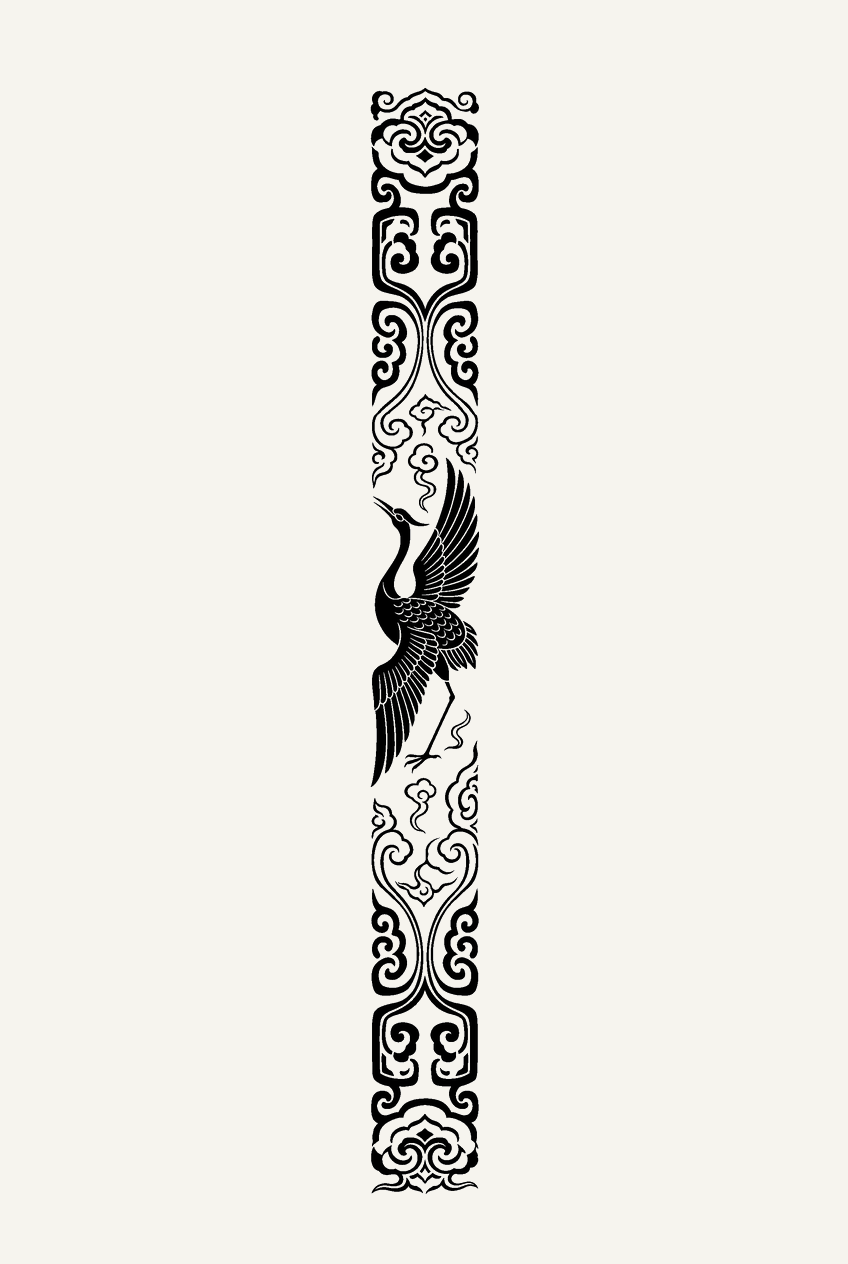
鹤云带 · Hè Yún Dài
Crane in the Clouds
Series: Symbols & Patterns · Design #16
Style: Crane-and-cloud vertical band · spread-wing crane registers alternating with rolling cloud scrolls · black-and-white block contrast · full arm-band or leg-band wrap · scalable 12–18 cm
Form: 图案
The Name
hè yún dài — the crane riding its own weather. In China the crane does not simply fly; it commutes between worlds. It carries immortals on its back, stands at the edge of pine-and-cloud paintings, and calls once — a sound the ancients claimed carried to heaven. The Book of Songs puts it plainly: 「鹤鸣于九皋,声闻于天」 — "the crane cries in the ninth marsh, and heaven hears it." Wrap that bird in scrolling clouds and you have the most upright of the Chinese bird band designs: altitude as character.
鹤云带(hè yún dài)——鹤,骑在自己制造的天气上。在中国,鹤不只是飞,它往返于两个世界之间:背驮仙人,站在松与云的画边上,一声长鸣——古人说这声音能传到天上。《诗经》说得直白:「鹤鸣于九皋,声闻于天。」把这只鸟裹进流云回卷里,就是中式鸟纹带里最挺拔的一条:海拔即品格。
Source & Provenance
Cranes among clouds in Chinese painting and applied art: the crane-and-cloud pairing runs from Han tomb murals through Song court painting — Emperor Huizong's *Auspicious Cranes* (瑞鹤图, 1112, Liaoning Provincial Museum) fixes twenty cranes wheeling above a cloud-edged palace roof — to Ming-Qing textiles and porcelain, where cloud scrolls under cranes became a standard rank badge and gift motif. The cloud scroll itself is the xiangyun (auspicious cloud) tradition, its tight spirals standardized by the Ming. Historical form reference: crane-and-cloud registers on Ming-Qing silk and porcelain. Inking note: this design adapts the classic line construction of the traditional motif and re-inks it as tattoo linework.
中国绘画与工艺里的鹤与云:鹤云组合从汉墓壁画一路走到宋代院画——宋徽宗《瑞鹤图》(1112 年,辽宁省博物馆藏)定格了二十只白鹤盘旋在云缘宫阙之上——再到明清的织物与瓷器,云上仙鹤成了标准的品官补子与贺礼母题。卷云本身属祥云体系,紧密的螺旋在明代定型。形制参考:明清丝绸与瓷器上的鹤云纹带。墨线转写:本设计以传统母题的经典线条造型为底,转写为纹身墨线。
Design Inspiration
Every form decision on this design points to a recorded source, element by element. ① The spread-wing crane register — wings fully open, neck extended, the flight posture of Song court crane paintings. ② The rolling cloud scroll — tight spiral heads with trailing tails, the Ming xiangyun standard. ③ The alternation — crane, cloud, crane, cloud, the register rhythm of textile bands. ④ The solid-black crane body — the mass-and-line contrast of woodcut-rendered bird painting.
本版每一处形制决定都有出处可查,逐条对账。① 展翅鹤段——双翅全开、长颈前伸,宋代院体鹤画的飞姿。② 回卷云头——紧螺旋加拖尾,明代祥云的标准形。③ 交替节奏——鹤、云、鹤、云,织物纹带的分段呼吸。④ 实黑鹤身——块面与线对比的木刻式禽鸟画法。
The Story
Every culture has a bird it trusts with its prayers. China's is the crane, and the reasons are precise. It stands one meter tall and is white as paper — it looks like it was drawn before it was born. It lives decades, which the ancients counted as forever. It migrates above the clouds, so it has literally been seen entering the sky. And its call, amplified by that long trachea, carries farther than any other bird's — the Song naturalists measured this and the poets never stopped using it.
So the crane became the bird that connects: heaven's messenger, the immortal's mount, the word 「鹤」 written on countless scholars' studio walls as a reminder of what dignity looks like at altitude. Song Huizong, watching twenty cranes circle his palace through evening clouds, took it as the best omen an emperor ever received, and painted each one.
The band gives that scene its textile form: crane after crane climbing through scroll after scroll of cloud, black on white, the way they appear on Ming robes. Around the arm it reads as altitude worn as jewelry — a promise that the direction you are moving in is up.
每种文化都有一只被托付祈祷的鸟。中国的这一只是鹤,理由都很具体:它高一米、白如纸——像是先被画出来、再被生出来的。它活几十年,古人把这个数字当作永远。它迁徙时飞在云上,所以有人真的见过它进天。它的叫声被那根长气管放大,传得比任何鸟都远——宋代的博物学家量过,诗人则用之不竭。
于是鹤成了「连接」的鸟:上天的信使、仙人的坐骑,「鹤」字被无数文人写在书斋墙上,提醒自己高处的人格长什么样。宋徽宗看二十只鹤在暮云里绕宫盘旋,认为那是帝王所能收到最好的预兆,于是把每一只都画了下来。
这条带把那个场景还原成织物形态:一只鹤接一只鹤,攀过一团接一团的卷云,黑上白下,像它们出现在明代的袍子上。绕在臂上,读作「把海拔戴成首饰」——一个承诺:你走的方向,是向上。
What It Means
Elevation earned and announced. The crane is longevity, sure-footed dignity, and the voice that reaches where it intends to go. With clouds beneath it, the meaning completes: high position with light footing. For someone at the start of a climb — or marking one already made — this is the band.
挣来的高度,并且宣告出来。鹤是长寿、站得住的品格,以及一声音达目的地的鸣叫。云在足下,意义才完整:位高而步轻。给正要开始攀登的人——或给要纪念一次已完成的攀登的人——就是这条带。
Where It Sits
Full arm band on the upper arm or forearm, 3–5 cm wide, cranes climbing around the limb. As a leg band at the calf it reads as ascent in the literal sense. Keep the lead crane's head pointing up the arm.
上臂或前臂整圈臂环,宽 3–5 厘米,鹤沿肢体攀行。小腿腿环上,字面意义上就是「向上」。领头鹤的头朝臂上方向。
Before You Ink
The crane's neck and wing-tips are long curves: choose an artist fluent in flowing linework, not only bold blackwork. ② Keep the white eye and feather-buttress lines from merging — width below 3 cm risks losing them. ③ Wrap direction matters: cranes climb with the arm's natural upward line, not across it. ④ Ink-only by design: the black body mass is the contrast engine. ⑤ Elbow-adjacent placements flex a lot; expect earlier touch-ups there.
鹤颈与翅尖是长曲线:选流畅线稿功力过关的纹身师,不能只会粗黑块面。② 白色眼线与羽下撑线别让它们并死——宽度不足 3 厘米有糊掉风险。③ 环绕方向重要:鹤要顺着肢体向上的自然线攀,不要横着走。④ 只宜墨线:黑色块面是对比的发动机。⑤ 靠近肘部的位置活动量大,补色会更早。
Every character on this card was selected and checked stroke by stroke by a native reader of Chinese.