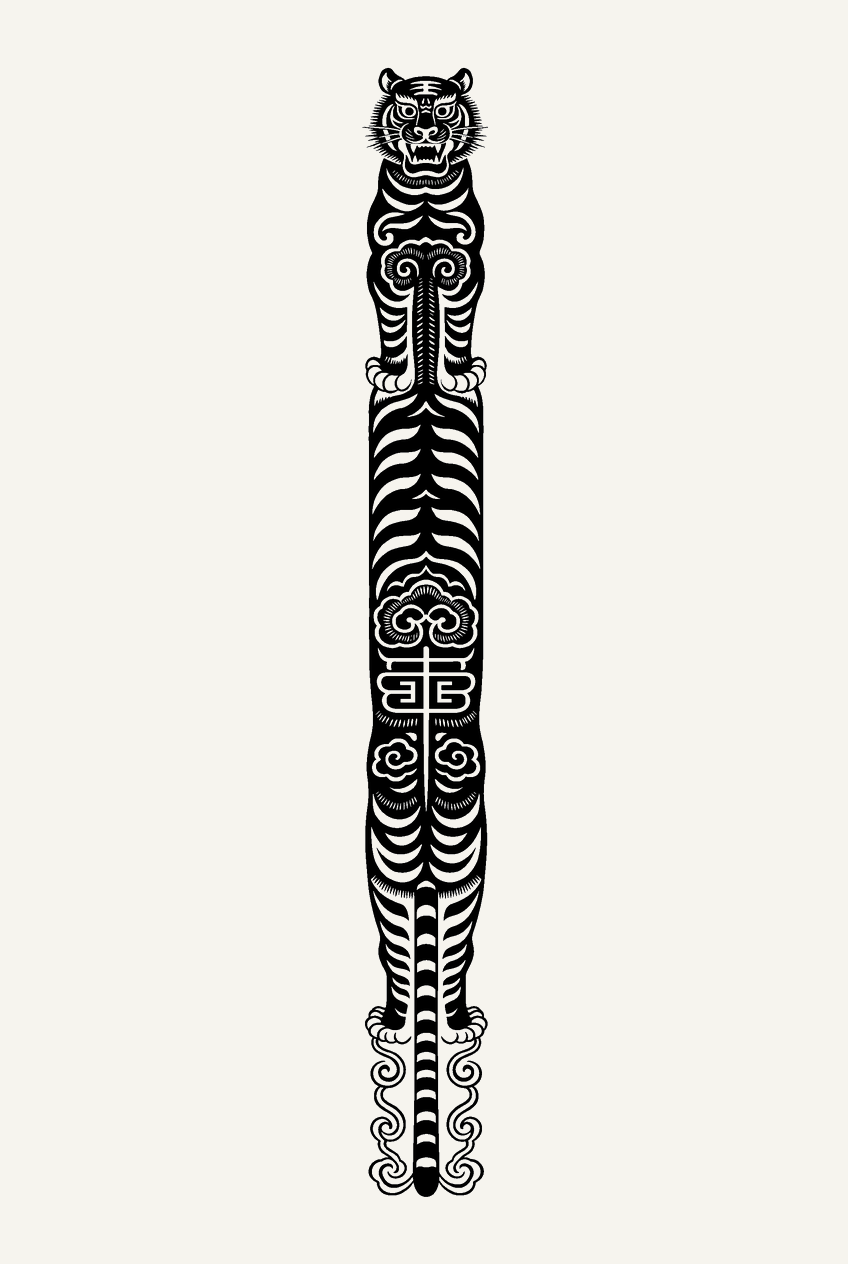
虎带 · Hǔ Dài
The Mountain Ruler
Series: Symbols & Patterns · Design #21
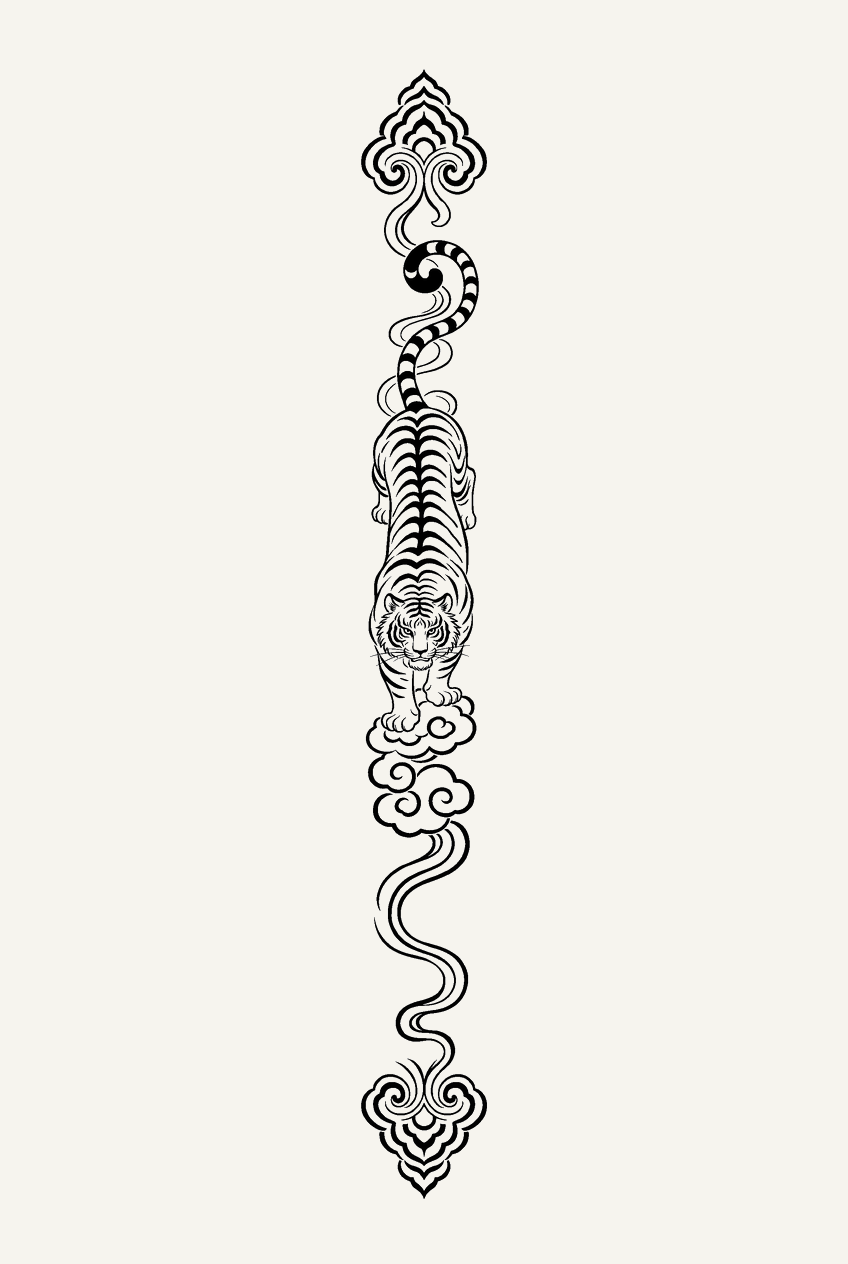
Style: Solid black tiger vertical band · the full cat descending the strip, cloud scrolls alongside · black-and-white block contrast · full arm-band or leg-band wrap · scalable 14–20 cm
Form: 图案
The Name
hǔ dài — the tiger, walking down a strip of skin the way it walks down a mountain. China made the tiger the west's guardian, the mountain's ruler, and the general's emblem, and it drew the animal accordingly: not lurking, but in stride — head low, shoulders rolling, stripes like command marks. The *I Ching*'s gloss on the pairing is the classic one: 「云从龙,风从虎」 — "clouds follow the dragon, wind follows the tiger." This band gives the tiger its wind: cloud scrolls run alongside it the whole way down.
虎带(hǔ dài)——虎,沿着一条皮肤往下走,像它走下山时那样。中国把虎立为西方的守护神、山林的君王、将军的旗徽,画它的时候也是照这个规格画的:不是潜伏,而是阔步——头压低、肩滚动、条纹像一道道军令。《周易》给这个组合的注脚是经典款:「云从龙,风从虎。」这条带把风还给虎:卷云一路随行,一直到带的尽头。
Source & Provenance
The tiger of the four-direction system: Bái Hǔ, the White Tiger of the West, paired with the Azure Dragon of the East on Han dynasty roof-tile ends, tomb murals, and star charts — a guardian constellation set fixed by the Han and worn on official gear for centuries after. The *I Ching* line 「云从龙,风从虎」 (*Qian* hexagram commentary) is the pairing's locus classicus. The descending stride with striped mass comes from the woodcut and paper-cut tradition of door-god and guardian tigers. Historical form reference: Han four-symbol tile-ends and later folk guardian-tiger woodcuts. Inking note: this design adapts the classic line construction of the traditional motif and re-inks it as tattoo linework.
四方体系里的虎:白虎,西方之神,与东方青龙配对,见于汉代瓦当、墓室壁画与星图——这套守护星座组合由汉代定下,此后数百年一直佩在官方行头里。《周易》「云从龙,风从虎」(《乾卦·文言》)是这对组合的出处正本。压低头颅、条纹成块的下山阔步,来自门神与守护虎的木刻与剪纸传统。形制参考:汉代四神瓦当与后世民间守护虎木刻。墨线转写:本设计以传统母题的经典线条造型为底,转写为纹身墨线。
Design Inspiration
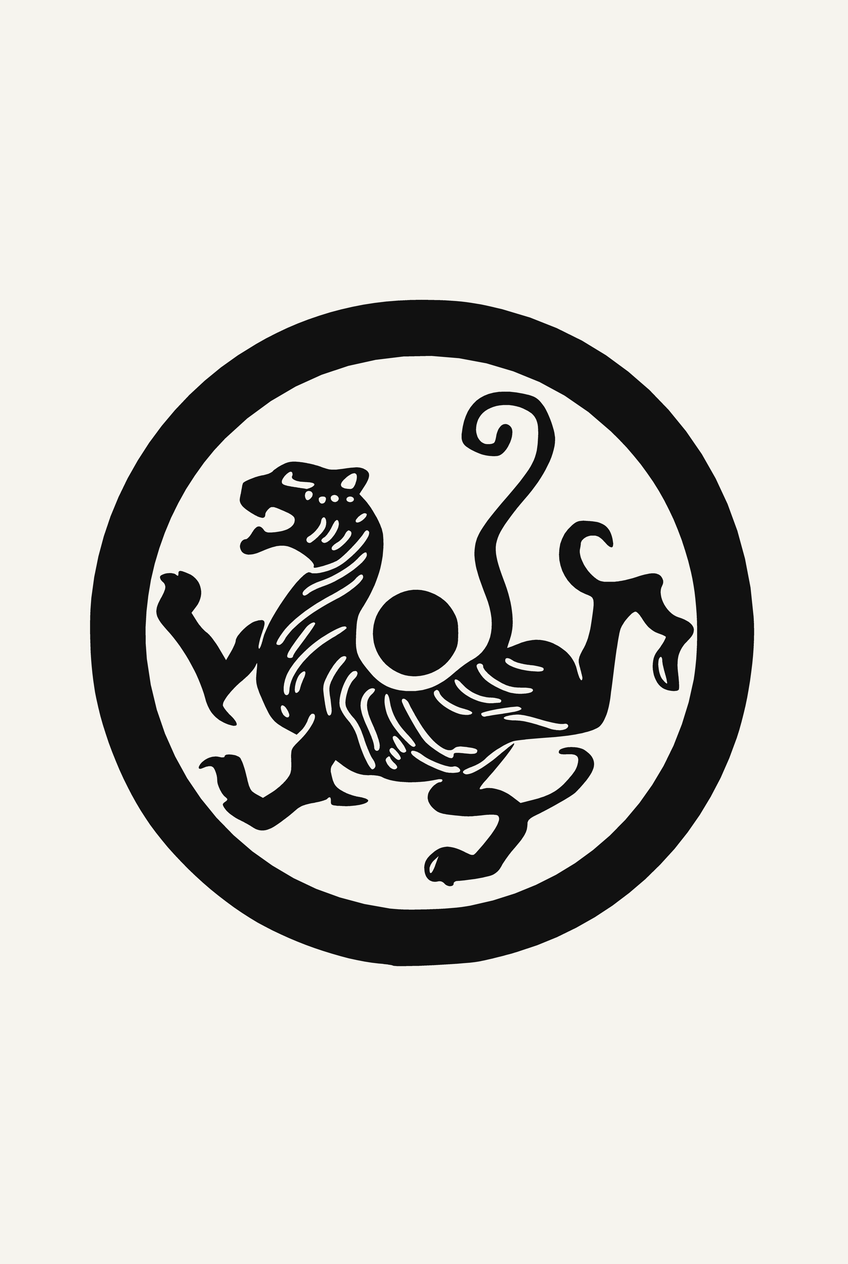
Every form decision on this design points to a recorded source, element by element. ① The solid black body — the tiger as one black mass, stripes carved as white channels, the woodcut guardian-tiger read. ② The descending stride — head low, forelegs reaching down the band, the "下山虎" of folk prints. ③ The white stripe channels — command-mark stripes cut clean through the black. ④ The companion cloud scrolls — wind-following clouds trailing the descent, the *I Ching* pairing made visible.
本版每一处形制决定都有出处可查,逐条对账。① 实黑身——虎为一大块黑,条纹用白色刻出来,木刻守护虎的读法。② 下山步态——头低、前肢探向带的下方,民间版画里的「下山虎」。③ 白色条纹通道——军令般的条纹干净利落地切开黑块。④ 随行卷云——风从虎的云一路尾随下山,《周易》那对组合的可见版。
The Story
The tiger is the only big cat China never had to import for its symbolism — it was always here, in the hills, eating livestock and occasionally people, and the culture built its respect accordingly. The tiger does not posture. It does not need the pack. It walks the ridgeline at dusk and the whole mountain rearranges its noise around that fact.
The Han court gave the tiger the west and made it a constellation; folk China gave it the door and made it a guardian; the army gave it the general's banner and made it a word for command — 虎符, the tiger tally that split in half, one half kept by the emperor, and only their joining could move an army. Every one of those jobs has the same job description: authority that works without explanation.
This band takes the descent as its composition. The tiger walks down the strip the way it walks out of the treeline — unhurried, shoulders first, clouds trailing because wind follows it wherever it goes. Wrapped around the arm it is a strip of that certainty: the thing at the top of the food chain does not run.
虎是中国唯一无需进口的大猫——它一直就在山里,吃牲口、偶尔吃人,这个文化对它的敬意是就地长出来的。虎不摆架子。它不需要群体。黄昏时它沿山脊走,整座山的声响都绕着这个事实重新排列。
汉室把西方划给它,让它成了星座;民间把家门划给它,让它成了守护者;军队把将旗划给它,让它成了「命令」这个词本身——虎符,剖成两半的信物,一半在皇帝手里,只有两半相合才能调动一军。这些职务的岗位说明是同一份:不需要解释就能运转的权威。
这条带把「下山」作为构图。虎沿着条带往下走,像它走出林线那样——不慌、肩在前,云在后面拖,因为风跟着它走到哪。绕在臂上,它就是一截那样的确信:食物链顶端的东西,不跑。
What It Means
Command without noise. The tiger is solitary competence: the strength that does not gather witnesses. Also protection in the folk sense — the guardian at the gate, the split tally that only you can complete. For someone who carries weight alone and prefers it that way, this is the emblem.
不出声的号令。虎是独行的胜任:不召集观众的力量。也是民俗意义上的守护——门口的守卫、只有你能合上的那半块符。给独自扛着重、并且甘愿如此的人,这就是徽记。
Where It Sits
Full arm band on the upper arm, 4–6 cm wide, the tiger descending around the limb, head at the outer face. As a leg band on the calf the descent reads as literal downhill — the strongest alternative. On the forearm it runs as a tall vertical piece.
上臂整圈臂环,宽 4–6 厘米,虎绕肢而下,头在外侧。小腿腿环上,「下山」读作字面意义的下坡——最强替位。前臂可作整条竖件。
Before You Ink
The black body mass is the structure: it needs 4 cm minimum width, or the white stripe channels flood shut. ② The stride must be templated to the limb's movement line — a tiger that walks against the muscle's grain reads stiff. ③ The seam should fall in cloud, never through the face or foreleg. ④ Ink-only by design: the white stripe channels are carved, not shaded. ⑤ Solid black over the deltoid heals in two stages; do not judge the density at week two.
黑块面是结构本体:至少 4 厘米宽,否则白色条纹通道会被涌进的黑色关死。② 步态必须顺着肢体的运动线转印——逆着肌肉纹走路的虎会显得僵。③ 缝口落在云里,绝不许穿脸或前肢。④ 只宜墨线:白色条纹是刻出来的,不是晕出来的。⑤ 三角肌上的实黑分两个阶段愈合——第二周不要急着判断浓度。
Every character on this card was selected and checked stroke by stroke by a native reader of Chinese.