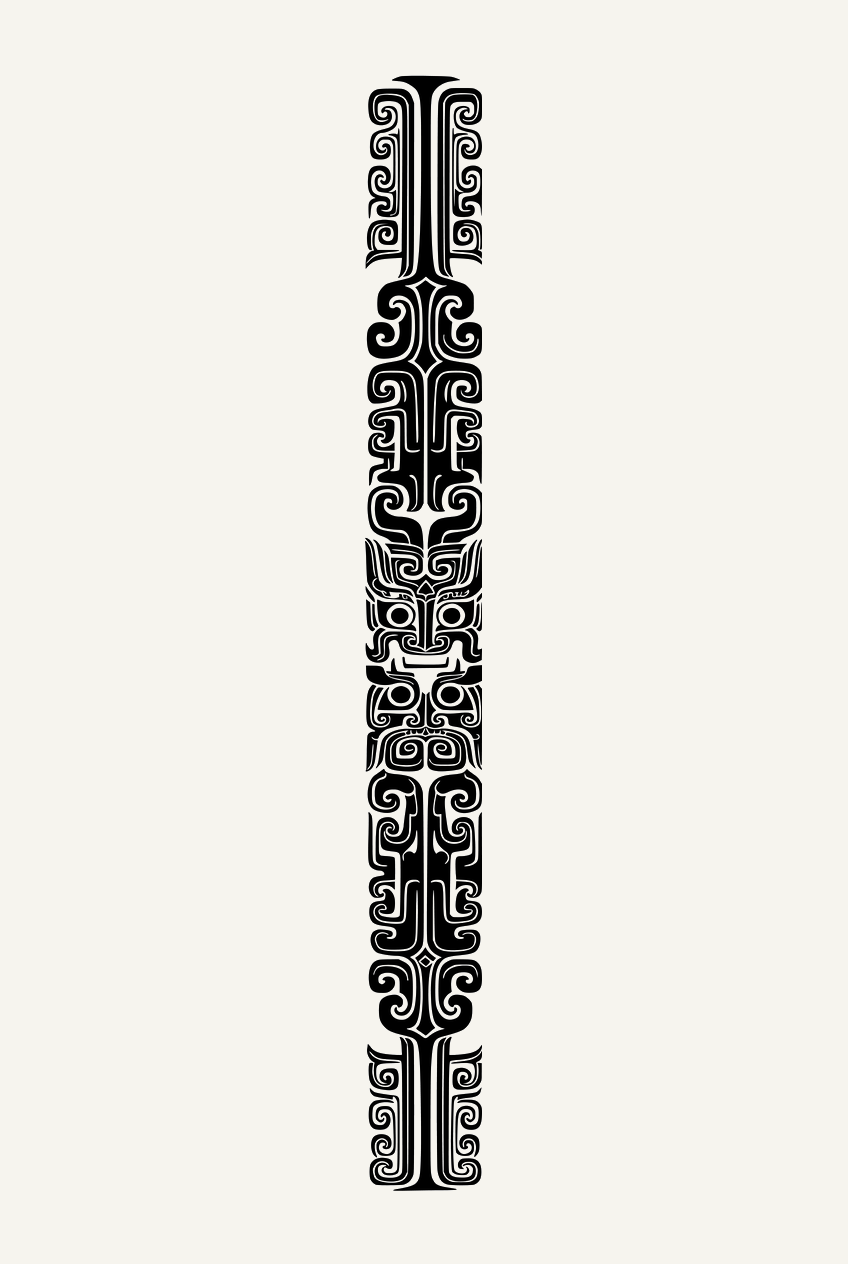
回纹带 · Huí Wén Dài
The Bronze Border
Series: Symbols & Patterns · Design #13
Style: Bronze fret-and-mask vertical band · bold black-and-white block contrast · full arm-band or leg-band wrap · scalable 14–20 cm
Form: 图案
The Name
huí wén dài — the fret promoted from border to architecture. The endless line of huiwen (回纹) was the frame on Chinese bronzes for a thousand years: it ran along the rims of ritual vessels, circled their feet, and divided their registers like the cordoning lines of a sacred building. This design keeps that vertical order — fret band, mask register, fret band — exactly as a bronze face sits framed on a ding. Worn around the arm, the frame closes on itself: a border with no end, worn as a ring.
回纹带(huí wén dài)——回纹从「边框」升格为「建筑」。那条不会断的回纹线,在中国青铜器上做了一千年的框架:沿着礼器的口沿走,绕住圈足,把纹饰分段隔开,像神圣建筑的勒线。这个设计保留的正是这种纵向秩序——回纹框、兽面段、回纹框,如同铜鼎正中的兽面被框着一样。戴在臂上,框架自己合拢:一条没有尽头的边,戴成了环。
Source & Provenance
Fret bands on Shang and Western Zhou ritual bronzes — the squared borders running along the mouths and feet of ding and gui vessels, framing the mask registers between them. The fret itself descends from the cloud-thunder spiral ground (leiwen) of the same bronzes; Song-dynasty antiquarians read the unit as the character 「回」, and the name has run ever since. Historical form reference: fret-bordered bronze vessels of the Shang-Zhou period, with their band-divided vertical registers. Inking note: this design adapts the classic line construction of the traditional motif and re-inks it as tattoo linework.
商与西周青铜礼器上的回纹边带——方折的边饰沿着鼎、簋的口沿与圈足走,把中间的兽面段框在其中。回纹本身承自同时期的云雷螺旋地纹;宋代金石学家把这个单元认作「回」字,名字沿用至今。形制参考:商周时期带回纹边饰的青铜器,及其分段式的纵向纹带布局。墨线转写:本设计以传统母题的经典线条造型为底,转写为纹身墨线。
Design Inspiration
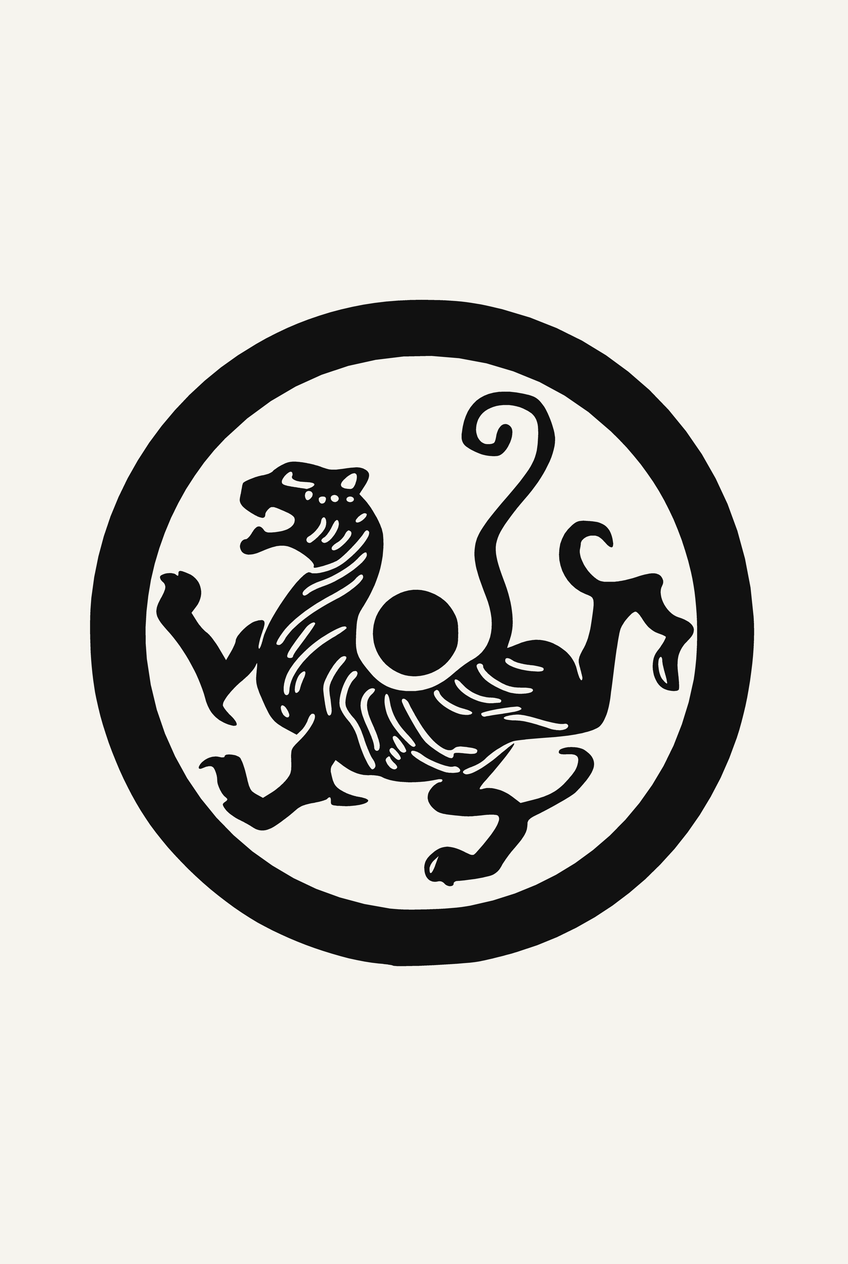
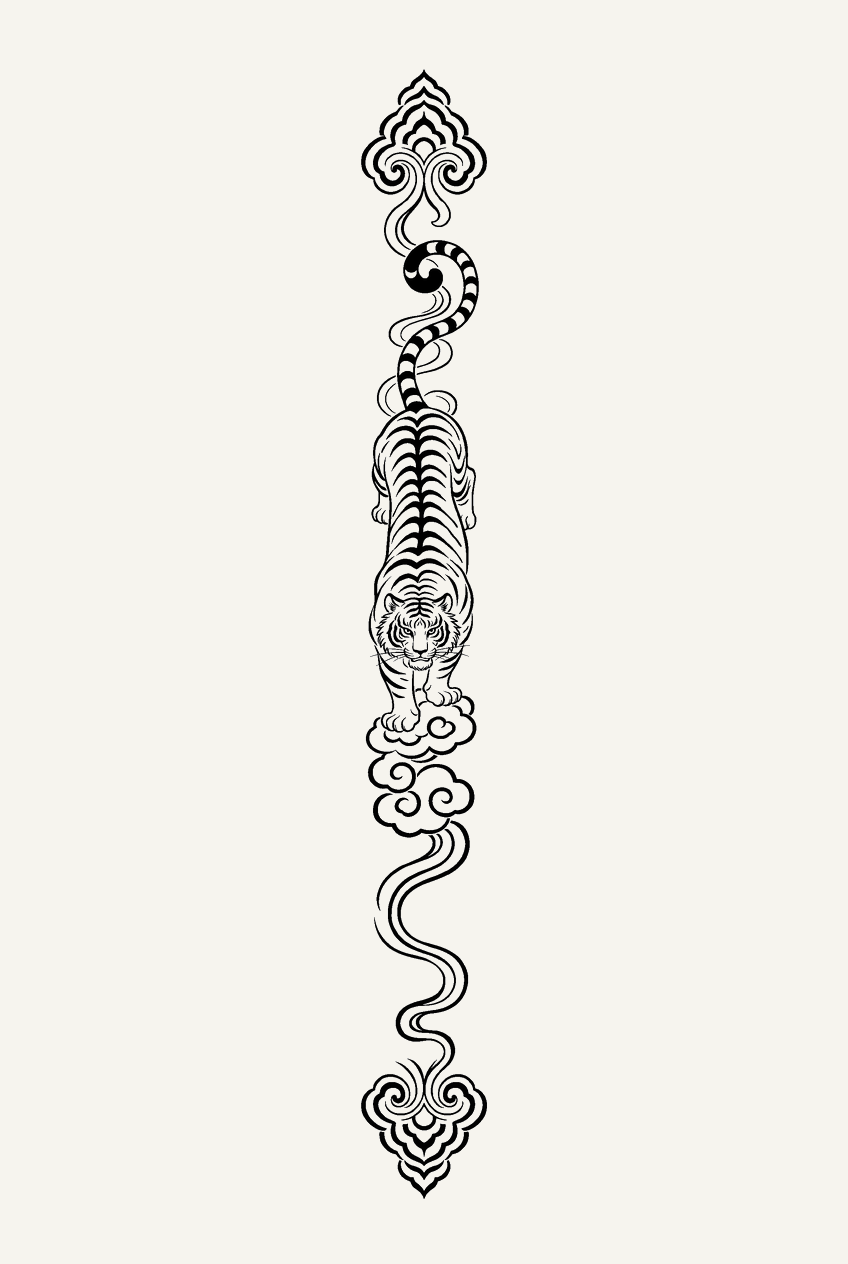
Every form decision on this design points to a recorded source, element by element. ① The vertical register order — fret frame, mask band, fret frame, the stacked composition of a bronze vessel face. ② The squared double-line fret — the nested-square unit drawn as a continuous border. ③ The mask register between frames — the beast face set into the band like a boss on a vessel wall. ④ The black-and-white block reversal — solid black ground with white fret lines alternating to white ground with black lines, the way bronze decor reads light and dark across a cast surface.
本版每一处形制决定都有出处可查,逐条对账。① 纵向分段秩序——回纹框、兽面带、回纹框,青铜器面纹的层叠构图。② 方折套线回纹——套方单元连成的连续边饰。③ 框间兽面段——兽面嵌进纹带,如铜壁上的乳突。④ 黑白块面反转——黑地白线与白地黑线交替,如同铸铜表面光影翻面的读法。
The Story
A bronze vessel is a building you can hold. Its bands are floors: thunder spirals below, fret borders above, a face at the center. For three thousand years, Chinese artisans stacked those floors the same way, and the fret was the level line that held each one. It is the most patient pattern in the collection — it does not leap like the dragon or stare like the taotie; it measures.
The band on this design is that measuring line made wearable. The fret frames at top and bottom do what bronze frames always did: they say where the sacred part begins and ends. Between them runs the mask register — the face of the vessel, compressed into a strip. Around your arm, the whole architecture closes into a loop, and the border that once framed a ding now frames you.
青铜器是一件拿在手里的建筑。它的纹带就是楼层:下面云雷,上面回纹,正中一张脸。三千年来,中国工匠用同样的方式叠这些楼层,回纹是托住每一层的水平线。它是本系列里最有耐心的纹样——不像龙那样腾跃,也不像饕餮那样瞪视;它只负责丈量。
本设计这条带,就是把那根丈量的线做成可佩戴的。上下两道回纹框,做的是青铜框一直做的事:宣告神圣的部分从哪里开始、到哪里结束。中间走的是兽面段——器物的脸,压进一条带里。绕在臂上,整座建筑合拢成环:曾经框住铜鼎的边框,现在框住你。
What It Means
Order that never ends. The fret's old blessing — wealth without a break in the line — now runs a full circle around the arm. This is the design for people who want structure that protects: a frame worn as jewelry, a boundary that reads as strength.
不会终结的秩序。回纹那句老话——富贵不断头——如今绕臂整整一圈。适合想要「守护型结构」的人:一道戴在身上的边框,一圈读作力量的边界。
Where It Sits
Built for the arm band first: the vertical registers wrap the upper arm as a full ring, 4–6 cm wide. As a leg band it reads the same at the calf. On the forearm it works as a partial band ending at the inner seam. The mask register should face outward.
首选臂环:竖向纹段绕上臂一整圈,宽 4–6 厘米。作腿环在小腿同理。前臂可作半环,收在内侧缝口。兽面段朝外。
Before You Ink
This is a wrap-around composition: ask your artist to template it on the arm and check the seam before committing — the two ends should meet inside a fret unit, never across a mask face. ② Block-black sections heal well but expand: keep the band width at 4 cm or more so the white lines survive healing. ③ Keep the mask register aligned with the muscle line; a mask that drifts off-center loses its authority. ④ Ink-only by design: the pattern lives in black-and-white contrast, not color. ⑤ High-movement zones (inner arm) blur first — schedule touch-ups earlier there.
这是环绕式构图:请纹身师先在臂上转印定位、核对缝口再落针——两端应在一个回纹单元内相接,绝不可跨过兽面。② 块面黑愈合良好但会扩张:带宽保 4 厘米以上,白线才能活过愈合期。③ 兽面段对准肌肉走向;兽面偏了轴,气势就散了。④ 只宜墨线:图案活在黑白对比里,不需要颜色。⑤ 高活动区(臂内侧)先糊——那里要提前安排补色。
Every character on this card was selected and checked stroke by stroke by a native reader of Chinese.