卷草纹 · Juǎn Cǎo Wén
The Scrolling Vine
Series: Symbols & Patterns · Design #35
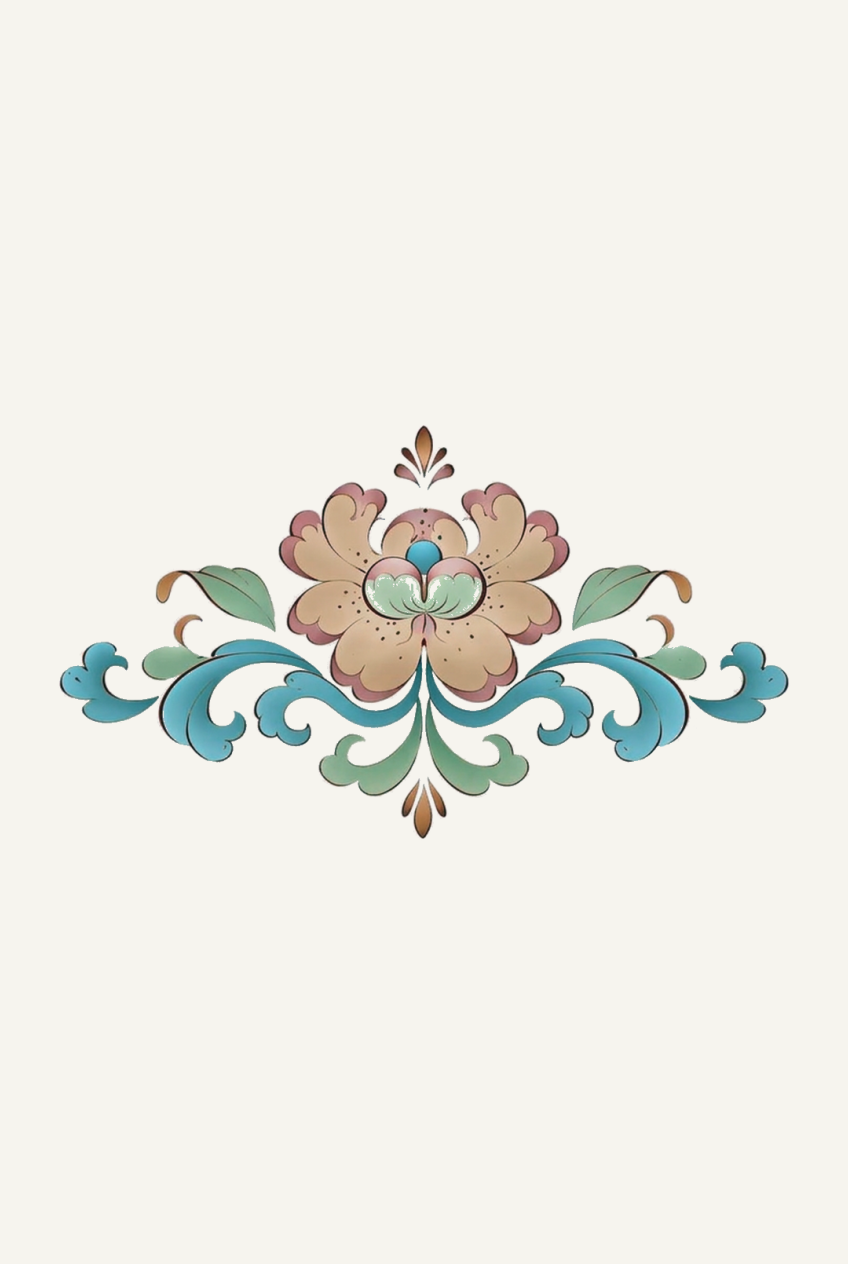
Style: A centered scrolling-vine rosette — a bloom at the heart, S-curved branches thrown to either side · ornamental fill · bilateral symmetry · scalable 10–16 cm
Form: 图案
The Name
*juǎn cǎo wén* — the "scrolling grass pattern," the vine that curls as it runs. It is the Chinese name for the same family the world calls arabesque and Japan calls 唐草. The defining gesture is in the word *juǎn*: to roll, to coil — a stem that refuses to go straight, turning each branch into a spiral before it moves on. Here that endless vine is gathered into a centered rosette rather than left to run as a border.
卷草纹(juǎn cǎo wén)——「卷」起来的草,一边走一边打卷的藤。全世界叫 arabesque、日本叫唐草的那一大家族,中文就叫卷草。要害在那个「卷」字:茎不肯走直线,每分出一枝都要先旋成一个涡,再往前去。这一张把那根无尽的藤收成了居中的团花,没让它沿着边饰跑掉。
Source & Provenance
The lineage runs west to east. Greek acanthus scrolls traveled with Buddhism through Gandhara and Central Asia, arrived in the Northern dynasties as the honeysuckle scroll (忍冬纹), and by the Tang had loosened into a fuller, freer vine — the scroll that fills Dunhuang's Tang borders and Tang silverwork. The Japanese name 唐草 (karakusa), "the vine from Tang," preserves the route in a word. Classical ornament used it two ways: as a continuous border band, and gathered into a symmetrical rosette with a bloom at the center — the form this design follows. Historical form reference: centered scrolling-vine rosettes on Tang metalwork and Dunhuang ornament. Inking note: this design adapts the classic line construction of the traditional motif and re-inks it as tattoo linework.
谱系自西徂东。希腊的莨苕卷草随佛教经犍陀罗、中亚东行,入北朝成忍冬纹,到唐代舒展成更饱满、更自在的一根藤——敦煌唐代边饰与唐代银器上,全是它。日语的「唐草」(karakusa),「来自唐的藤」,把一个词就成了路线的见证。古典装饰用它有两路:一路作连绵的边饰带,一路收成中心开花的对称团花——本图走的是后一路。形制参考:唐代金属器与敦煌装饰上的居中卷草团花。墨线转写:本设计以传统母题的经典线条造型为底,转写为纹身墨线。
Design Inspiration
Every form decision here answers to the source type. ① The central bloom — an orange-pink lotus-flower heart with a blue-green calyx: the pause where the vine gathers before it throws outward. ② The S-curved branches — blue scrolls flung left and right, each ending in a tight spiral, the acanthus curl that traveled five thousand kilometers without losing its spring. ③ The mirrored halves — the two sides answer each other across a center line; the vine is endless in principle but held here in balance. ④ The trailing leaf — a single orange-red leaf dropping from the base, giving the rosette a bottom and a sense of gravity.
这里每一处形制都有可对的谱系。① 中心花——橙粉的莲花心配青绿萼片:藤在向外抛之前,先收拢的那一处停顿。② S形卷枝——蓝色的卷枝向左右抛出,末端收成紧紧的涡,那是走了五千里也没丢掉弹性的莨苕卷。③ 镜像的两半——两侧隔着中轴互相呼应;藤原理上无尽,这里被收进了一个平衡里。④ 垂叶——底部一片橙红的叶子垂下来,给团花一个底,也有了重量。
The Story
Follow the vine for a moment. It starts as a Greek leaf, rides east with the sutras, becomes the tight honeysuckle of the northern caves, then loosens into the Tang scroll — and boards a ship for Japan, where it keeps the name 唐草 to this day. What crosses a whole continent is not a shape but an idea: growth with no seam, any point you pick is the middle.
This design takes that endless vine and folds it into a rosette. Nothing is lost — the curls are all still there, the branches still spiral — but the eye is given a center and a pause. On skin that matters: a border wants to wrap a limb, while a rosette wants to sit still and be read from the front.
The meaning travels with it. Continuity without a break; a life that keeps putting out new growth from the same stem. Held in symmetry, it becomes a quiet emblem for things you intend to keep going — not tied, not closed, just continuing.
跟着这根藤走一段。它起点是一片希腊叶子,随经卷东行,变成北朝石窟里紧实的忍冬,再舒展成唐代的卷草——然后登船去日本,至今还叫「唐草」。跨过整块大陆的不是某个形状,是一个观念:没有接缝的生长,你随手点中的任何一点都是中段。
这一张把那根无尽的藤折成了团花。什么都没丢——卷还在,枝还在旋——只是眼睛有了一个中心、一处停顿。这在皮肤上有讲究:边饰想缠住肢体,团花却想静静坐着、从正面被读。
寓意跟着一起过来了:不断头的延续,同一根茎上一直发新枝。收进对称里,它成了给「打算继续下去的事」的一个安静记号——不系紧,不闭合,只是继续。
What It Means
Unbroken continuity, held in balance. The one motif in the collection that literally has no starting point; here gathered around a bloom so the eye has somewhere to rest. Wear it for things you mean to keep growing.
不断头的延续,收在平衡里。全系列里唯一字面上没有起点的纹样;这里被收拢到一朵花周围,好让眼睛有处歇脚。给那些你打算让它一直长下去的事。
Where It Sits
A centered rosette wants a flat, readable field: upper arm or thigh at 10–13 cm, shoulder blade or center of the back at 13–16 cm, and the center of the chest at 10–12 cm. Let the two halves sit across the midline; the trailing leaf gives you a natural "bottom" to orient by.
居中的团花需要平整、看得全的地方:上臂或大腿 10–13 厘米,肩胛或后背正中 13–16 厘米,胸口正中 10–12 厘米。让两半跨在中线两侧;底部垂叶正好给你一个天然的「朝下」参照。
Before You Ink
Keep the vine connected. The curls must read as one stem feeding every branch; a "convenient" break kills the continuity. ② Color is optional, line is not. The reference fills orange-pink, blue-green and blue; the transfer linework alone carries the scroll, and many keep it ink-only. ③ Respect the scale. Minimum 10 cm — below that the spirals weld and the vine clogs. ④ Choose a flat plane. The symmetry wants a stable surface; avoid elbows, kneecaps and the sides of the torso.
让藤连着。 每一卷都要读作同一根茎喂出来的;为排版方便「断一刀」,continuity 就没了。② 颜色可选,线不可省。 参考图填橙粉、青绿与蓝;转印线稿本身就撑得住卷草,很多人只留墨线。③ 留够尺寸。 最小 10 厘米——再小旋涡焊死,藤就堵了。④ 选平面。 对称要一块稳定的面;避开关节、膝盖与躯干两侧。
Every character on this card was selected and checked stroke by stroke by a native reader of Chinese.