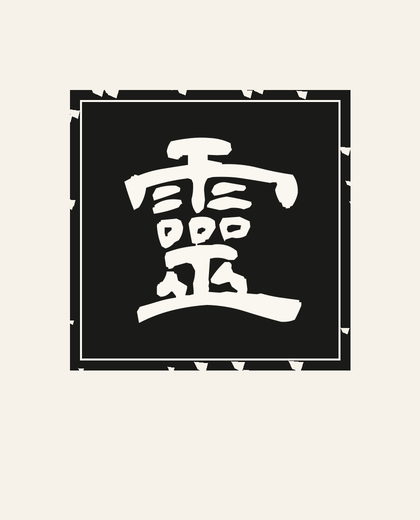
灵 · Líng
Spirit / Spiritual
Series: Single-Character Zen · Design #58
Style: Single character · Han-seal filled-white (bǎiwén) stamp — black ground, reversed white glyph, weathered border · clerical script (lishu), traditional form 靈 · medium scale
Form: 文字
The Name
*Líng* — spirit, the numinous, the quick intelligence of something alive. The traditional form 靈 stacks three elements: 雨 (rain) above, three 口 (mouths) in the middle, 巫 (shaman) below — rain, voices, and the person who mediates between them. It is one of the densest, most layered characters in the language, and it has kept its religious charge for three thousand years.
灵(繁 靈,líng)——灵、灵性,活物身上那点通达的聪明。繁体「靈」叠了三层:上面雨、中间三个口、下面巫——雨、众声、以及替人沟通两者的那个人。它是汉字里笔画最密、层次最多的字之一,三千年来一直带着宗教的电。
Source & Provenance
Etymology and text: *Shuōwén Jiězì* (Eastern Han): 靈,巫也。以玉事神 — "ling is the shaman; one who serves the spirits with jade." The traditional graph combines 雨 (rain), three 口, and 巫 — the shaman calling for rain, the voice that reaches the unseen. The simplified 灵 (彐 + 火) is a later, unrelated contraction; this design uses the traditional form 靈 to keep the original structure. The word runs through the *Chǔ Cí* (Songs of Chu) — 灵均, the "balanced spirit," is Qu Yuan's courtesy name — and into the ordinary Chinese word for a soul or a clever person. No third-party source image was used for this design. Inking note: this design adapts the classic line construction of the traditional motif and re-inks it as tattoo linework.
字源与出处:《说文解字》(东汉):靈,巫也,以玉事神。繁形由雨、三口、巫合成——巫祈雨,是那道通到看不见之处的声音。简体「灵」(彐+火)是后世另一路的省写;本设计采用繁形「靈」,保留原本的结构。这个词贯穿《楚辞》——「灵均」是屈原的字——一直到今天指灵魂、指聪明人的日常用法里。本设计未使用任何第三方源图像。墨线转写:本设计以传统母题的经典线条造型为底,转写为纹身墨线。
Design Inspiration
Every form decision points to a recorded source, element by element. ① The filled-white seal — the numinous cut out of the dark, the three stacked layers left standing in white. ② Clerical script, traditional form 靈 — the Han-stone register, and the full traditional structure; the seal script would hide the three mouths and the shaman, so the older graph would lose its story. ③ The three 口 kept as three — in white-negative these mouths must not merge into a bar, or the "voices" disappear. ④ Weathered border — a shaman's mark, hand-set and imperfect.
本设计每一处形制决定都有出处可查,逐条对账。① 满白文印——灵从暗里被刻出来,叠着的三层以白色立着。② 隶书、繁形「靈」——汉石经的语域,保留完整繁体结构;换成篆体会把三个口和巫藏起来,老字形就丢了它的故事。③ 三个口保持为三——白文印里绝不能并成一横,否则"众声"就没了。④ 残边——巫者的记号,手工盖出、不完美。
The Story
Open up 靈 and you find a whole scene from early Chinese religion: rain above, three mouths calling, and the shaman below who stands between the people and what they cannot see. The character's original job was to name a person — the one who serves the spirits with jade. Over centuries the word travelled from that person to the quality they had: *ling*, spiritual, numinous, alive with a kind of intelligence that is not merely cleverness.
That is why the word can describe both a ghost and a quick mind. In Chinese, the same *ling* is in 灵魂 (soul), 灵感 (inspiration), 灵巧 (deft), and 机灵 (sharp). Spirit and skill share a root because both are the mark of something that responds — to a presence, to a moment, to a problem.
The *Chǔ Cí* gave the word one of its most enduring human uses: Qu Yuan called himself 灵均, the balanced spirit, and wrote of a shaman travelling through the sky. The religious image and the personal one have never fully separated since.
To wear 靈 is to claim the older, layered thing: not "I am spiritual" as decoration, but an affinity with the quick, responsive intelligence the character has carried from rain-ritual to everyday speech.
把「靈」拆开,是一幅中国早期宗教的完整场景:上面是雨,中间三张嘴在呼喊,下面是站在人与不可见之物之间的巫。这个字最初的工作是指一个人——以玉事神的那位。几百年里,这个词从那个人走到了他身上的品质:灵,灵性,通灵,带着一种不只是聪明的聪明。
所以这个词既能形容鬼魂,也能形容敏捷的心。中文里,灵魂、灵感、灵巧、机灵,共用同一个「灵」。灵性与技艺同根,因为两者都是"会回应"的记号——回应一个存在、一个瞬间、一道难题。
《楚辞》给了这个词最持久的人格用法之一:屈原字灵均,写下巫者飞天行旅的句子。从此宗教的图像和个人的气质再没完全分开过。
纹「靈」,是认领那个更古老、更多层的东西:不是把"我很灵性"当装饰,而是认同一个从祈雨仪式一路带进日常语言里的、通达而会回应的聪明。
What It Means
Spirit as responsiveness — the numinous intelligence the character carries from shaman-rain to inspiration and quickness of mind. For people who think of themselves as sensitive to things others miss, and who would rather keep the full traditional form than a simplified shortcut.
灵是"会回应"——这个字从祈雨的巫一路带着的那点数灵感通,到灵感,到心灵的敏捷。给那些对自己能察觉别人察觉不到的东西有认同、并且宁可保留完整繁形而不要简化捷径的人。
Where It Sits
This is the densest character in the set — it needs room. Upper back or outer forearm at 7–10 cm; shoulder blade at 8–10 cm. At 5–6 cm on the back of the neck the three mouths begin to close — keep it larger if you want the structure legible. Below 5 cm is not recommended for 靈.
这是本批最密的字,需要空间。上背或小臂外侧 7–10 厘米;肩胛 8–10 厘米。放在后颈 5–6 厘米时三个口开始合拢——想让结构读得出就放大。低于 5 厘米不建议纹「靈」。
Before You Ink
Traditional form 靈, not simplified 灵. The simplified form loses the rain, the three mouths and the shaman — the whole etymology. ② Negative-form seal — white-ground black-line transfer sheet. ③ The three 口 must stay three separate openings. ④ No freehand — this is the easiest character in the set to ruin with one crowded stroke. ⑤ Ink only; minimum 7 cm recommended. ⑥ One script only — clerical version; do not substitute a seal-script 靈.
繁形「靈」,不是简体「灵」。 简体丢掉了雨、三口和巫——整个字源都没了。② 负形印——用白底黑线转印页。③ 三个口必须保持为三个开口。 ④ 切勿徒手——这是本批里最容易一笔挤坏的字。⑤ 只用墨;建议最小 7 厘米。 ⑥ 只纹一体——本款隶书,勿以篆书「靈」替代。
Every character on this card was selected and checked stroke by stroke by a native reader of Chinese.



