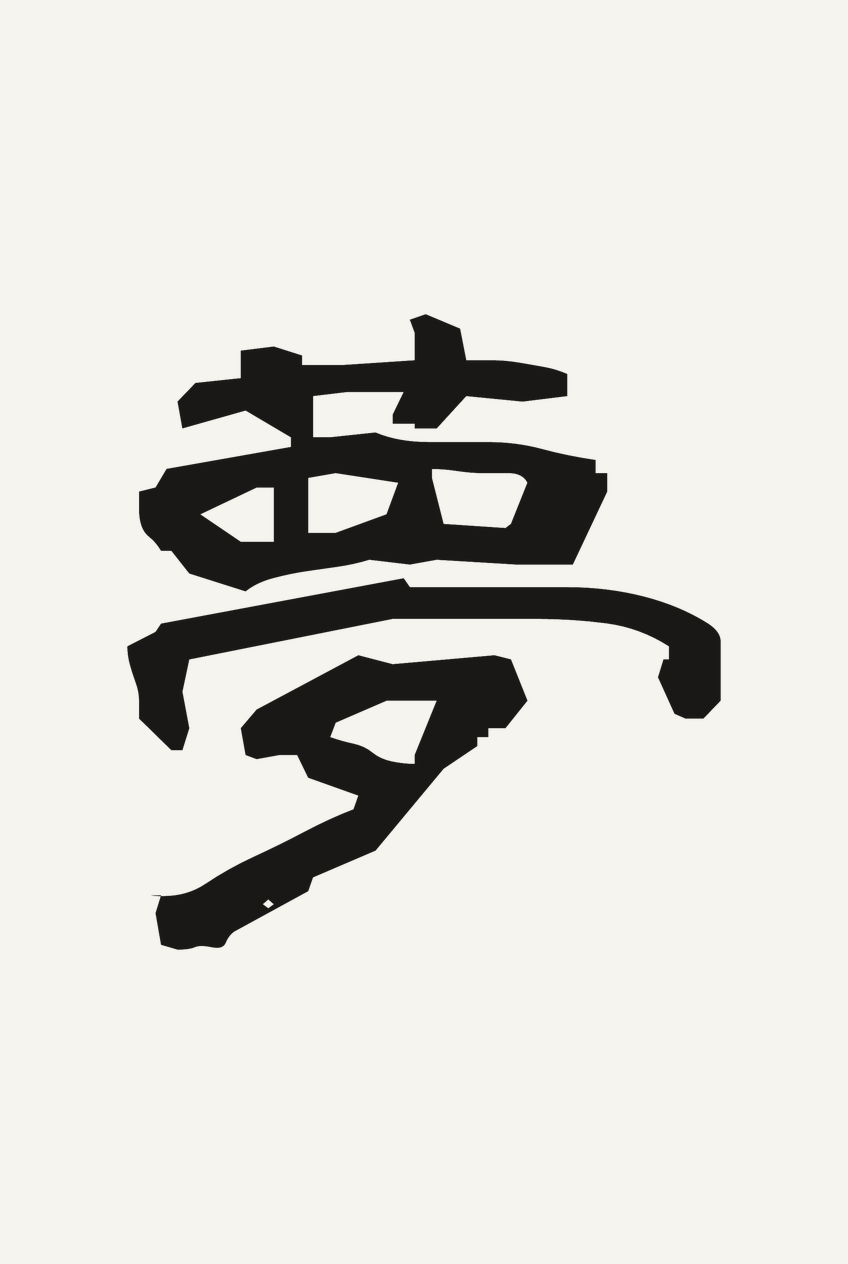
梦 · Mèng
Dream
Series: Single-Character Zen · Design #13
Style: single character, large · clerical script (lishu) · traditional form 夢 · small-to-medium
Form: 文字
The Name
*Mèng* — dream. The traditional glyph is a thicket: grass, eyes, twilight — a person seeing through dusk growth, the original dream-sight of dusk fields. China gave the world the deepest dream story it has: Zhuangzi woke from being a butterfly and could not verify which direction the error ran. As a tattoo, 梦 does not promise the dream comes true; it promises you keep both eyes open in the dusk — dreaming and doubting, beautifully, on purpose.
梦——繁体的字形是一片草丛:草、眼、暮——一个人透过黄昏的草木看出去,那是暮野里最初的梦视。中国给了世界最深的一个梦的故事:庄子从化蝶中醒来,无法验证错误朝哪个方向跑。纹下「夢」,它不承诺梦会成真;它承诺你在暮色里睁着双眼——一边做梦,一边怀疑,而且是有意为之的、漂亮的。
Source & Provenance
Zhuangzi's butterfly (*Qiwulun*): 莊周夢為蝴蝶…俄然覺,則蘧蘧然周也 — "Zhuangzi dreamed he was a butterfly… suddenly he woke, and there he was, solid Zhuangzi again. He did not know if he was a man who had dreamed of being a butterfly, or a butterfly now dreaming of being a man." The *Daozang* dream diviners and the Tang novelists built on it; the character 夢 in the grass-and-twilight glyph predates all of them. Inking note: this design adapts the classic line construction of the traditional motif and re-inks it as tattoo linework.
《庄子·齐物论》:「莊周夢為蝴蝶……俄然覺,則蘧蘧然周也。不知周之夢為蝴蝶與,蝴蝶之夢為周與?」唐人小说与道藏的占梦家在这上面盖楼;而草暮结构的「夢」字比他们所有人都老。墨线转写:本设计以传统母题的经典线条造型为底,转写为纹身墨线。
Design Inspiration
Every form decision points to a recorded source, element by element. ① One character, alone, large — a dream is self-contained; the single hanging character is its native frame. ② Clerical script, traditional form 夢 — the twilight thicket stays legible in lishu's strokes: grass, eye, dusk, compressed. ③ Small-to-medium scale — 8 cm wrist; 12 cm forearm. ④ Black ink only — dreams render in grayscale; ask anyone who has had one.
本设计的每一处形制决定都有出处可查,逐条对账。① 一字、独处、够大——梦自成一体;单字悬挂是它的原生画框。② 隶书、繁形「夢」——暮色草丛在隶书笔画里保持可读:草、眼、黄昏,压缩在一体。③ 小到中尺寸——腕上 8 厘米;小臂 12 厘米。④ 只用墨——梦是灰度渲染的;做过的人都知道。
The Story
Zhuangzi's butterfly is two minutes long and undefeated after twenty-three centuries. He wakes, he is Zhuangzi, fine. And then the ground gives way: the boundary between dream and waking is undecidable from inside either one. Most philosophers panic here and build walls — prove the turtle, prove the evil demon, prove the brain in the vat. Zhuangzi does the opposite: he laughs, and calls it 物化 — the transformation of things. The walls were the mistake. You were never a resident; you were weather in one system of weather.
The Chinese tradition did not pathologize the dream after him; it employed it. The Yellow Emperor toured his kingdom in dream; the Tang scholar dreamed his whole lifetime in a pillow-second and woke at the millet cart — the Handan dream — and learned what a life weighs. 梦 in this lineage is not escapism; it is the epistemology department. Worn on the skin, the character keeps Zhuangzi's smile: hold your dreams the way he held the butterfly — seriously, lightly, both at once.
庄子的蝴蝶只有两分钟,两千三百年了还没被打败。他醒来,他是庄周,很好。然后地面塌了:梦与醒的边界,从任何一边内部都无法裁定。多数哲学家在这里恐慌并开始筑墙——证明那只龟,证明那个恶魔,证明缸中的脑。庄子反着做:他笑了,并且管这叫物化。墙才是错的那一步。你从来不是住户;你是天气系统里的一段天气。
庄子之后的中文传统没有把梦病理化;它把梦聘用了。黄帝在梦里巡游了他的国土;唐代书生在枕上一秒里过了一整生,醒来时黄粱还没蒸熟——邯郸梦——并知道了一个人生的重量。这个谱系里的「夢」不是逃避主义;它是认识论系。戴在皮肤上,这个字保持着庄子的笑意:像他捧着那只蝴蝶一样捧着你的梦——认真地、轻轻地,同时。
What It Means
For the dreamers who also read footnotes: artists, founders, night students, emigrants. It is not a wish banner; it is a wager with a smile — dream at full volume, verify at full honesty, and enjoy the impossibility of telling which state is funding which.
给同时读脚注的做梦人:创作者、创业者、夜校学生、移民。它不是许愿条幅;它是带着笑意的赌约——用最大音量做梦,用最大诚实求证,并且欣赏「哪一个状态在给另一个供资」这件事的不可判定。
Where It Sits
One character, one plane: the inner wrist, the nape, the shoulder blade. 6–8 cm reads as a private dusk; 10–12 cm, a posted twilight. The shoulder blade suits the glyph's thicket — something growing on the back, seen only by others.
一个字,一个平面:腕内侧、后颈、肩胛。6–8 厘米读作私人的黄昏;10–12 厘米读作张贴的暮色。肩胛最合这个字的草丛——长在背上的东西,只有别人看得见。
Before You Ink
One character is the whole design. ② Traditional form 夢. The grass-eye-twilight thicket is the character's landscape; the simplified 梦 loses the field. ③ Clerical script stays level but soft. ④ Minimum 5 cm. ⑤ It is a double entry. 梦 books two things at once: the dream and its undecidability. If you want only the aspiration and none of the Zhuangzi, other characters exist — this one always comes with the butterfly.
一个字就是全部设计。 ② 繁形「夢」。 草-眼-暮的草丛是这个字的风景;简体「梦」丢了那片田野。③ 隶书保持平、但柔。 ④ 5 厘米起。 ⑤ 它是复式记账。 「夢」同时记两笔:梦,以及梦的不可判定。如果你只要「励志」不要庄子,别处有别的字——这个字永远自带那只蝴蝶。
Every character on this card was selected and checked stroke by stroke by a native reader of Chinese.



