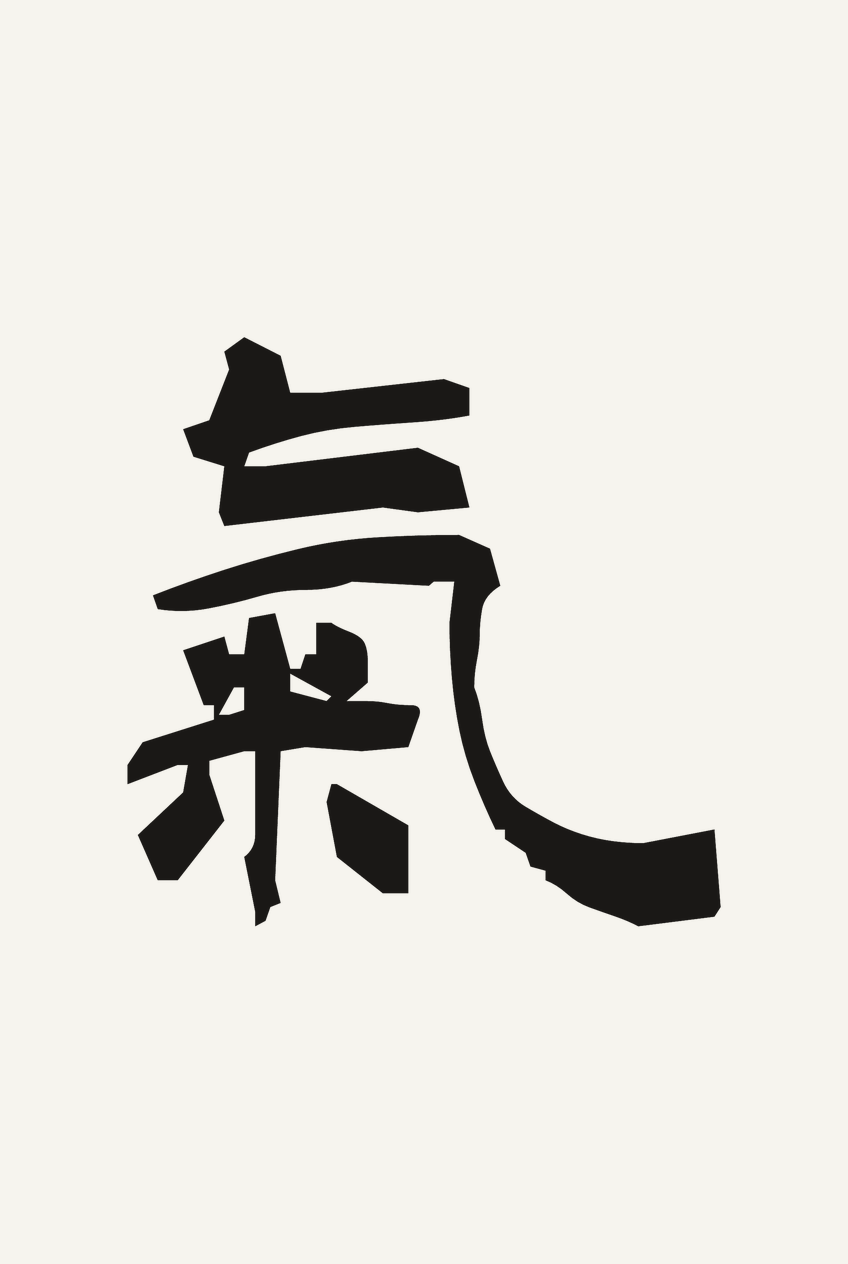
气 · Qì
Vital Energy
Series: Single-Character Zen · Design #10
Style: single character, large · clerical script (lishu) · traditional form 氣 · small-to-medium
Form: 文字
The Name
*Qì* — breath, energy, the moving stuff of everything. The traditional form 氣 shows rice (米) inside a vapor: grain becoming blood becoming motion — food, air, and spirit as one continuous supply line. No Chinese concept is more known abroad and less translatable: tai chi, qigong, feng shui all run on it. As a tattoo, it names the current, not the static: the word is about what flows through you, not what you own.
气——呼吸、能量、万物流动的那点东西。繁体「氣」是一缕气裹着「米」:谷化血、血化力——食物、空气与精神是同一条补给线。没有哪个中文概念在海外更有名、又更难译:太极、气功、风水都靠它运转。纹下它,命名的是电流而非电器:这个字讲的是流经你的,不是你拥有的。
Source & Provenance
Zhuangzi: 通天下一氣耳 — "all under heaven is one breath" (*Zhi Bei You*). Mencius gave it a moral capacity: 浩然之氣 — "the vast, flooding breath" that righteousness feeds and wrongdoing starves (2A2). The physicians of the *Huangdi Neijing* made it clinical: qi is what moves when you are alive and stops when you are not. Inking note: this design adapts the classic line construction of the traditional motif and re-inks it as tattoo linework.
《庄子·知北游》:「通天下一氣耳。」《孟子》给了它道德容量:「浩然之氣」——义养它,恶饿它(《公孙丑上》)。《黄帝内经》的医家把它临床化:气,活着的时候在走,停了就不在。墨线转写:本设计以传统母题的经典线条造型为底,转写为纹身墨线。
Design Inspiration
Every form decision points to a recorded source, element by element. ① One character, alone, large — 氣's vapor-and-grain architecture is self-sufficient; the hanging single-character format suits a word about presence. ② Clerical script, traditional form 氣 — the rice inside the vapor stays legible in lishu's weighted strokes: sustenance you can see. ③ Small-to-medium scale — 8 cm wrist; 12 cm forearm. ④ Black ink only — the design holds one continuous breath from top to bottom.
本设计的每一处形制决定都有出处可查,逐条对账。① 一字、独处、够大——「氣」气裹谷的建筑自成一体;单字悬挂的格式配一个讲「在场」的词。② 隶书、繁形「氣」——气里的米在隶书承重的笔画里保持可读:看得见的给养。③ 小到中尺寸——腕上 8 厘米;小臂 12 厘米。④ 只用墨——整个设计自上而下是一口连续的气。
The Story
Mencius was asked what his greatest skill was. Not argument, he said — though he never lost one. His skill was 善養吾浩然之氣: "I am good at nourishing my vast, flooding breath." Pressed for a definition, he refused three times — it is not born once and done; it is fed daily by right actions and starved by each deception, too vast to be grasped and too real to doubt. The honest translation is regimen, not possession: qi as a practice you tend, like a fire that is never yours, only lit.
The physicians mapped the supply line. Breath from air, grain from food, essence from parents — three currents converging in the chest, distributed by the pulse, spent by every thought. The doctors' prescription is the philosophers' in scrubs: sleep, walk, eat on schedule, stop the leaks — rage leaks, grief leaks, midnight screens leak. 氣 on the skin is the regimen's sigil: the reminder that the supply is continuous but not guaranteed, and the tending is the whole of the art.
有人问孟子最大的本事是什么。不是辩论——尽管他从没输过。他的本事是「善養吾浩然之氣」。被追问定义,他三次拒绝——它不是一次生成、终身保有;它每天由正当的行为喂养,被每一次欺瞒饿着,大到无法把握,又实到无法怀疑。诚实的翻译不是「拥有」,是「养护」:气是需要照料的一炉火——它从来不属于你,只是被点着了。
医家画出了补给线。气从空气来,谷气从食物来,精气从父母来——三股流在胸口汇合,由脉搏分发,被每一个念头花费。医嘱就是穿上白大褂的哲学:睡足,走路,按点吃饭,堵住漏口——怒在漏,悲在漏,深夜的屏幕在漏。皮肤上的「氣」是这套养护的符记:补给是连续的,但没有保证;照料,就是这门手艺的全部。
What It Means
For the depleted and the rebuilding — and for anyone who trains: dancers, lifters, runners, meditators. It marks the current, not the possession. The daily question the tattoo asks is not "how much do you have" but "what fed it, what leaked it, today."
给耗竭中的与重建中的——也给所有训练的人:舞者、力量举者、跑者、冥想者。它标记的是电流,不是电池。这个纹身每天问的不是「你有多少」,而是「今天,什么喂了它,什么漏了它」。
Where It Sits
One character, one plane: the inner wrist (pulse's address — the design's most literal site), the nape, the sternum. 6–8 cm reads as a private sigil; 10–12 cm, a stated regimen.
一个字,一个平面:腕内侧(脉搏的住址——这个设计最字面的位置)、后颈、胸骨。6–8 厘米读作私人的符记;10–12 厘米读作公开的养护条目。
Before You Ink
One character is the whole design. ② Traditional form 氣. The rice inside the vapor is the character's meal — the simplified 气 loses the grain and with it the argument. ③ Clerical script stays weighted but breathing — the strokes must move, not freeze. ④ Minimum 5 cm. ⑤ It is a maintenance mark. 氣 tattoos the tending, not the having. If nothing in your schedule feeds it — sleep, work, love — the character becomes inventory rather than current. Feed it.
一个字就是全部设计。 ② 繁形「氣」。 气里的米是这个字的饭——简体「气」丢了谷,也丢了论点。③ 隶书保持承重但要有呼吸感——笔画要动,不要冻。④ 5 厘米起。 ⑤ 这是一枚养护标记。 气纹的是「照料」,不是「持有」。如果你的日程里没有任何喂养它的东西——睡眠、工作、爱——这个字就从电流变成库存。喂它。
Every character on this card was selected and checked stroke by stroke by a native reader of Chinese.



