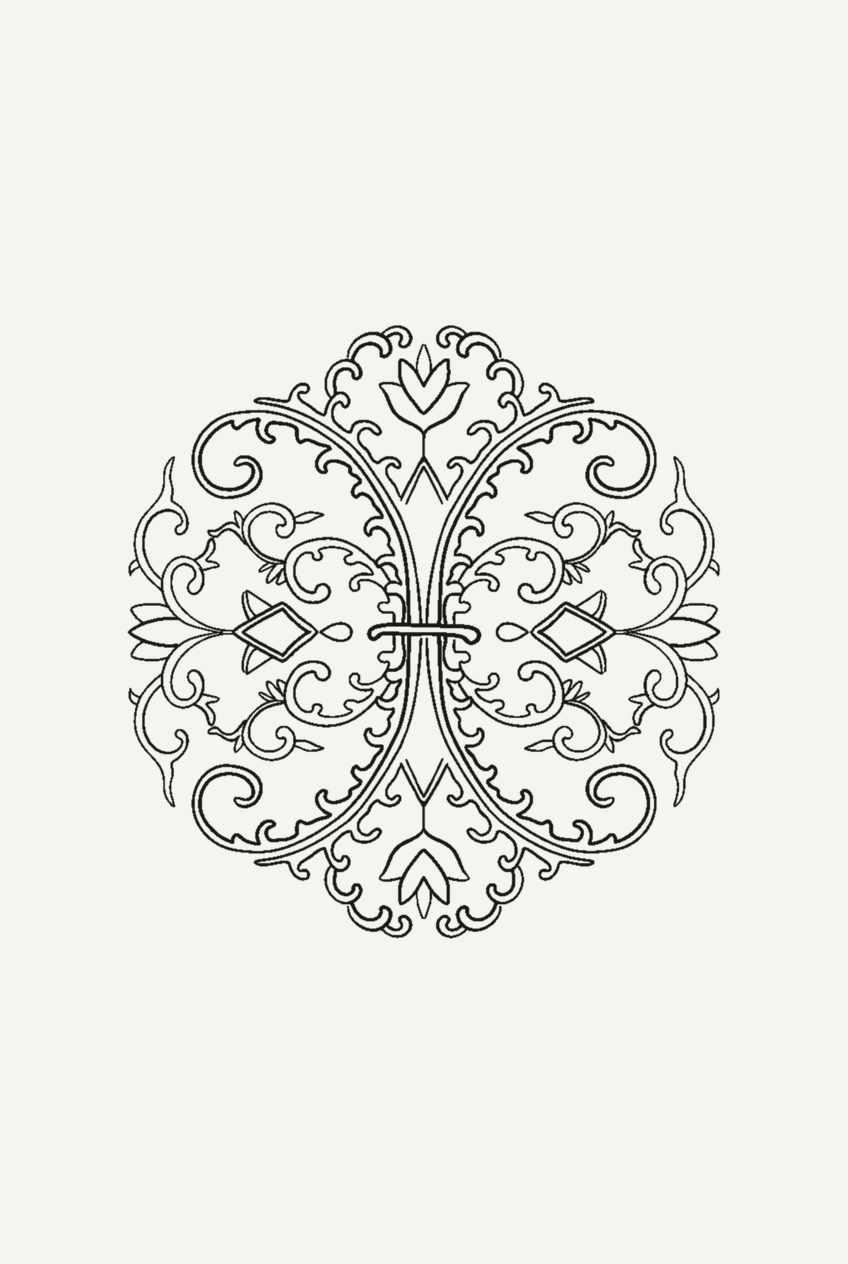
忍冬纹 · Rěn Dōng Wén
The Vine That Outlasts Winter
Series: Symbols & Patterns · Design #08
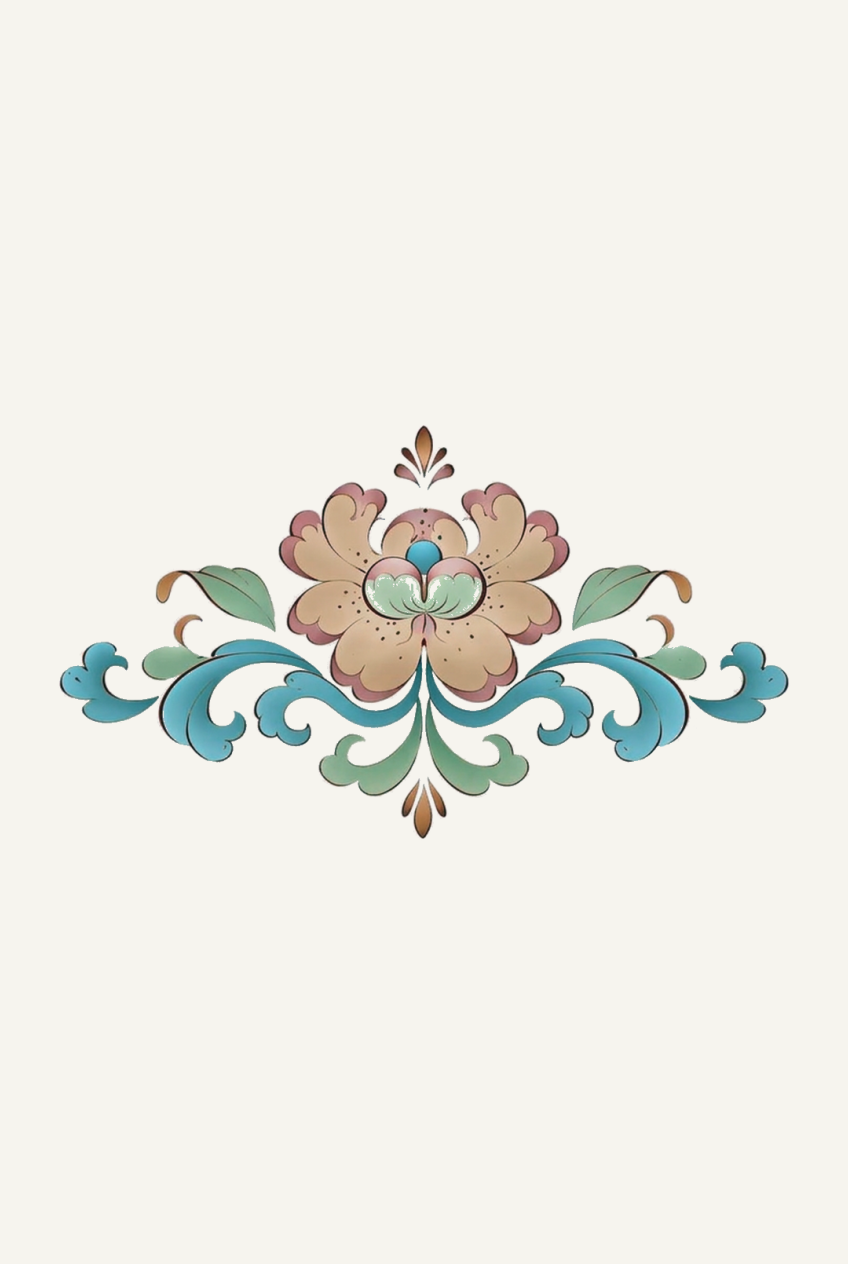
Style: A symmetric honeysuckle roundel: two S-curved vines with serrated leaves rising from a central knot, tulip buds at top and bottom, lozenge medallions at the sides · fine-line · scalable 8–14 cm
Form: 图案
The Name
*rěn dōng wén* — and the name is a biography. 忍冬, "enduring winter": the honeysuckle, a vine that keeps its leaves when nothing else bothers. When the pattern reached China with Buddhism in the Northern dynasties, the translators reached for precisely this vine to carry it — a foreign god's border-ornament, grafted onto a native plant whose whole identity is refusing to die back. The name did the theology before the priest could.
忍冬纹(rěn dōng wén)——这个名字本身就是一篇传记。忍冬:忍过冬天——就是金银花,万物都懒得管的时候它还挂着叶子的那根藤。南北朝,这纹样随佛教抵达中国,译者们恰好选中了这根藤来承载它——一位外来神明的边饰,嫁接到一种以「拒绝枯萎」为全部身份认同的本土植物上。神学还没来得及讲,名字先讲完了。
Source & Provenance
The honeysuckle scroll traveled the full length of the Silk Road: Greek acanthus → Gandharan Buddhist borderwork → Central Asia → the cave temples of China's Northern dynasties (4th–6th century), where it rings ceilings, niches and edges — the most international pattern of the age, at home in Yungang and Dunhuang alike. Its Chinese name nods to the plant's habit of holding its leaves through frost. By the Tang it relaxed into the scrolling vine (卷草), its direct descendant still called 唐草. Historical form reference: honeysuckle scrolls on Northern-dynasties cave temple decoration. Inking note: this design adapts the classic line construction of the traditional motif and re-inks it as tattoo linework.
这根忍冬卷草走完了丝绸之路全程:希腊莨苕 → 犍陀罗佛教边饰 → 中亚 → 中国北朝石窟(4—6 世纪),在那里环绕窟顶、龛楣与边框——那个时代最「国际化」的纹样,云冈与敦煌同样常见。它的中文名致敬这种植物凌霜不凋的习性。入唐后它舒展为卷草纹,其直系后代至今仍叫「唐草」。形制参考:北朝石窟装饰中的忍冬卷草。墨线转写:本设计以传统母题的经典线条造型为底,转写为纹身墨线。
Design Inspiration
Every form decision on this design points to a recorded source, element by element. ① The symmetric roundel — the mirror-form of the paired-scroll composition favored on Northern-dynasties borders. ② The serrated leaf edges — the honeysuckle leaf's honest tooth, kept where softer descendants smoothed it away. ③ The tulip-like buds at top and bottom — the honeysuckle bud-form that anchors the classic scroll. ④ The central knot and side lozenges — the weaver's geometry: knot and lozenge are how the scroll was tied off and framed in textile borders.
本版每一处形制决定都有出处可查,逐条对账。① 对称团窠——北朝边饰偏爱的对卷镜像构图。② 锯齿叶缘——忍冬叶诚实的齿,后来更柔的子孙都把它磨平了,本版保留。③ 上下郁金蕾——经典卷草赖以定锚的忍冬蕾形。④ 中央绶带结与两侧菱珠——织者的几何:结与菱,正是织物边饰上卷草被收束与装框的方式。
The Story
Here is what the textbooks skip: the honeysuckle scroll is the most well-traveled pattern on this site. Born as a Greek leaf, converted in Gandhara, carried by monks through deserts, it arrived in China in the worst centuries to arrive — the Northern and Southern dynasties, when north and south had spent two hundred years demonstrating what happens when the center fails. Refugees, burned cities, short reigns. And into this walked a foreign religion with a border pattern made of a vine that does not die in winter.
The Chinese took one look and understood the assignment. The plant was native; the symbolism was free; the fit was exact. A pattern of survival, arriving in an age that needed survival — no translation required, only a name, and the name wrote itself: 忍冬, endure-winter. Cave painters ran it around ceilings at Yungang and Dunhuang; it framed Buddhas, marked niches, edged the border between the painted world and the rock. For two hundred years it was the sound of steadiness in an unsteady world.
Then, having done its work, it did the most Chinese thing possible: it softened. The Tang loosened the vine, widened the leaf, and the honeysuckle scroll grew into the scrolling vine — tang cao, the "Tang grass," which sailed to Japan and never left. Every endless vine you meet in East Asia is this vine's grandchild. But the grandchild's promise is abundance; the grandmother's promise was harder and better: winter happens — and you are still here. Wear the vine that stayed green on principle.
说一段课本跳过的历史:忍冬卷草是本站最「走过路」的纹样。生为一片希腊叶子,在犍陀罗皈依佛教,被僧侣携着穿过沙漠,抵达中国时赶上的是最坏的年月——南北朝,北与南花了近两百年演示「中央失灵」会发生什么。流民、焚城、短命的年号。就在这时走进来一个外来宗教,带着一种由「冬天冻不死的藤」编成的边饰。
中国人看了一眼,就懂了这道题。植物是本土的;象征是现成的;贴合是严丝合缝的。一个关于「活下去」的纹样,抵达一个需要活下去的时代——不需要翻译,只需要一个名字,而名字自己写好了:忍冬——忍过冬天。石窟画师在云冈与敦煌让它绕着窟顶跑;它框住佛像,标记龛位,镶在「画出来的世界」与岩壁的交界。两百年里,它是一个摇晃世界里「稳」的声音。
然后,功成之后,它做了最中国的一件事:变柔。唐代把藤放松、把叶放宽,忍冬卷草长成了卷草纹——唐草,随后渡海去了日本,再没离开。你在东亚遇到的每一根无终之藤,都是这根藤的孙辈。但孙辈的承诺是丰盛;祖母辈的承诺更硬、也更好:冬天会来——而你还在。纹这根凭原则常青的藤。
What It Means
Endurance as identity: the leaf that holds through frost, not by luck but by constitution. For survivors — of winters literal and figurative — and for anyone whose quiet defining trait is simply not giving up.
以坚韧为身份:靠的不是运气,是构造——凌霜而不落的叶。给幸存者——字面意义的与比喻意义的冬天的幸存者——也给一切以「不放弃」为安静底色的人。
Where It Sits
The roundel reads best in a framed spot: 8–10 cm on the inner forearm, the upper back between the shoulder blades, or the chest over the heart; a compact 6 cm sits behind the shoulder. Symmetric by design — center it on the body's axis and let the mirror do its work.
团窠适合有「框」的位置:8–10 厘米置小臂内侧、两肩胛之间的上背,或心口;紧凑的 6 厘米收在肩后。天生对称——沿身体中轴居中,让镜像自己发力。
Before You Ink
Symmetry is the spine of the design: insist on a true mirror — a tilted roundel reads as an error, not a variation. ② Keep the serrated leaf edge; smoothing it into a generic vine erases the honeysuckle and its whole biography. ③ Ink-only by design: the scroll is pure linework; a single red dot at the central knot is the traditional option (see the collection's color rule). ④ Respect the scale. Minimum 6 cm: under that the S-curves weld and the roundel clogs. Chest and upper-back placements keep it symmetrical; avoid winding it around a limb, where the mirror breaks.
对称是全图的脊梁:坚持真镜像——歪了的团窠读作失误,不是风格。② 保住锯齿叶缘;把它磨成普通的藤,忍冬和它整部传记就都没了。③ 只宜墨线:本图为纯墨线;传统上可在中央绶带结上点一粒朱砂红(见本站色彩规则)。④ 留够尺寸。 最小 6 厘米:再小 S 形卷藤焊死,团窠就堵了。胸口与上背能让它保持对称;别绕着肢体走,镜像会碎。
Every character on this card was selected and checked stroke by stroke by a native reader of Chinese.