忍冬纹 · Rěn Dōng Wén
The Honeysuckle
Series: Symbols & Patterns · Design #30
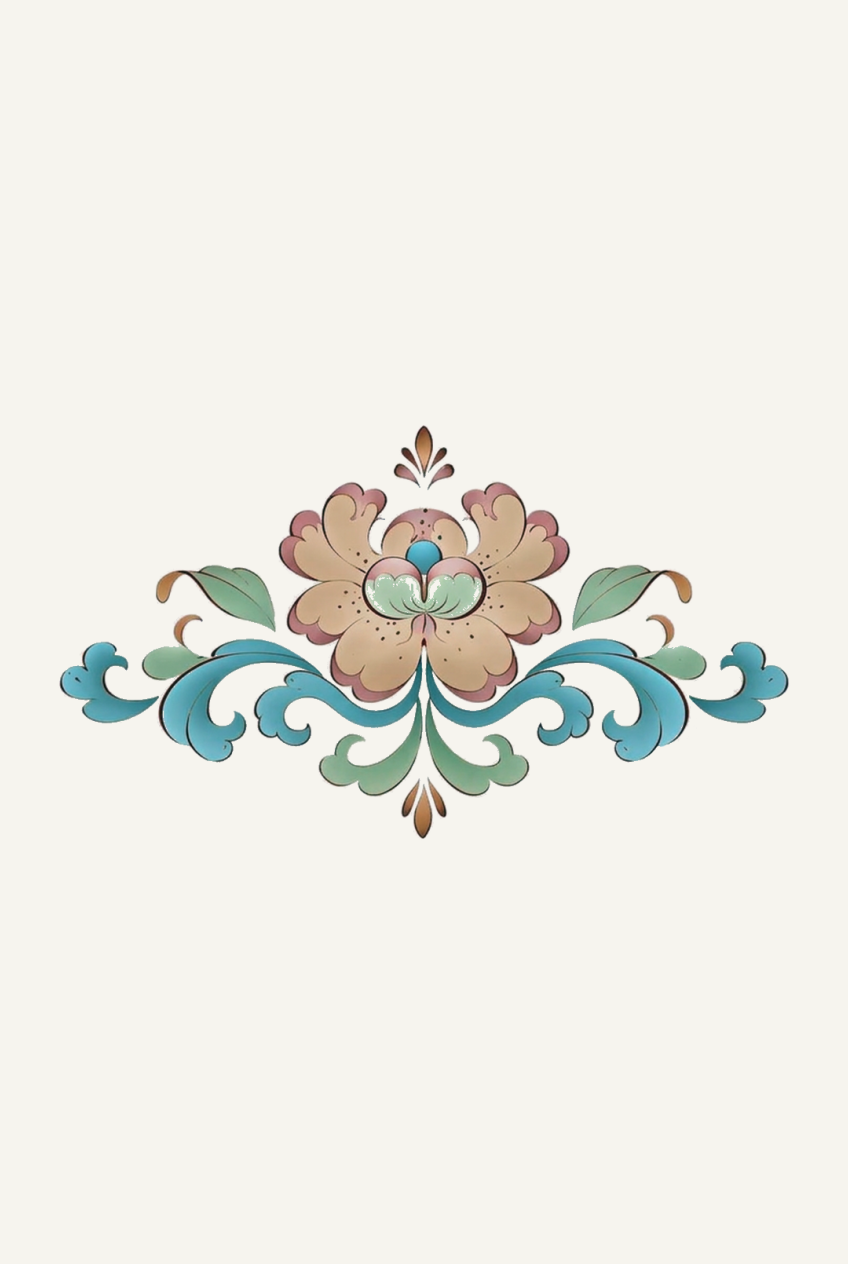
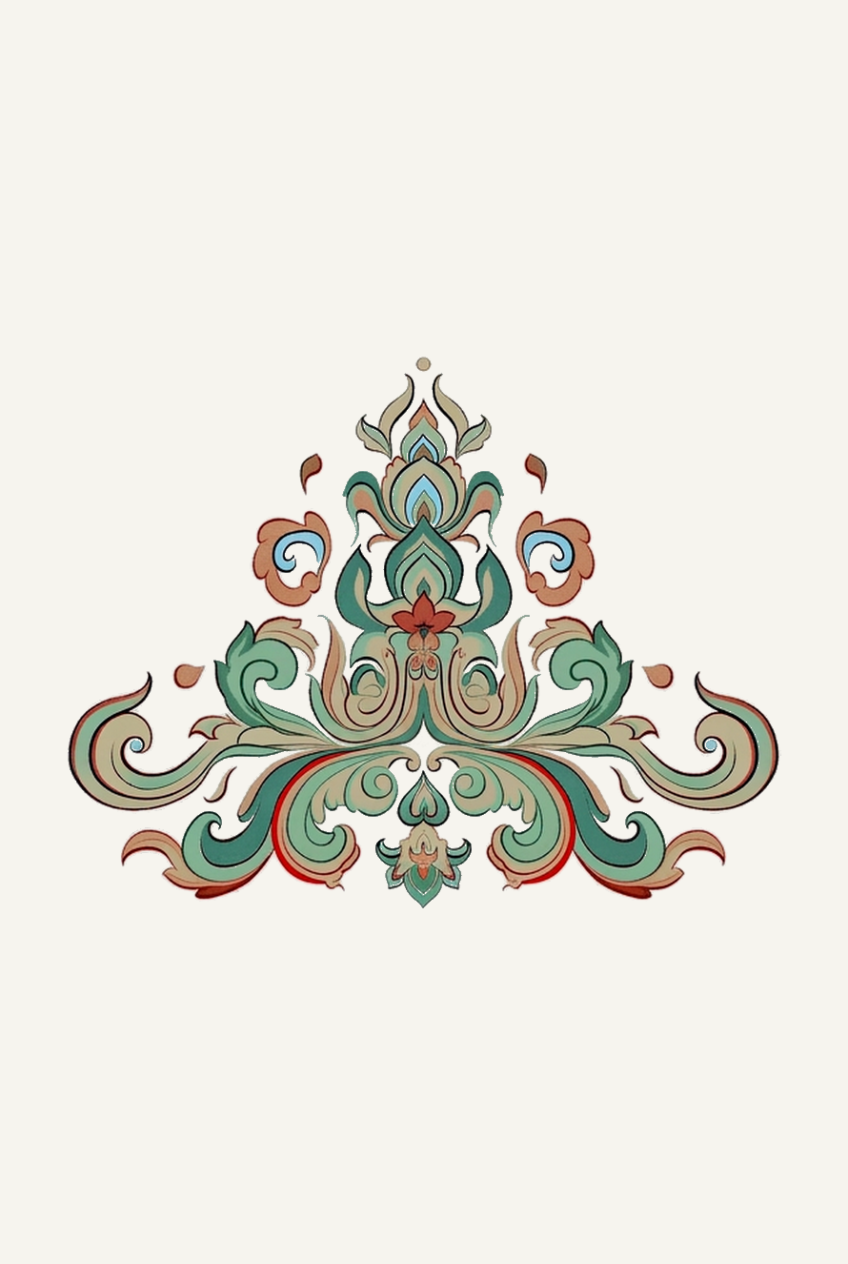
Style: A mirrored honeysuckle rosette — a small bloom rising at the center, leaf-scrolls curling out to either side · ornamental fill · horizontally balanced · scalable 10–16 cm
Form: 图案
The Name
*rěn dōng wén* — the "honeysuckle pattern." The name is a claim about endurance: *rěn*, to bear, and *dōng*, winter — the vine that holds through the cold. It answers to another name, 金银花, gold-and-silver flower, for a single stem that opens white and ages to gold. What reaches ornament is not the flower but the leaf: a three-lobed blade that turns back on itself, and keeps turning.
忍冬纹(rěn dōng wén)——名字本身就是一句关于耐寒的断言:「忍」是忍耐,「冬」是冬天,是那根熬过寒冬还不枯的藤。它还有个名字叫金银花:同一根茎上,花开时白,过时转金。真正走 ornament 走进纹样的不是花,是叶——一枚三裂的叶子,卷回来,再卷回去。
Source & Provenance
The motif enters Chinese decoration with Buddhism, in the Northern dynasties — the honeysuckle scroll winding across the cave ceilings of Yungang and the early Dunhuang grottoes. Li Shizhen's *Běn Cǎo Gāng Mù* records the plant under 忍冬: 凌冬不凋, it does not wither in deep winter, and its flowers open white before turning gold, hence 金银花 — gold and silver on one stem. That two-colored, leaf-curling plant became a standard medallion and border form of the Northern and Sui periods, before the Tang loosened it into the fuller scroll called 卷草. Historical form reference: honeysuckle medallions and scrolls on Northern-dynasty cave ornament and metalwork. Inking note: this design adapts the classic line construction of the traditional motif and re-inks it as tattoo linework.
这枚纹样是随佛教进入中国装饰的,时在南北朝——忍冬卷草绕着云冈与敦煌早期洞窟的窟顶走。李时珍《本草纲目》把这种植物收在「忍冬」条下:凌冬不凋,深冬也不枯;花开时白,转而变金,所以叫金银花——一茎之上,金与银同在。这株两色卷叶的植物,成了北朝与隋代常见的团花和边饰,到唐代才舒展成更饱满的卷草。形制参考:北朝石窟装饰与金属器上的忍冬团花、忍冬卷草。墨线转写:本设计以传统母题的经典线条造型为底,转写为纹身墨线。
Design Inspiration
Every form decision here answers to the source type. ① The three-lobed leaf — the honeysuckle's 忍冬叶, hooking back on itself rather than lying flat. ② The mirrored pair — the motif's old habit of facing two vines across a center, here closed into one balanced round. ③ The central bloom — a small lotus-like flower where the two vines meet: the pause in an otherwise continuous scroll. ④ The three-color fill — celadon, cinnabar and rice-white following the leaf layers, the palette northern ornament carried on cave and bronze.
这里每一处形制都有可对的谱系。① 三裂叶——忍冬叶的本来样子,卷钩着往回走,不是摊平的。② 左右成对——这类纹样的老规矩:两株藤隔着中轴相望,这里收成一团对称的圆。③ 中心小花——两藤交汇处抽出一朵小莲花:连续卷草里的一处停顿。④ 三色填瓣——青绿、砖红、米白顺着叶层走,是北朝装饰在石窟与铜器上用的那套颜色。
The Story
A honeysuckle does something quiet and stubborn: it stays green when the rest of the garden has given up. The name 忍冬 says so outright — the one that endures winter. Ornament took the leaf before it took the flower, and the leaf's trick of curling back became the pattern's signature: a vine that never runs straight, always folding over itself, always coming back to its own center.
On a northern cave ceiling the scroll ran in borders, one vine feeding the next without a seam. What made it survive a thousand years was not the flower but that discipline — the way every curl returns, the way two facing halves hold a single axis. The gold-and-silver flower was only the excuse; the real subject was persistence held in symmetry.
Put that on skin and the logic is unchanged. The center gives the eye a place to rest; the two sides repeat each other the way a hard season repeats and is answered. It is a design about holding on — not by force, but by curling back into your own shape every time.
忍冬做了一件安静而固执的事:满园都放弃了,它还绿着。「忍冬」两个字把这件事说透了——熬过冬天的那一个。纹样先取的不是花,是叶;叶子往回卷的习性,成了这个图案的签名:一根从不走直线的藤,总是折回自己,总是回到自己的中心。
在北朝的窟顶上,卷草沿着边饰走,一藤接一藤,没有接缝。让它活过一千年的不是那朵花,是这份纪律——每一卷都回来,相对的两半守着一根中轴。金银花只是由头;真正的题目,是在对称里守住的韧性。
放到皮肤上,道理不变。中心给眼睛一处歇脚;左右两侧互相重复,像一个难熬的季节来了,又被回应了一次。这是一个关于「撑住」的图案——不靠硬扛,靠每一次都卷回自己的形状。
What It Means
Endurance, and return. The vine that does not wither in winter; the leaf that curls back into itself instead of running off. Wear it for the part of you that stays green on schedule, no matter the season.
韧,与回归。深冬不枯的藤,往回卷而不是跑掉的叶。给那个到点就还绿着的自己——不管什么季节。
Where It Sits
A balanced rosette wants a flat, symmetric field: upper arm or thigh at 10–13 cm, shoulder blade at 12–15 cm, and center of the back at 14–17 cm. The two halves should sit evenly across the body's midline; mark the axis before you ink.
对称的团花需要平整、成双的地方:上臂或大腿 10–13 厘米,肩胛 12–15 厘米,后背正中 14–17 厘米。两半要在身体中线上摆匀;下针前先定轴。
Before You Ink
Keep the mirror exact. The design lives on two halves answering each other; a "good enough" offset kills the balance. ② Color is optional, line is not. The reference fills celadon, cinnabar and rice-white; the transfer linework alone holds the motif, and many keep it ink-only. ③ Respect the scale. Minimum 10 cm — below that the three-lobed leaves weld into a single mass. ④ Skip high-friction spots. Elbows, kneecaps and the side seams of the torso blur the tight curls fastest.
对称要准。 这个图案靠两半互相呼应活着;「差不多」的偏移就毁了平衡。② 颜色可选,线不可省。 参考图填青绿、砖红、米白;转印线稿本身就撑得住,很多人只留墨线。③ 留够尺寸。 最小 10 厘米——再小三裂叶就焊成一团。④ 避开高摩擦处。 肘、膝和躯干两侧最快把细卷磨糊。
Every character on this card was selected and checked stroke by stroke by a native reader of Chinese.