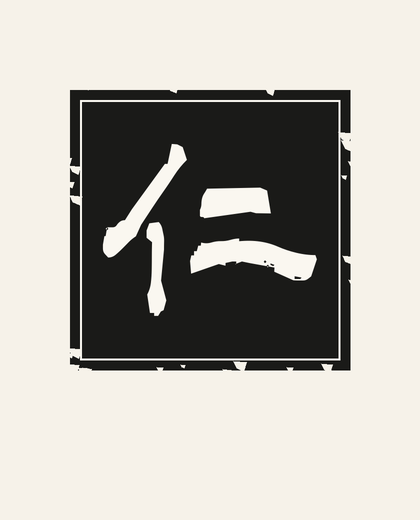
仁 · Rén
Humaneness
Series: Single-Character Zen · Design #54
Style: Single character · Han-seal filled-white (bǎiwén) stamp — black ground, reversed white glyph, weathered border · clerical script (lishu) · medium scale
Form: 文字
The Name
*Rén* — humaneness, the particular Chinese word for being good to another person. The character is built from 人 (person) and 二 (two): it only exists in the space *between* two people. There is no 仁 in solitude. It is the moment you treat a second person as fully as you treat yourself.
仁(rén)——仁爱,中文里专门讲"怎么对另一个人好"的那个字。它由「人」和「二」组成:只存在于两个人*之间*。一个人独处时没有「仁」。它是你把第二个人当作和自己一样完整的那一刻。
Source & Provenance
Etymology and text: *Shuōwén Jiězì* (Eastern Han): 仁,亲也。从人从二 — "ren is closeness; it follows person and two." The *Analects* (*Lúnyǔ*) returns to it constantly: 仁者爱人 — "the humane person loves others" (Yányuān chapter); 己所不欲,勿施于人 — "what you do not want done to you, do not do to others" (Wèi Líng Gōng). 仁 became the central virtue of Confucianism and the first of the five constant virtues (五常). No third-party source image was used for this design. Inking note: this design adapts the classic line construction of the traditional motif and re-inks it as tattoo linework.
字源与出处:《说文解字》(东汉):仁,亲也,从人从二。《论语》反复回到这个字:「仁者爱人」(《颜渊》);「己所不欲,勿施于人」(《卫灵公》)。仁成为儒家的核心德性、五常之首。本设计未使用任何第三方源图像。墨线转写:本设计以传统母题的经典线条造型为底,转写为纹身墨线。
Design Inspiration
Every form decision points to a recorded source, element by element. ① The filled-white seal — a relationship carved out of the dark: two people, and the space between them left open. ② Clerical script — the Han-stone register; 仁 is the word the Han state carved into its classics, so the script is historically its own. ③ The open right side — 仁's 二 is two short horizontal strokes; the seal keeps them cleanly separate so the "two" never merges into one bar. ④ Weathered border — set by hand, imperfect, like the actual practice of humaneness.
本设计每一处形制决定都有出处可查,逐条对账。① 满白文印——一段关系从暗里刻出来:两个人,中间留着空。② 隶书——汉石经的语域;「仁」正是汉王朝刻进石经的字,书体在历史上就属于它。③ 右边留白——「仁」的二是两短横,印章把它们留得清清楚楚,绝不并成一横。④ 残边——手工盖出来的、不完美的,就像"仁"真的做起来那样。
The Story
Take the character apart and the philosophy is already there: 人, a person; 二, two. Humaneness is not a quality you possess alone. It is a relation. Confucius was asked for one word you could live by, and he gave the negative form — 己所不欲,勿施于人 — because it is the version nobody can misunderstand: do not do to another what you would not want done to you.
What makes 仁 demanding is that it starts from the self, not from a rule about others. You find out what humaneness is by noticing what you yourself dislike, and then refusing to pass it on. It is empathy with a workload: it requires you to pay attention to your own reactions and then restrain them on someone else's behalf.
The tradition put 仁 first among the five virtues for that reason. Without it, the other four can become performances — courage that bullies, ritual that excludes, knowledge that wins arguments, faith that hardens. 仁 keeps them pointed at another human being.
To wear 仁 is to wear a small diagram of two people and the gap between them. It says less about your goodness than about the standard you have chosen to hold yourself to in the presence of others.
把这个字拆开,道理已经在了:人,一个人;二,两个。仁不是你独自拥有的品质,是一段关系。有人问孔子有没有一个字可以终身奉行,他给的是否定式——己所不欲,勿施于人——因为这一版谁都不会误解:你不愿意别人怎样对你,就别那样对别人。
「仁」难就难在它从自己开始,不是从一套关于别人的规矩开始。你先注意到自己不喜欢什么,然后拒绝把它转嫁出去。这是带着工作量的共情:要留意自己的反应,还要替别人把它按住。
传统把「仁」放在五常之首,正因为如此。没有它,另外四德都可能变成表演——会欺人的勇、会排斥人的礼、会赢辩论的知、会变硬的信。仁负责让它们始终对着一个具体的人。
纹「仁」,就是把这个"两个人以及其间空隙"的小图带在身上。它说的与其说是你有多好,不如说是你在别人面前,选择拿什么标准约束自己。
What It Means
Humaneness as a relation, not a virtue you own. 人 plus 二: the character only exists between two people, and Confucius defined it by what you refuse to pass on. For anyone who measures themselves by how they treat people who cannot do anything for them.
仁是一段关系,不是你独占的美德。人加二:这个字只在两人之间存在,孔子用"你不愿意转嫁什么"来定义它。给那些用"如何对待帮不上自己的人"来衡量自己的人。
Where It Sits
A sparse, balanced character; it reads well almost anywhere flat. Outer forearm or inner forearm at 4–7 cm is the cleanest; the back of the neck at 4–6 cm is the classic single-character spot; below the collarbone works at 5–8 cm. The two strokes of 二 need clear space, so avoid tapering areas and high-friction edges.
疏朗匀称的字,几乎任何平面都好看。小臂外侧或内侧 4–7 厘米最干净;后颈 4–6 厘米是单字经典位;锁骨下 5–8 厘米也成立。「二」的两横需要清楚的空间,避开收细处和高摩擦边缘。
Before You Ink
Negative-form seal — use the supplied white-ground black-line transfer sheet. ② Keep the two strokes of 二 separate — if they merge, the character stops saying "two people." ③ No freehand Chinese characters. ④ Ink only. ⑤ Minimum 4 cm. ⑥ One script only — clerical-script version; never combine with seal-script 仁 in one tattoo.
负形印——用随卡附的白底黑线转印页。② 「二」的两横必须分开——一并起来,字就不再说"两个人"了。③ 切勿徒手画汉字。 ④ 只用墨。 ⑤ 最小 4 厘米。 ⑥ 只纹一体——本款隶书,勿与篆书「仁」混纹。
Every character on this card was selected and checked stroke by stroke by a native reader of Chinese.



