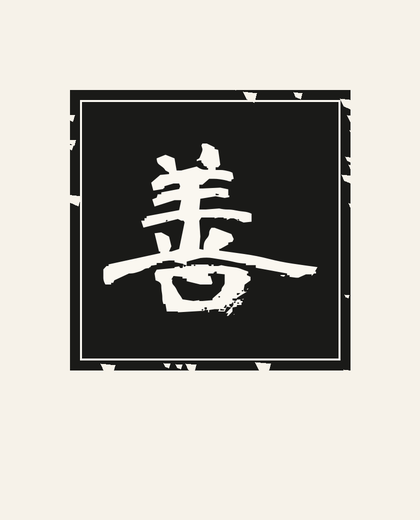
善 · Shàn
Goodness
Series: Single-Character Zen · Design #55
Style: Single character · Han-seal filled-white (bǎiwén) stamp — black ground, reversed white glyph, weathered border · clerical script (lishu) · medium scale
Form: 文字
The Name
*Shàn* — goodness, kindness, the good that is skilful rather than merely well-meant. The character's oldest shape shows a sheep above two 言 (words): a bleating, harmless thing, and speech. Its original sense is close to "gentle in word" — goodness with a manner, not just an intention.
善(shàn)——善良、好,是那种做得漂亮的"好",不只是好心。它最古的形体是羊在上、两个言在下:一只咩咩叫的、无害的东西,加上言语。本义近于"言语和善"——带着分寸的善,不只是动机。
Source & Provenance
Etymology and text: *Shuōwén Jiězì* (Eastern Han): 善,吉也。从誩从羊 — "shan is auspicious/good; it follows two words and sheep." Bronze forms show 羊 over dual 言. The *Classic of Changes* (*Zhōuyì*, Xìcí): 积善之家,必有余庆 — "the family that accumulates good will have abundance of blessing." The *Analects* uses 善 for the good and the skilful alike — 择其善者而从之 — "choose the good in others and follow it." No third-party source image was used for this design. Inking note: this design adapts the classic line construction of the traditional motif and re-inks it as tattoo linework.
字源与出处:《说文解字》(东汉):善,吉也,从誩从羊。金文是「羊」在上、双「言」在下。《周易·系辞》:积善之家,必有余庆。《论语》以「善」兼指好的与擅长的:择其善者而从之。本设计未使用任何第三方源图像。墨线转写:本设计以传统母题的经典线条造型为底,转写为纹身墨线。
Design Inspiration
Every form decision points to a recorded source, element by element. ① The filled-white seal — the good cut out of the dark, left visible in white. ② Clerical script — the Han-stone register, fitting a character whose authority runs through the Han classics. ③ The three horizontal strokes kept distinct — 善's lower 羊 has three evenly spaced lines; in white-negative they must stay separate because closing them destroys the character's balance. ④ Weathered border — a hand-set seal, imperfect in the same way real goodness is.
本设计每一处形制决定都有出处可查,逐条对账。① 满白文印——善从暗里被刻出来,以白色留下来。② 隶书——汉石经的语域,配得上这个权威贯穿汉代经典的字。③ 三横必须分明——「善」下头的羊有三道等距横,白文印里要保持分离,一合拢字的平衡就毁了。④ 残边——手工盖出的印,跟真实的善一样,不会完美。
The Story
The Chinese character for goodness contains a sheep and two words. It is a strangely gentle picture for a moral term — not a command from a mountain, but a small domestic scene: a harmless creature, and someone speaking kindly near it. The earliest meaning is closer to "gentle-spoken" than to abstract virtue. Goodness, in this grammar, has a voice and a manner.
That is why the *Changes* can say 积善之家,必有余庆 without sounding like a transaction. Good is something that accumulates — the way small gentle acts build up in a house until the blessing is simply the kind of place it has become. The *Analects* goes further and makes 善 include skill: 择其善者而从之 — take the good in others and learn it. Goodness is not only a virtue you have; it is a craft you can study in other people.
The character also carries a quieter claim: its 羊 component links it to 祥 (auspicious) and 義 (righteousness). In the Chinese moral vocabulary, gentleness and rightness share a root. Being good was never imagined as being soft in the weak sense — it is the strength to keep one's speech and conduct gentle on purpose.
To wear 善 is to choose the older meaning: not a badge of being a good person, but a commitment to the manner — the way you speak, the way you keep small promises, the good you make skilful by repeating.
中文里表示善的字,里面装着一只羊和两个言。对一个道德词来说,这是幅出奇温柔的图——不是从山上颁下来的诫命,是个家居小景:一只无害的生灵,旁边有人好好说话。最早的意思近于"言语和善",而非抽象德目。照这个语法,善是有声音、有分寸的。
所以《周易》说「积善之家,必有余庆」时不像在做交易。善是会积累的东西——小小的温和举动在一户人家里攒着,攒到最后,福气就是这户人家变成了什么样。《论语》再进一步,把「善」连到技艺上:择其善者而从之——把别人身上好的挑出来学。善不只是你有的德性,还是一门可以在别人身上观摩的手艺。
这个字还藏着一个更安静的意思:它的羊旁把它和「祥」「義」连在一根上。在中国的道德词汇里,温和与正当同根。善从来不是软弱意义上的软——它是有意识地把言语和行为保持温和的那股力气。
纹「善」,是选那个更古老的意思:不是"我是好人"的徽章,是对分寸的承诺——你怎么说话、怎么守小约、怎么把善通过重复做得熟练。
What It Means
Goodness as a practiced manner, not a self-description. 善 holds sheep and speech: gentleness with a voice, virtue with craftsmanship. For people who think character shows up in small repeated conduct rather than in declarations.
善是被练出来的分寸,不是自我描述。这个字装着羊与言:温柔带着声音,德性带着手艺。给那些相信品性显现在日复一日的小行为、而不是宣言里的人。
Where It Sits
A balanced, mid-density character. Outer forearm or upper back at 5–8 cm gives the three lower strokes room; back of the neck at 4–6 cm works for a smaller seal; below the collarbone at 5–7 cm is also clean. Avoid very small sizes — the lower 羊's strokes must stay apart.
匀称、中等密的字。小臂外侧或上背 5–8 厘米能容下底下三横;后颈 4–6 厘米适合小号印章;锁骨下 5–7 厘米也干净。避免过小——底下「羊」的笔画必须保持分开。
Before You Ink
Negative-form seal — transfer from the supplied white-ground black-line sheet. ② Keep the three horizontal strokes of 羊 separate and even. ③ No freehand Chinese characters. ④ Ink only. ⑤ Minimum 5 cm recommended for this character. ⑥ One script only — this is the clerical-script form; the seal script has no 善 glyph and must not be substituted by guesswork.
负形印——用随卡附的白底黑线页转印。② 「羊」的三横要分开、要匀。 ③ 切勿徒手写汉字。 ④ 只用墨。 ⑤ 这个字建议最小 5 厘米。 ⑥ 只纹一体——本款为隶书;篆书没有「善」的字形,切勿凭空替代。
Every character on this card was selected and checked stroke by stroke by a native reader of Chinese.



