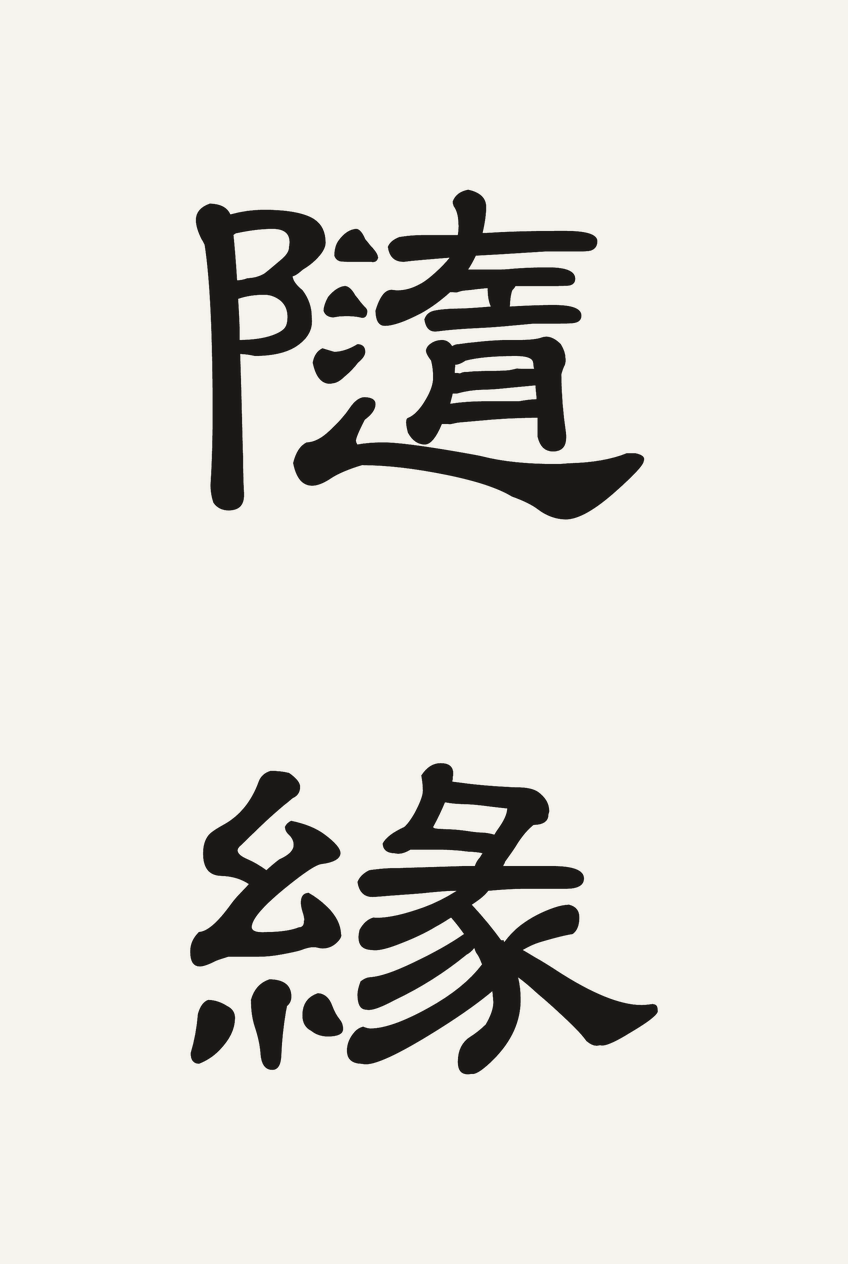
随缘 · Suí Yuán
Follow the Conditions
Series: Single-Character Zen · Design #20
Style: two characters, vertical column · clerical script (lishu) · traditional form 隨緣 · small-to-medium
Form: 文字
The Name
*Suí yuán* — follow the conditions. 缘 (pratyaya) is the Buddhist word for the web of circumstances any event needs in order to happen: seed, rain, soil, worker — none sufficient alone, all required together. 随缘 is the practitioner's stance toward that web: work with the conditions as they are, not as you scheduled them. Often heard at partings, it is less a farewell than a cosmology: this meeting had conditions; when the conditions end, what follows is not a betrayal but weather. As a tattoo, it is grace under unplanned outcomes.
随缘——顺着缘。缘(pratyaya)是佛教对「一件事发生所需的条件之网」的命名:种子、雨、土、人——单独哪一个都不够,合在一起才够。随缘是行者对这张网的姿态:条件是什么样,就跟什么样合作,而不是照你的日程表来。这个词常在告别时听见,但它不是道别,是宇宙论:这场相遇有它的条件;条件尽了,接下来的不是背叛,是天气。纹下它,是计划之外的平静。
Source & Provenance
缘 as a technical term comes from the sutra translations (pratyaya, "condition"), and the compound 隨緣 became a pillar of Chinese Buddhist doctrine: the Huayan master Fazang (法藏) taught 隨緣不變,不變隨緣 — "conditioned, yet unchanging; unchanging, yet following conditions" — the mind that engages the world's flux without dissolving into it. The phrase spread from the lecture hall into everyday speech: what a grandmother says at a train platform. Inking note: this design adapts the classic line construction of the traditional motif and re-inks it as tattoo linework.
缘作为术语出自佛经翻译(pratyaya,条件),词组「隨緣」长成中国佛教教义的支柱:华严宗师法藏教「隨緣不變,不變隨緣」——随缘而不变,不变而随缘——那颗入世随波却不被溶解的心。这句话从讲堂走进日常口语:火车月台上,祖母说的就是它。墨线转写:本设计以传统母题的经典线条造型为底,转写为纹身墨线。
Design Inspiration
Every form decision points to a recorded source, element by element. ① Two characters, one vertical column — the stance as it is held: the follower (隨) above, the conditions (緣) below, moving together down the limb. ② Clerical script (lishu), traditional form 隨緣 — the Han-dynasty administrative hand suits a word about yielding: level, patient strokes, and in 緣 the silk radical (糸) still reads as thread, which is what the word says. ③ Small-to-medium scale — 6–10 cm; the term travels lightly. ④ Black ink only — conditions have no color of their own.
本设计的每一处形制决定都有出处可查,逐条对账。① 二字竖列——如这个姿态被持守的样子:随在上面,缘在下面,一起沿肢体下行。② 隶书、繁形「隨緣」——汉代文书之手的平正与耐心,正合「顺从」这个词:笔画从容不迫;「緣」的绞丝旁仍读作丝线——正是这个词的本义。③ 小到中尺寸——6–10 厘米;这个词轻装旅行。④ 只用墨——条件本身没有颜色。
The Story
The doctrine is exact before it is consoling. Buddhist psychology says every event is a confluence: intention is real, and it is one ingredient among many. You chose the career and the century chose the industry; you chose the person and the city chose the timing. 随缘 is not resignation — resignation stops choosing. It is precision about the boundary of the will: plant in spring, harvest in autumn, and between those, cooperate with what arrives. Fazang's gloss keeps the second half honest: 隨緣不變 — follow the conditions without the conditions deciding who you are.
That is why the word lives at departures. Chinese says 随缘 at platform goodbyes, at unmatched introductions, at jobs that ended — because it holds two truths at once: the meeting was real, and the meeting was conditional. Western consolation usually picks one truth (it was fate! it meant nothing!) and pays for the choice in either delusion or bitterness. 随缘 pays nothing: the seed was real; the season turned. Worn on skin, it is the sentence you will most need exactly when outcomes ignore your plans — which is to say, eventually, always.
教义在安慰人之前是精确的。佛教心理学说每个事件都是合流:意图是真的,但它是诸成分之一。你选了这行职业,世纪选了这个行业;你选了那个人,城市选了那个时辰。随缘不是放弃——放弃的人不再选择。它是对意志边界的精确认识:春天播种,秋天收获,中间的部分,与到来的一切合作。法藏的注解保住了后半句的诚实:隨緣不變——跟随条件,但不让条件决定你是谁。
所以这个词住在告别里。中文在月台送别、未成缘的引荐、结束的工作上说「随缘」——因为它同时握住两个真相:相遇是真的,相遇是有条件的。西方的安慰通常只挑一个真相(是命运!本来就没意义!)并用幻想或苦涩为这个选择付费。随缘不付费:种子是真的;季节转向了。戴在皮肤上,它是结果无视你的计划时你最需要的那句话——也就是说,最终,一直需要。
What It Means
For the planners whose plans have been outvoted — the jilted, the relocated, the ones watching a timeline dissolve. It restores the two-sided ledger: your effort was real; the conditions were also real. Neither cancels the other.
给计划被现实否决的人——被辜负的、被迫迁的、眼看着时间表溶解的。它把账本恢复成两栏:你的努力是真的;条件也是真的。两者互不抵消。
Where It Sits
Two characters, one plane: inner wrist, nape, sternum. 6–8 cm reads as a private stance; below 5 cm the clerical strokes clog.
两个字,一个平面:腕内侧、后颈、胸骨。6–8 厘米读作一次私人的立场;低于 5 厘米隶书笔画会糊。
Before You Ink
Two characters are the whole design. ② Clerical script, traditional form 隨緣. The silk radical in 緣 is the word's whole etymology — thread. ③ Clerical stays level. No angular "improvements"; the patience is the meaning. ④ Minimum 6 cm for the wave strokes to read. ⑤ Follow is not float. The doctrine praises cooperation with conditions — which requires reading them first. If 随缘 ever starts meaning "stop trying," it has been mistranslated — usually by the wearer.
两个字就是全部设计。 ② 隶书、繁形「隨緣」。 「緣」的绞丝旁就是整部字源——线。③ 隶书保持平正。 不要做棱角化的「改良」;从容就是意义。④ 6 厘米起,波磔才读得出。⑤ 随不是漂。 教义称赞与条件合作——前提是先读懂条件。如果随缘开始变成「别努力了」,它就被误译了——误译者通常是佩戴者本人。
Every character on this card was selected and checked stroke by stroke by a native reader of Chinese.



