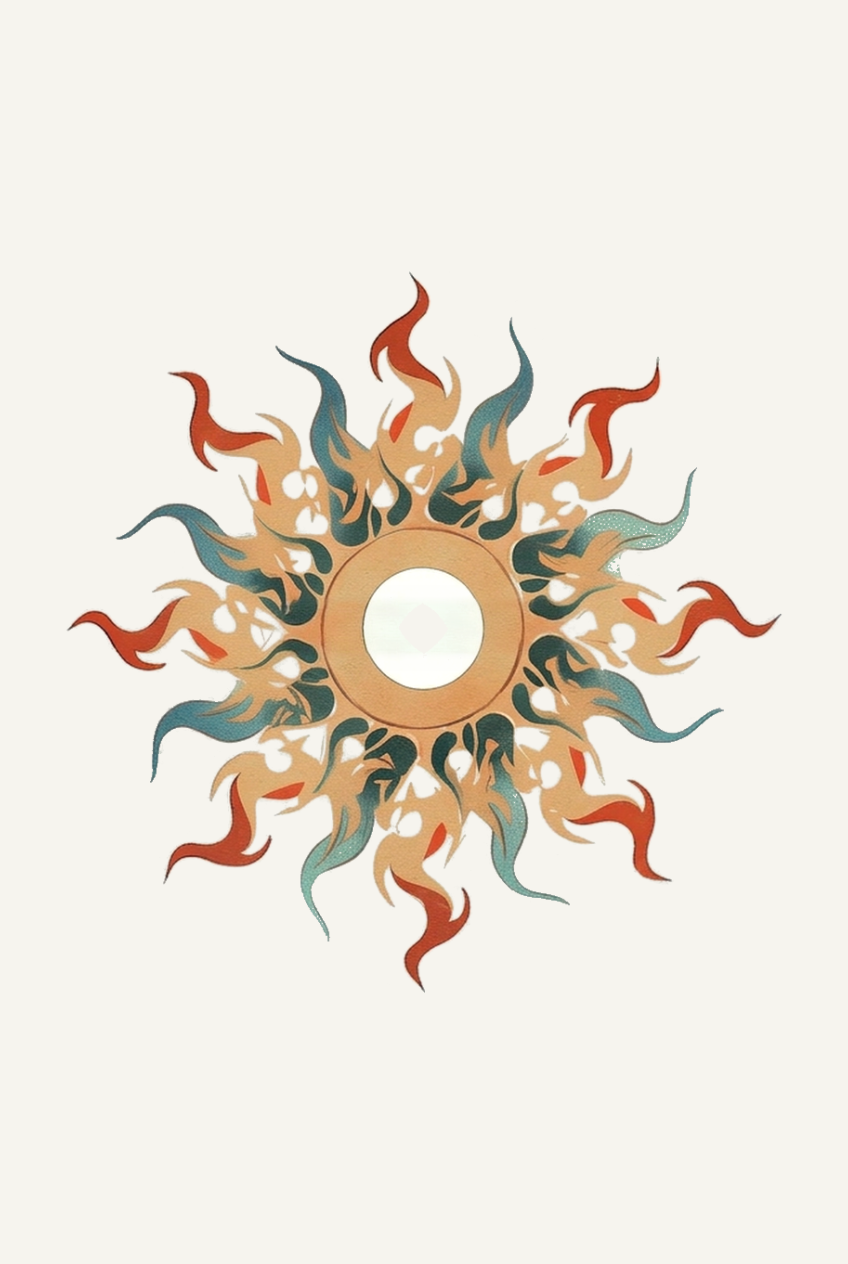
太阳纹 · Tài Yáng Wén
The Sun
Series: Symbols & Patterns · Design #37
Style: A central sun disc with concentric gold rings, ringed by radiating flames in cinnabar and celadon · ornamental fill · radial symmetry · scalable 12–18 cm
Form: 图案
The Name
*tài yáng wén* — the "sun pattern." The name is plain and old: 太 is great, 阳 is the yang, the great yang — the sun. The design draws it the way the motif always has: a round disc at the center, and around it tongues of flame or rays pushing outward in every direction. The disc is left light, almost empty; all the work is done by what leaves it.
太阳纹(tài yáng wén)——名字朴素而古老:「太」是至大,「阳」是阳,至阳之象,就是太阳。纹样一直这么画:正中一轮圆盘,四周是火舌或光芒,朝各个方向推出去。圆盘留得浅、几乎空着;所有的功夫都花在「离开它」的东西上。
Source & Provenance
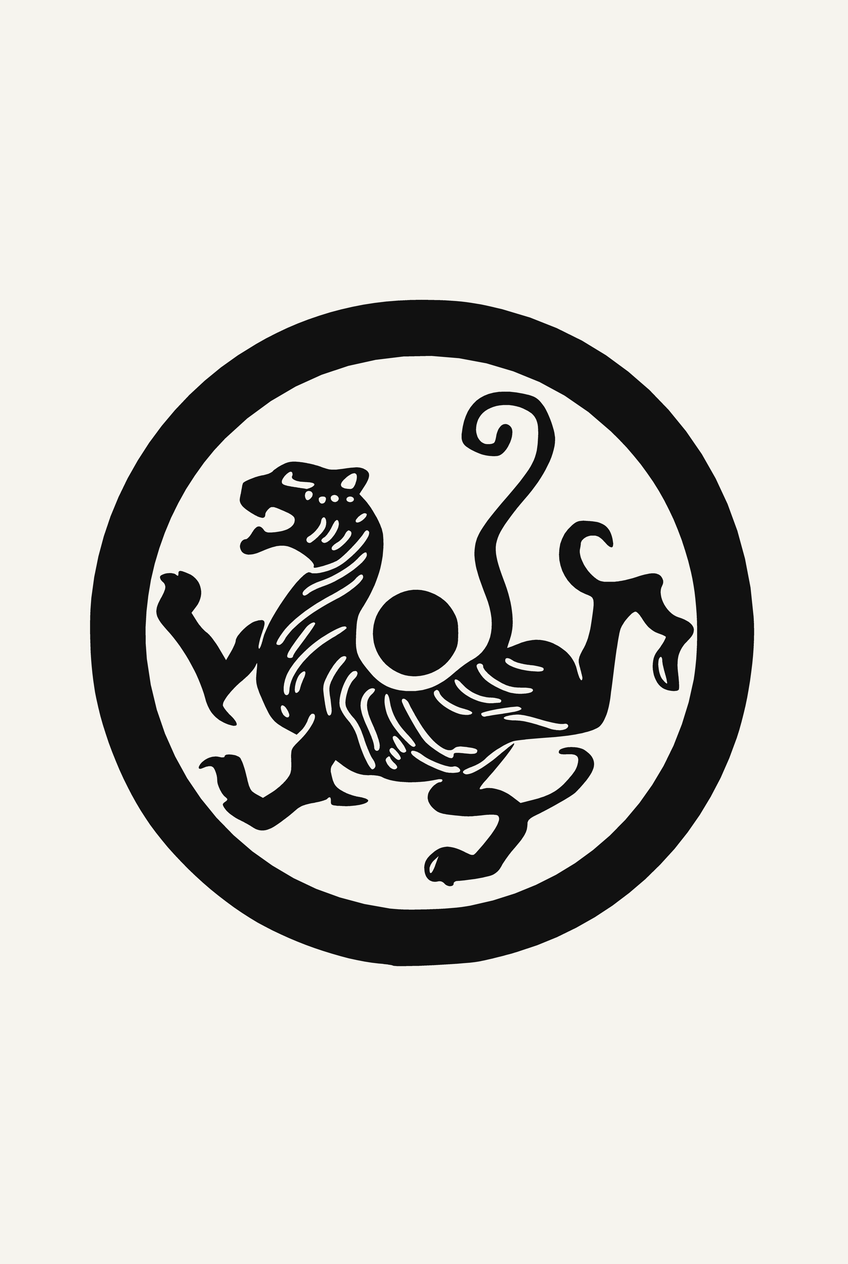
The sun is among the oldest images in Chinese archaeology, appearing as a ringed disc with radiating rays on Yangshao painted pottery. Myth gave it a family: the *Shān Hǎi Jīng* places ten suns bathing in the Fusang tree, and the Han image of the 金乌 — the golden crow that carries the sun — fixes the bird-in-the-disc form. Fire-rayed suns recur on Han tomb art and later on mirrors, textiles and architectural painting, the rays read sometimes as light, sometimes as flame. Historical form reference: ringed sun discs with radiating rays on Yangshao pottery and Han decorative art. Inking note: this design adapts the classic line construction of the traditional motif and re-inks it as tattoo linework.
太阳是中国考古里最古老的图像之一,仰韶彩陶上就有带光芒的圆环。神话还给它配了家世:《山海经》写十个太阳在扶桑树上沐浴,汉代「金乌负日」的形象,把「鸟在日中」的样子定了下来。带火芒的太阳在汉墓艺术、后来的铜镜、织物与建筑彩画上反复出现,那些芒有时读作光,有时读作火。形制参考:仰韶彩陶与汉代装饰上的环形日轮与放射光芒。墨线转写:本设计以传统母题的经典线条造型为底,转写为纹身墨线。
Design Inspiration
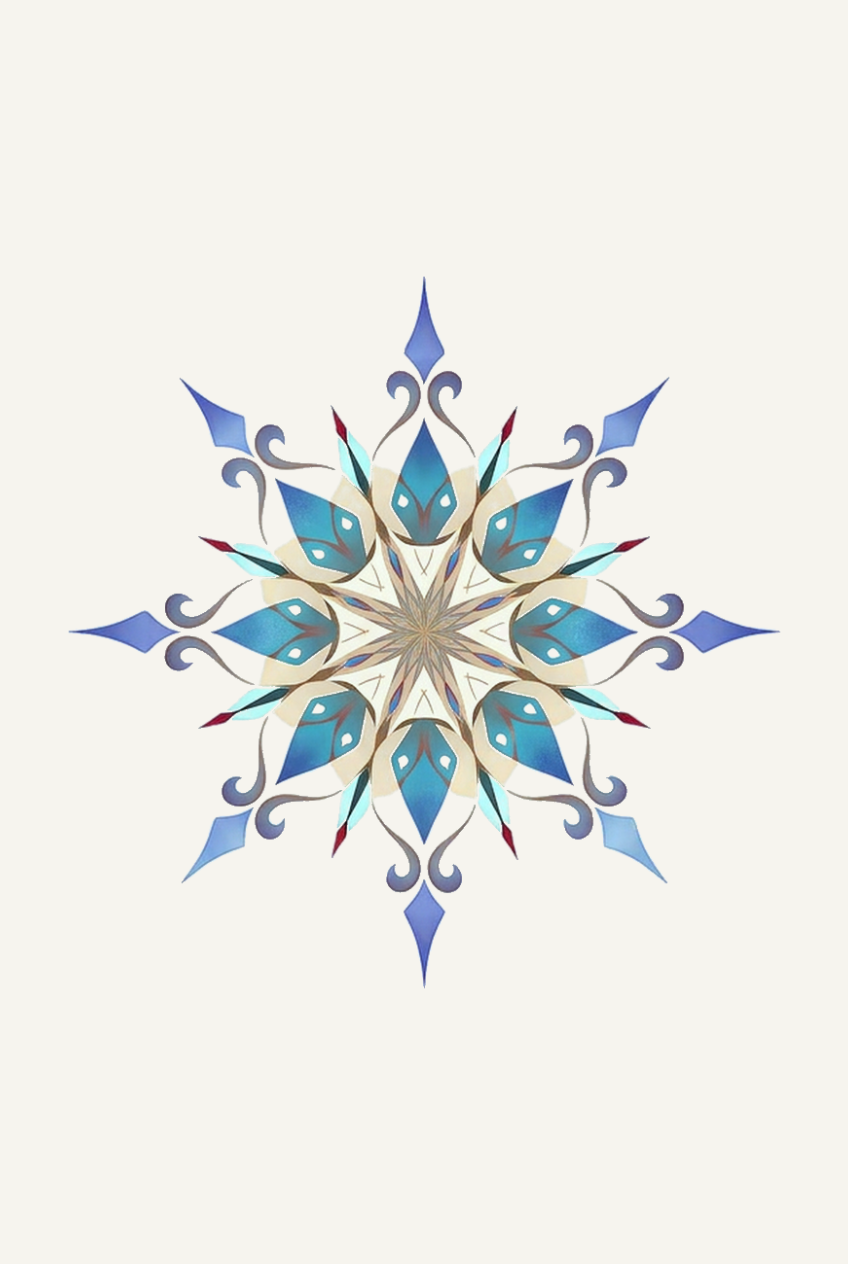
The design follows the fire-rayed type, element by element. ① The light disc — a pale center held inside clean concentric gold rings: the sun itself, kept quiet so the rays can do the moving. ② The radiating flames — cinnabar and celadon tongues pushed outward in every direction, each curling as it rises; the "rays" here are deliberately flames, in the gold-crow tradition. ③ The alternating colors — red and green flames set against each other around the ring, so the eye reads a turning, living motion rather than a fixed star. ④ The open center — the disc is left almost blank; the design's energy comes from what radiates, not from what sits still.
本版守着「火芒太阳」这一类,逐条对账。① 浅色日轮——淡色的中心,外面几道干净的金色同心环:太阳本身留得安静,好让芒去动。② 放射火舌——朱砂与青绿的火舌朝四面推出去,每一条上升时都打着卷;这里的「芒」刻意画成火焰,走的是金乌那一脉。③ 红绿相间——红火与青火围着环交错,让眼睛读到一种转动的、活的劲,不是一颗定住的星。④ 中宫留白——圆盘几乎空着;全图的力气在放射出去的东西上,不在坐着的东西上。
The Story
The sun is the one image every culture arrives at on its own, and China arrived at it early — painted on pottery, then carried into myth as ten suns in a tree and a crow that bears the light across the sky. What matters is not the discovery but the way it was drawn: a quiet round center, and everything around it in motion.
This design makes that motion fire. The rays are tongues, red and green alternating, each one curling as it lifts off the ring. A sun drawn this way is not a static emblem; it is the sun at the moment it is giving off light — which is to say, giving itself away. The pale, nearly empty disc is what makes that readable: the center holds nothing back, so the flame can be all there is to see.
Worn on skin, it wants a large, flat field so the rays can spread. It suits someone who recognises themselves in that economy — quiet at the center, generous at the edges. An old image, worn not as a badge but as a reminder of what you have to give.
太阳是每种文化都会自己抵达的图像,中国到得很早——先画在陶上,再走进神话:树上的十个太阳,一只驮着光飞过天空的乌鸦。要紧的不是「发现」,是画法:中心安静的一轮圆,四周都在动。
这一张把那份动画成了火。芒是一条条火舌,红绿相间,每一条离开金环时都打着卷。这样画的太阳不是一枚静止的徽记,是正在发光那一瞬的太阳——也就是,正在把自己给出去的太阳。浅而几乎空着的圆盘,正是为了让这件事读得出来:中心什么都不留,火就成了唯一看得见的东西。
戴在皮肤上,它要一块大而平的地方,好让火芒铺开。它适合在那种「节俭」里认出自己的人——中心安静,边缘慷慨。一个极古老的图像,不当徽章戴,只当一句提醒:你有什么可以给。
What It Means
Light given freely. The pale center that holds nothing back; the flames that spend themselves outward. Wear it for the part of you that is brightest when it is giving — and for the warmth that costs the giver nothing to pass on.
光,给出去。浅色的中心什么都不留,火芒把自己往外花掉。给那个「给出去时最亮」的自己——也给那种传出去、自己丝毫不减的暖。
Where It Sits
A large radial sun wants a broad, flat field: the center of the back at 16–20 cm, the thigh at 15–18 cm, or the outer upper arm at 12–15 cm. Give the flames room in every direction — a radial design needs its full circle to hold its balance.
大幅放射的太阳要一块宽而平的地方:后背正中 16–20 厘米,大腿 15–18 厘米,或上臂外侧 12–15 厘米。火芒四面都要留地方——放射图案要靠完整的圆才立得住平衡。
Before You Ink
Keep the disc light. The pale center is the design's logic; filling it dark kills the contrast that makes the flames read as light. ② Color is optional, line is not. The reference uses cinnabar and celadon flames with gold rings; the transfer linework alone carries the sun, and many keep it ink-only. ③ Respect the scale. Minimum 12 cm; this is a wide radial composition, and below that the flames weld into a single mass. ④ Center it. Mark the body's midline first — a radial sun shows any offset immediately.
让日轮留浅。 浅色中心是全图的道理;把它填黑,火就读不成光了。② 颜色可选,线不可省。 参考图用朱砂与青绿的火、金色的环;转印线稿本身就撑得住太阳,很多人只留墨线。③ 留够尺寸。 最小 12 厘米;这是横向放射构图,再小火芒就焊成一团。④ 摆正中。 先定身体中线——放射的太阳,偏一点立刻看得出来。
Every character on this card was selected and checked stroke by stroke by a native reader of Chinese.