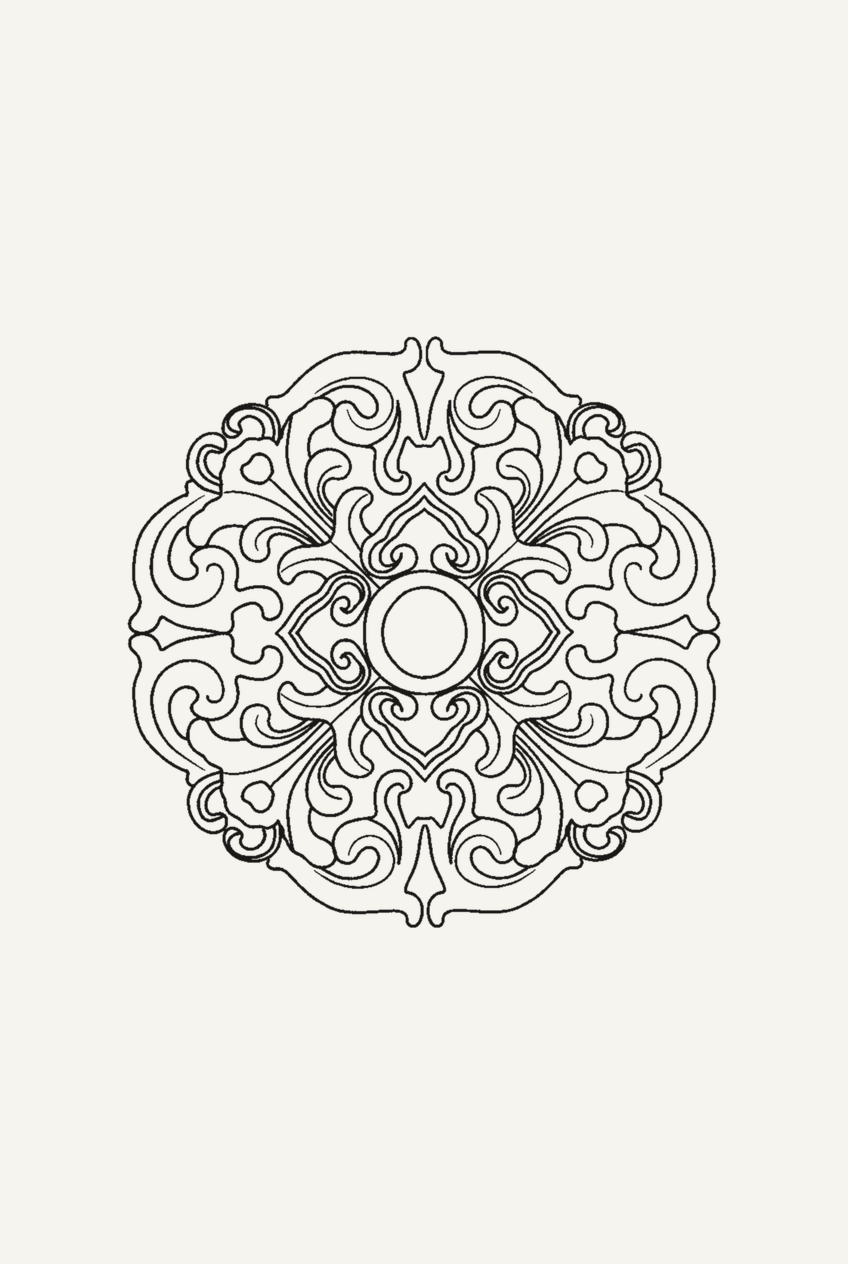
唐草纹 · Táng Cǎo Wén
The Endless Vine
Series: Symbols & Patterns · Design #06
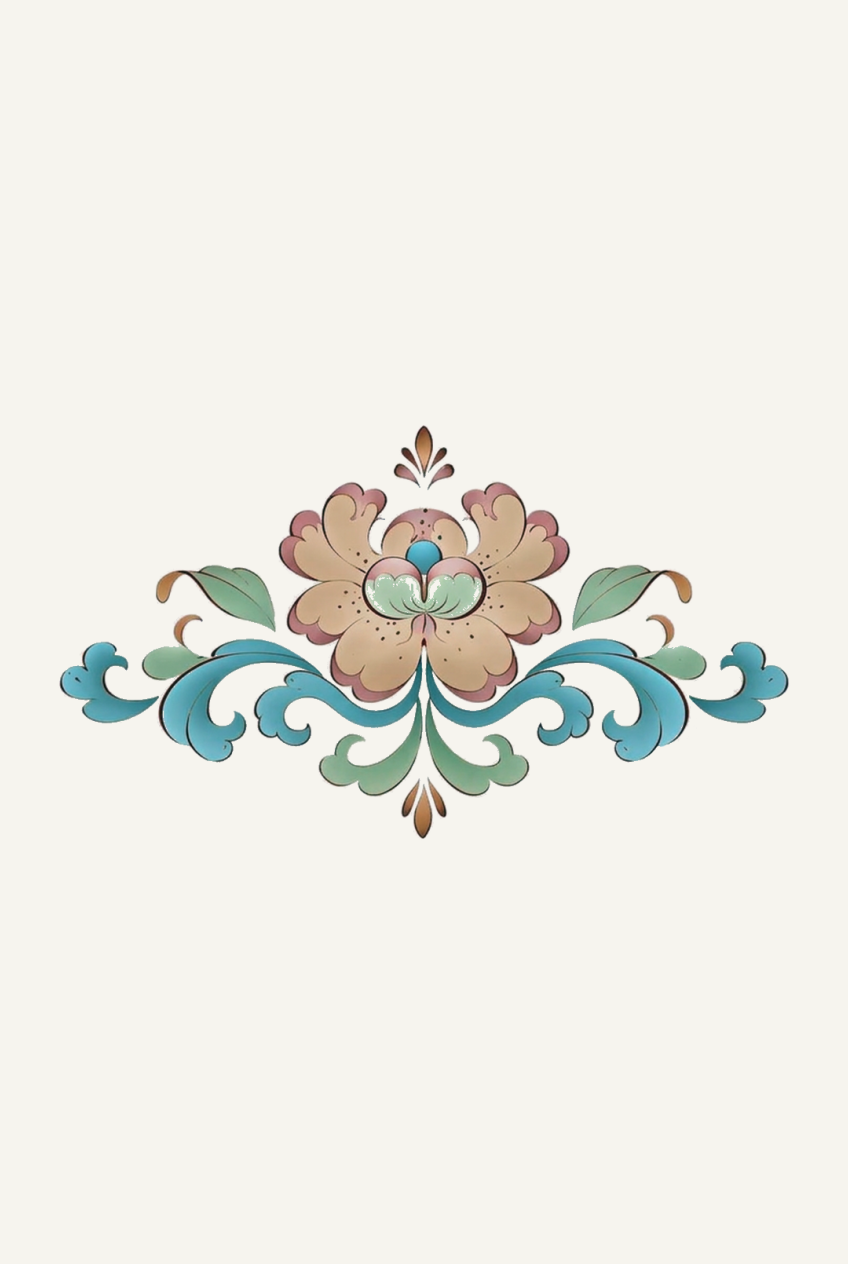
Style: A continuous scrolling vine band with spiraling tendrils and lobed leaves · fine-line · landscape band · scalable 10–18 cm
Form: 图案
The Name
*táng cǎo wén* — the "Tang vine," though the Tang dynasty only perfected what the Silk Road delivered. It is the Chinese name for what the world calls arabesque: one vine, drawn without beginning and without end, branching into spiral after spiral. The Japanese still call it 唐草 — "the vine from Tang" — a thousand years after the ships stopped sailing. A pattern so complete it outlived the empire that named it.
唐草纹(táng cǎo wén)——名为「唐」,但唐朝只是把丝路送来的东西熬到了最圆熟。它是全世界所谓 arabesque(卷草饰)的中国名字:一根藤,无始无终,一路分叉成一个个螺旋。日本至今还叫它「唐草」——唐船停航一千年后,仍叫「来自唐的藤」。一个图案活得比给它命名的帝国还长。
Source & Provenance
The lineage runs west to east: Greek acanthus scrolls traveled through Gandhara and Central Asia with Buddhism, arrived in the Northern dynasties as the honeysuckle scroll (忍冬纹), and by the Tang had melted into a fuller, looser vine — the scroll that fills the borders of Dunhuang's Tang cave paintings, the rims of Tang silvers, the bases of pagoda niches. The Tang term itself survives in Japanese 唐草 (karakusa), the name for every scrolling vine motif that crossed the sea. Historical form reference: scrolling vine bands on Tang metalwork and Dunhuang border painting. Inking note: this design adapts the classic line construction of the traditional motif and re-inks it as tattoo linework.
谱系自西徂东:希腊的莨苕叶卷随佛教经犍陀罗与中亚一路东行,入北朝化作忍冬卷草,到唐代融成更饱满、更舒展的一根藤——敦煌唐代洞窟的边饰、唐代银器的口沿、塔龛的基座上,全是它。「唐草」这个名目本身也活在日语的「唐草」(karakusa)里——凡渡海东传的卷草纹样,至今统称此名。形制参考:唐代金属器与敦煌边饰画中的卷草带。墨线转写:本设计以传统母题的经典线条造型为底,转写为纹身墨线。
Design Inspiration
Every form decision on this design points to a recorded source, element by element. ① The single continuous vine — the defining discipline of the type: one stem feeding every branch, no seam, no restart. ② The spiraling tendrils — the acanthus inheritance, the curl that traveled five thousand kilometers without losing its spring. ③ The lobed leaves — the Tang fullness, broader and calmer than its Northern-dynasty ancestor. ④ The band composition — the way Tang craftsmen actually used it: running along a rim, a hem, a border — made to wrap a body.
本版每一处形制决定都有出处可查,逐条对账。① 一藤到底——这一类纹样的看家纪律:一根主茎喂饱所有分支,没有接缝,没有重新起笔。② 螺旋卷须——莨苕的遗产,那个走了五千里也没丢掉弹性的卷。③ 裂片叶——唐代的饱满,比北朝祖先更宽、更从容。④ 带状构图——唐人工匠本来的用法:沿着口沿、衣缘、边框行进——天生就是用来缠绕的。
The Story
Follow one vine for a moment. It starts as a Greek leaf — the acanthus, carved on Corinthian capitals two thousand three hundred years ago. Buddhism picks it up in Gandhara, packs it with the sutras, and walks it across deserts. In the Northern dynasties it lands in China as the honeysuckle scroll, tight and solemn, ringing the ceilings of cave temples. Then the Tang gets hold of it, and the vine relaxes. The leaves widen, the tendrils loosen, the whole thing starts to move like it is growing while you watch. By the high Tang it is everywhere — on silver mirrors and monk's staffs, on the borders of the Dunhuang murals, wrapped around pagoda niches — and it boards ships for Japan, where it keeps the name 唐草, "the vine from Tang," to this day.
What the vine carries is a single idea: continuity without a seam. The stem never ends; any point you pick is the middle. There is no head, no tail, no climax — just growth, indefinitely. A civilization that organized itself around generations and descent found the perfect emblem for it: not a knot (which ties) and not a circle (which closes) but a vine, which keeps going. 福气不封顶,日子不断头 — that is the band, in seven characters.
Which makes it quietly perfect for skin. A vine band wants to wrap — a forearm, an ankle, a shoulder — and its endlessness reads differently on a body than on paper: on a cylinder, the pattern's "end" can be its own beginning. The Greeks, the Buddhists, the Tang silversmiths and the Japanese karakusa carvers all agreed on this one. Now it is your turn to keep a five-thousand-kilometer vine growing.
跟着这根藤走一段。它起点是一片希腊叶子——莨苕,两千三百年前刻在科林斯柱头上。佛教在犍陀罗拾起它,和经卷打成一个包,徒步穿过沙漠。北朝时它在中国落地,叫忍冬卷草,紧而庄重,绕着窟顶跑。然后唐朝接手,藤松弛了下来。叶子放宽,卷须舒展,整个图案开始流动,像当你看着它时它仍在生长。盛唐时它无处不在——银镜与锡杖上,敦煌壁画的边饰里,缠着塔龛——然后它登船渡日,在日本保住了「唐草」这个名字,直到今天。
这根藤承载的只有一个观念:没有接缝的连续。主茎永不收尾;你随手点中的任何一点都是中段。没有头,没有尾,没有高潮——只有生长,不限期。一个以世代与传承组织自身的文明,为此找到了最贴切的图腾:不是结(会打结)也不是圆(会闭合),而是一根一直往前走的藤。「福气不封顶,日子不断头」——这条带子,七个字说完。
这也让它安安静静地适合皮肤。卷草带天生想缠绕——小臂、脚踝、肩——而它的「无终」落在身体上与落在纸上不一样:在一个圆柱上,图案的「终点」可以恰好是它自己的起点。希腊人、佛教徒、唐代的银匠与日本刻唐草的匠人在这一点上全票通过。现在轮到你,让这条走了五千里的藤继续长。
What It Means
Unbroken continuity — of days, of generations, of fortune. The one motif in the collection that literally has no starting point: wherever your eye lands is the middle of the story. A quiet emblem for things you intend to keep going.
绵延不断——日子、世代、福气都是。全系列唯一一个字面上没有起点的纹样:目光落在任何一处,都是故事的中段。给它一个安静的定位:一切你打算让它继续下去的事。
Where It Sits
The band is built to wrap: forearm or ankle at 10–14 cm, upper arm as a full ring at 14–18 cm. A shortened section sits well along the collarbone. On a limb, the vine's ends can meet — let your artist plan the junction where head meets tail.
这条带子为缠绕而生:10–14 厘米缠小臂或脚踝,14–18 厘米在上臂收成整环。截短的一段沿锁骨也安放得体。在肢体上,藤的两端可以相遇——让纹身师提前规划头尾相接的那一处。
Before You Ink
The continuity is the design — insist that the vine stays one connected stem; a "convenient" break for placement kills the meaning. ② Direction matters on a wrap: tendrils spiraling toward the hand read as growing; reversed they read as retreating. ③ Ink-only by design: the vine is pure linework; a single red dot at one tendril's heart is the traditional optional accent (see the collection's color rule). ④ Respect the scale. Minimum 10 cm as a band — under that the tendrils weld and the vine clogs. Curved placements (arm, ankle) age best; keep it off kneecaps and elbows where flexion chafes the stem.
连续性就是本图的生命——坚持让主藤一气贯通;为了排版方便「断一刀」,寓意就断了。② 缠绕方向有讲究:卷须朝手腕方向卷读作「生长」,反向则读作「退缩」。③ 只宜墨线:本图为纯墨线;传统上可在某一卷须正中点一粒朱砂红作点睛(见本站色彩规则)。④ 留够尺寸。 带状不小于 10 厘米——再小卷须焊死,藤就堵了。弧面部位(臂、踝)老化最慢;避开膝盖与肘尖,屈曲摩擦最先伤主茎。
Every character on this card was selected and checked stroke by stroke by a native reader of Chinese.