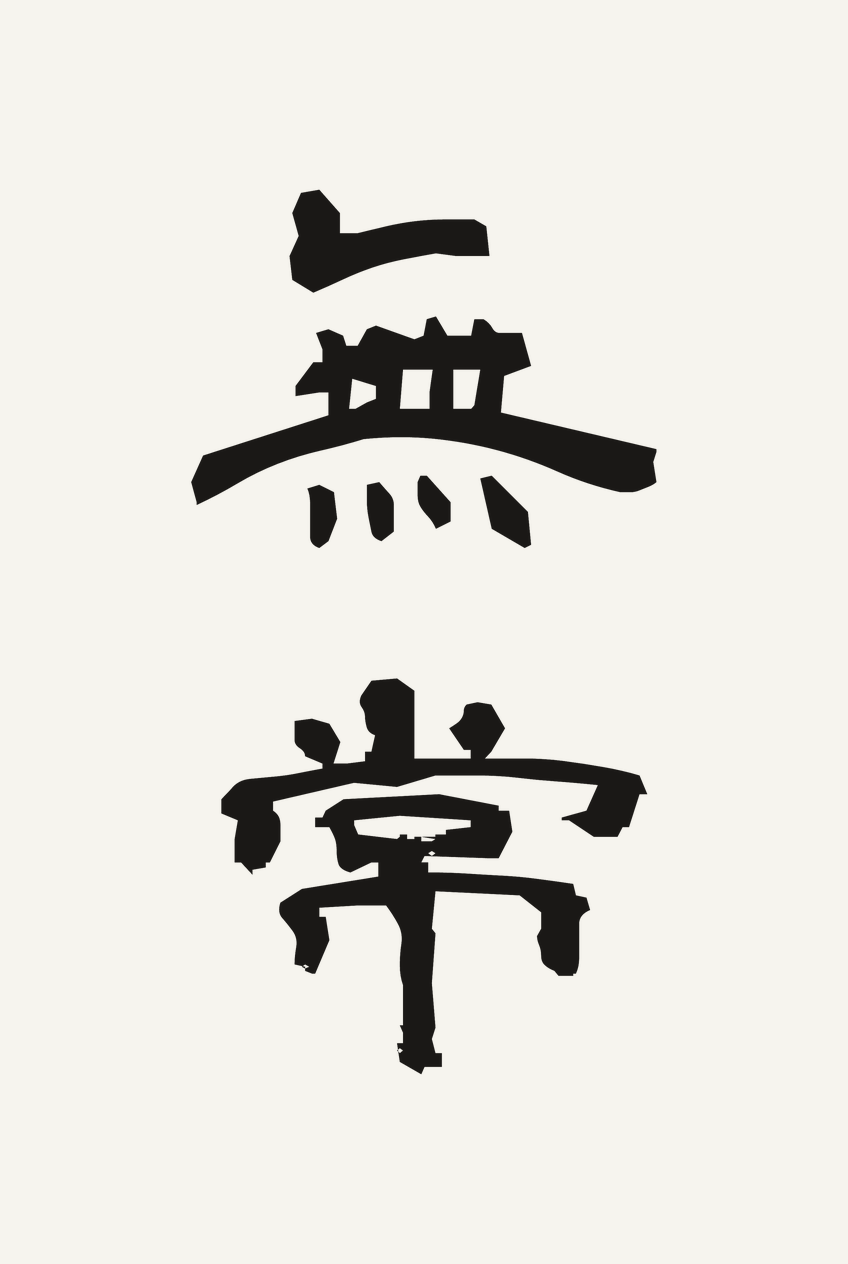
无常 · Wú Cháng
Impermanence
Series: Single-Character Zen · Design #06
Style: two characters, vertical column · clerical script (lishu) · traditional form 無常 · small-to-medium
Form: 文字
The Name
*Wú cháng* — no-constancy. Not a complaint; a description. Everything that arises changes while it lasts: bodies, markets, weather, love, the self doing the reading. The word arrived in Chinese with the Buddhist sutras — 諸行無常, "all conditioned things are impermanent" — and became one of the few loan-philosophies so naturalized that grandmothers use it for the weather. As a tattoo, it is the honest companion: nothing you are looking at is finished, including the grief, including you.
无常——不是抱怨;是描述。凡生起者,在存续期间一直在变:身体、市场、天气、爱、正在读这行字的这个自我。这个词随佛经进入汉语——諸行無常——并且本土化到连祖母都会拿来说天气。纹下它,是一个诚实的同伴:你眼前没有什么是定稿,包括悲伤,包括你。
Source & Provenance
The opening note of the Dharma: 諸行無常,是生滅法 — "all conditioned things are impermanent; they arise and pass away" — the first of the three marks taught across the early sutras. In China the phrase escaped the monastery within centuries: 阴晴圆缺 in Su Shi's moon poem, 世事無常 in the great novels — the doctrine folded into ordinary speech about tides, seasons, and luck. Inking note: this design adapts the classic line construction of the traditional motif and re-inks it as tattoo linework.
法音的第一声:諸行無常,是生滅法——早期诸经共教的三法印之首。这个词在数百年间走出寺院:苏轼咏月的「阴晴圆缺」、小说里的「世事無常」——教义折进了关于潮汐、季节与运气的日常口语。墨线转写:本设计以传统母题的经典线条造型为底,转写为纹身墨线。
Design Inspiration
Every form decision points to a recorded source, element by element. ① Two characters, one vertical column — the compound as it is chanted, stacked; the reading falls top to bottom like a thing passing. ② Clerical script, traditional form 無常 — 無's dense strokes carry the weight of what they say; lishu's level hand keeps the verdict calm, not tragic. ③ Small-to-medium scale — impermanence does not shout; 8–10 cm reads as a private acknowledgment. ④ Black ink only — no color, because no state lasts long enough to deserve a hue.
本设计的每一处形制决定都有出处可查,逐条对账。① 二字竖列——如念诵时的叠置;阅读自上而下落,像一件事正在过去。② 隶书、繁形「無常」——「無」的致密笔画承住它所说的重量;隶书平缓的手法让判词平静而不悲情。③ 小到中尺寸——无常不喊叫;8–10 厘米读作一次私下的承认。④ 只用墨——不上色,因为没有哪种状态久到配得上一抹色。
The Story
The sutra story behind the chant: a young disciple asked the Buddha for a cure for death. The answer was not an escape but a lens — look directly at arising and passing until the fear loosens its grip. 无常 is that lens in two syllables. It does not console; it orients. The flower is not sadder for being brief; the brevity is what makes the looking worth anything.
China's poets made the doctrine domestic. Su Shi, watching the moon over a tavern mid-exile, wrote that people's meetings and partings are just the moon's bright and dark — neither is a malfunction. The Chinese novel of everyday life took 无常 for its chorus: fortunes turn, dynasties turn, the beggar's son passes the exam. Worn on the skin, the word performs its own lesson — ink fades, skin changes, the tattoo itself obeys the sentence it spells.
经文背后的故事:一位年轻弟子问佛陀,有没有治死的药。回答不是逃逸,而是一枚镜片——直视生起与消逝,直到恐惧松开它的手。无常就是那枚镜片,两个音节。它不安慰;它定向。花不因短暂而更悲伤;短暂正是这一眼值得的原因。
中国的诗人把教义过成了家常。苏轼在贬途中望酒楼上的月亮,写人的聚散不过是月的圆缺——哪一样都不是故障。世情小说拿无常做副歌:风水轮流,王朝轮流,叫花子的儿子中举。戴在皮肤上,这个词表演着它自己的功课——墨会淡,皮肤会变,纹身本身就服从它拼出的那句话。
What It Means
For people in transition who want the truth written on them rather than against them: the divorced, the bereaved, the migrated, the recovered. It is the opposite of a promise ring — a promise that the current season, good or bad, is already on its way out. Grief gets the same verdict as luck.
给处在变动期、想把真相纹在身上而不是纹在对立面的人:离婚的、丧亲的、迁徙的、康复中的。它和情侣对戒正好相反——它承诺的是:眼下的这一季,无论好坏,已经在退场的路上。悲伤与好运拿到的是同一纸判词。
Where It Sits
Two characters, one plane: inner wrist, nape, sternum. At 6–8 cm it reads as a private acknowledgment; at 10–12 cm, a stated philosophy. Centered vertical placement suits the column; avoid folding joints.
两个字,一个平面:腕内侧、后颈、胸骨。6–8 厘米读作私下的承认;10–12 厘米读作公开的哲学。居中竖排最合这一列;避开折叠的关节。
Before You Ink
Two characters are the whole design. The empty paper around them is the doctrine's other half. ② Traditional form 無常. The dense 無 carries more gravity than the spare 无 — weight suits the verdict. ③ Clerical script stays level. Calm strokes for a hard sentence; the drama is not in the hand. ④ Minimum 6 cm for 無's internal density to hold. ⑤ Do not fight the fading. This design ages faster than most by its own argument — touch-ups are allowed; panic about it is missing the point.
两个字就是全部设计。 字四周的空纸是教义的另一半。② 繁形「無常」。 致密的「無」比留白的「无」更有分量——这份判词配得上重一点。③ 隶书保持平。 难句配平静的笔画;戏不在手上。④ 6 厘米起,「無」的内部密度才立得住。⑤ 不要与褪色作对。 这个设计按它自己的论点会比多数纹身老得更快——补色允许;为此恐慌,就没懂它。
Every character on this card was selected and checked stroke by stroke by a native reader of Chinese.



