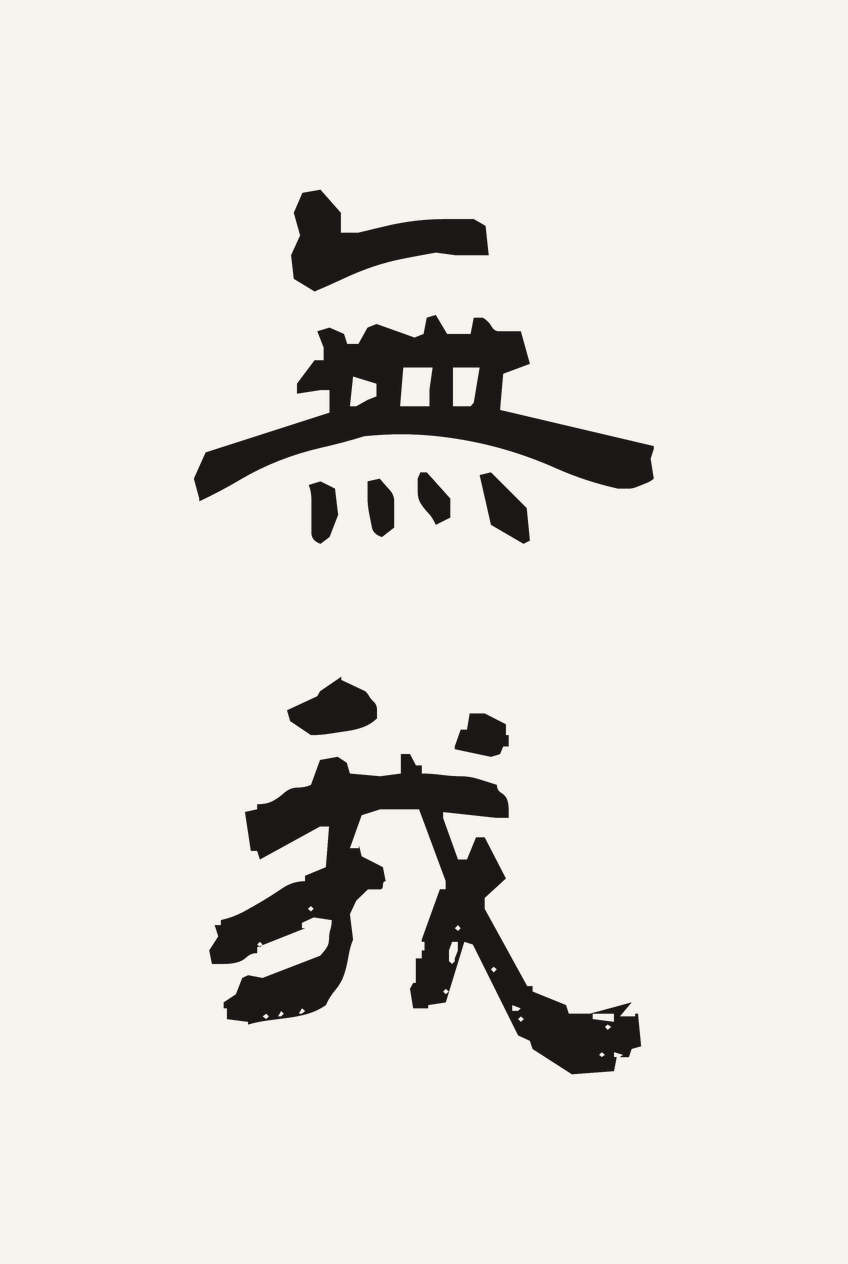
无我 · Wú Wǒ
No-Self
Series: Single-Character Zen · Design #08
Style: two characters, vertical column · clerical script (lishu) · traditional form 無我 · small-to-medium
Form: 文字
The Name
*Wú wǒ* — no-self. The most misread word in the shop's library. It does not say you do not exist; it says the thing you defend so loudly — the solid, separate, finished self — is a construction, edited daily, and far more brittle than the actual process it is printed on. The teaching lands as relief: if there is no fortress, there is nothing to besiege. As a tattoo, it is the lightest armor you will ever wear.
无我——馆藏里被误读最多的词。它不是说你不存在;它说你拼命保卫的那个东西——那个坚固、独立、定稿的自我——是造出来的,每天还在修订,远比它印在上面的那个实际过程脆弱。这个教义落地时是一种松脱:没有堡垒,就没有围城。纹下它,是你戴过的最轻的甲。
Source & Provenance
The second of Buddhism's three marks: 諸法無我 — "all phenomena are without a permanent self." The Huineng tradition pressed it into the famous line 本來無一物,何處惹塵埃 — "fundamentally there is not one thing; where would the dust land?" (*Platform Sutra*). In martial and tea practice it became the practical state: the expert acts without an audience of one watching over his own shoulder. Inking note: this design adapts the classic line construction of the traditional motif and re-inks it as tattoo linework.
佛教三法印之第二:諸法無我。惠能一系把它压成那句名偈:「本來無一物,何處惹塵埃」(〈壇經〉)。在武艺与茶道里,它成了实用状态:高手动作时,肩后没有那位只看自己的观众。墨线转写:本设计以传统母题的经典线条造型为底,转写为纹身墨线。
Design Inspiration
Every form decision points to a recorded source, element by element. ① Two characters, one vertical column — 無 above 我: the subtraction sits above the pronoun it empties. ② Clerical script, traditional form 無我 — 無's dense grid over 我's assertive spear: the visual argument of the whole teaching in one column. ③ Small-to-medium scale — 8–10 cm; armor this light travels small. ④ Black ink only — nothing here belongs to anyone, including a color.
本设计的每一处形制决定都有出处可查,逐条对账。① 二字竖列——「無」在上、「我」在下:减法坐在它要清空的那个代词上方。② 隶书、繁形「無我」——「無」的致密格阵压着「我」那杆矛:整门教义的视觉论证都在这一列里。③ 小到中尺寸——8–10 厘米;这么轻的甲,行装也轻。④ 只用墨——这里没有东西属于谁,包括颜色。
The Story
The Platform Sutra's scene: two verses pinned to the monastery wall. The senior monk writes that the body is a tree, the mind a mirror — polish it constantly, keep no dust alighting. All practice, all vigilance, a self improving itself forever. Huineng, the kitchen hand, answers at night: 本來無一物,何處惹塵埃 — there never was a mirror separate from what it reflects; where, on empty light, would dust land? He wins the robe and the argument: the self polishing itself is the only dust there is.
Martial artists know the state from the other side. The archer whose arrows drift asks for a tip and gets a question: who is watching the shot? The internal audience — the self-as-spectator — pulls every release a degree off-true. 無我 is not self-sacrifice; it is the removal of the spectator. What remains is exactly what was needed: the bow, the target, the morning. Everything load-bearing survives the demolition.
《坛经》的场景:两首偈钉在寺墙上。上座师兄写:身是菩提树,心如明镜台——时时勤拂拭,勿使惹尘埃。全是修行,全是警觉,一个自我在永远地改善自己。夜里,灶房杂役惠能答了一首:本來無一物,何處惹塵埃——从来不存在一面与所照之物分开的镜子;在空性的光上,尘埃落在哪里?他赢了衣钵,也赢了论证:那个自己擦自己的自我,就是全部的尘埃。
武人从另一侧认得这种状态。箭偏的射手求一个诀窍,得到的是一个问题:是谁在看这一箭?内在的观众——自设为看台的那个自我——让每一次撒放都偏一度。無我不是自我牺牲;是把看台撤掉。剩下的恰好是够用的:弓,靶,清晨。一切承重的东西,都从这场拆迁里活了下来。
What It Means
For the self-conscious — the performers, the over-defenders, the ones exhausted from curating a character. It is not a vow of self-erasure; it is permission to demote the project manager between you and your life. Things get lighter without getting smaller.
给自我意识过载的人——表演者、过度防御者、因为长期运营「人设」而耗尽的人。它不是自我抹除的誓愿;它是许可:把你和你生活之间的那位项目经理降职。东西变轻了,但没有变小。
Where It Sits
Two characters, one plane: nape, inner wrist, sternum. 6–8 cm reads as private doctrine; over the sternum it sits close to the architecture it describes.
两个字,一个平面:后颈、腕内侧、胸骨。6–8 厘米读作私下的教义;戴在胸骨上,紧贴它所描述的那副架构。
Before You Ink
Two characters are the whole design. ② Traditional form 無我. 無's density over 我's spear is the composition's whole argument. ③ Clerical script stays level. ④ Minimum 6 cm for 無 to hold its grid. ⑤ Do not wear it as an apology. 無我 is a technical term, not a permission slip for others to shrink you. If someone reads your tattoo as an invitation to demand your silence, cite Huineng: there was never a thing there to begin with.
两个字就是全部设计。 ② 繁形「無我」。 「無」的格阵压着「我」的矛——整幅构图就这一个论点。③ 隶书保持平。 ④ 6 厘米起,「無」的格阵才撑得住。⑤ 不要把它戴成道歉。 无我是术语,不是给别人缩你的许可。如果有人把你的纹身读成「请你闭嘴」的邀请,引惠能:本来无一物。
Every character on this card was selected and checked stroke by stroke by a native reader of Chinese.



