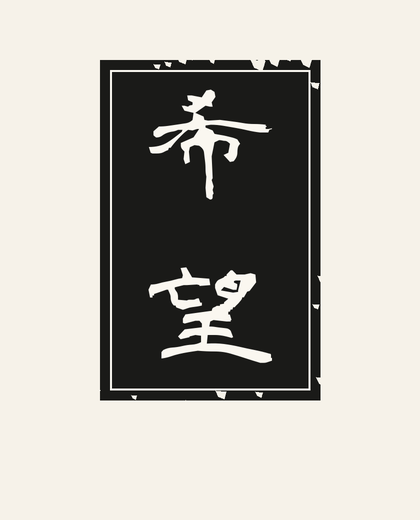
希望 · Xī Wàng
Hope
Series: Single-Character Zen · Design #62
Style: Two characters, vertical column · Han-seal filled-white (bǎiwén) stamp — black ground, reversed white glyphs, weathered border · clerical script (lishu) · medium scale
Form: 文字
The Name
*Xī wàng* — hope, the looking-forward that keeps a person going. The two characters are 希 (rare, to hope for) and 望 (to gaze into the distance, to look toward). Put together, the word is almost a physical description: looking out toward something you want and do not yet have. It is less an emotion than a posture — the head turned forward.
希望(xī wàng)——希望,让人撑下去的那种朝前看。两个字是「希」(少有、企望)和「望」(远看、朝向)。合起来几乎是一幅身体描写:朝着一个你想要、还没有的东西望出去。它与其说是情绪,不如说是一个姿势——头朝着前面。
Source & Provenance
This design works from the word itself rather than from a single documented classical source. 望 is ancient — it appears in early texts for looking into the distance and for the full moon — and 希 carried the sense of "rare" and "longed for," but the fixed compound 希望 as the everyday word for hope is a later development, without one authoritative origin text. The design therefore claims no classical quotation and no motif lineage; it simply sets the two characters in the seal form and script used across this series. What it offers is the word as it is actually felt now: the deliberate act of looking forward. No third-party source image was used for this design.
这张图用的是这个词本身,不靠某一条典籍出处。「望」很古——早期文本里指远望、也指满月——「希」带着"稀有、企盼"的意思,但把「希望」固定成日常表示盼望的词,是后来的发展,没有唯一的权威出处文本。因此本设计不引古典、不攀纹样谱系,只是把这两个字用本系列统一的印形与书体摆出来。它给的就是这个词今天真实被感受到的样子:有意地朝前看。本设计未使用任何第三方源图像。
Design Inspiration
Read it as a seal, top to bottom. ① Two characters in one vertical column — the classic stamp-strip format; the eye travels down the line the way hope travels forward. ② Clerical script — the Han-stone register, its level strokes keeping the word steady rather than breathless. ③ The filled-white treatment — both characters cut from the dark field, hope left as what remains visible. ④ The dense 希 over the balanced 望 — in white-negative, 希's fine upper strokes are kept open so the rarer, harder character does not clog above the steadier one. ⑤ Weathered border — a hand-set seal; hope is not a pristine thing.
从上到下,把它当一枚印来读。① 两字一竖列——经典的印章条幅格式;眼睛沿着线往下走,正如希望朝前走。② 隶书——汉石经的语域,横平笔画让这个词稳住,不显得气喘。③ 满白文处理——两个字都从黑地里挖出来,希望是留下来可见的东西。④ 密的「希」压在匀的「望」上——白文印里,「希」细密的上半保持通透,免得这个更稀有、更难的字糊在上头。⑤ 残边——手工盖出的印;希望从来不是一件干净无瑕的东西。
The Story
The word describes an act of the eyes. 望 is looking into the distance; 希 is the thing that is rare and longed for. Hope, in Chinese, is not a feeling you sit with — it is the direction your attention is pointed when the thing you want is not yet in front of you.
That distinction matters. The word does not promise that what you look for will arrive. It only names the looking. You can hope and be disappointed; the character still describes what you were doing in the meantime — holding your gaze out there, refusing to turn it back toward what you have already lost.
Because the compound is late and has no single classical anchor, it belongs entirely to ordinary speech. People say it to each other in hard moments without reaching for a classic: 还有希望 — there is still hope. That everydayness is what makes it honest. It is not a doctrine. It is what a person says when they choose, deliberately, to keep looking forward.
To wear 希望 is to fix that posture on the skin: not a guarantee about the future, but a decision about where you are looking today.
这个词描写的是一个眼睛的动作。「望」是往远处看,「希」是稀少、企盼的东西。中文里的希望不是一个坐着体会的情绪——是当你想要的东西还没出现在眼前时,你的注意力所指的方向。
这个分别很重要。这个词并不许诺你望的东西一定会来。它只命名那个"望"。你可以希望然后失望;这个字描述的仍然是你在这期间做的事——把目光留在外面,不肯转回去看已经失去的。
因为这个复合词出现得晚、没有唯一的古典锚点,它完全属于日常语言。人在难的时候互相说这句话,不用搬经典:还有希望。这种日常性正是它诚实的地方。它不是教义,是一个人决定继续朝前看时说出的话。
纹「希望」,是把这个姿势定在皮肤上:不是对未来的保证,是对"今天我把目光放在哪里"的决定。
What It Means
Hope as a deliberate direction of attention — looking toward what is rare and not yet present. A modern, everyday word in a traditional seal: not a promise about the future, but a decision about where you are looking today.
希望是有意地把注意力朝向一个方向——朝着稀少、尚未在场的东西。一个近代的日常词装进传统印章:不是对未来的承诺,是对"今天往哪里看"的决定。
Where It Sits
Two characters stacked want a vertical plane. Outer forearm or inner forearm at 7–10 cm total column height; the side of the neck or below the collarbone at 6–8 cm for a smaller seal; the calf or upper back at 10–12 cm. The tall narrow frame needs its full height, so keep both characters in one unbroken column.
两个竖排的字需要纵向的面。小臂外侧或内侧总列高 7–10 厘米;颈侧或锁骨下 6–8 厘米适合小号;小腿或上背 10–12 厘米。窄长印面需要完整高度,两字保持一竖列不拆。
Before You Ink
Negative-form seal — use the supplied white-ground black-line transfer sheet, not the black cover. ② Two characters, one column — do not split them side by side. ③ Keep 希's upper strokes open — the denser character must not clog. ④ No freehand Chinese characters. ⑤ Ink only; minimum 3 cm per character. ⑥ One script only — clerical version; do not substitute seal script.
负形印——用随卡附的白底黑线转印页,不要用黑底封面。② 两字一竖列——不要拆成左右并排。③ 「希」的上半保持通透——密处不能糊住。④ 切勿徒手画汉字。 ⑤ 只用墨;每字最小 3 厘米。 ⑥ 只纹一体——本款隶书,勿以篆书替代。
Every character on this card was selected and checked stroke by stroke by a native reader of Chinese.



