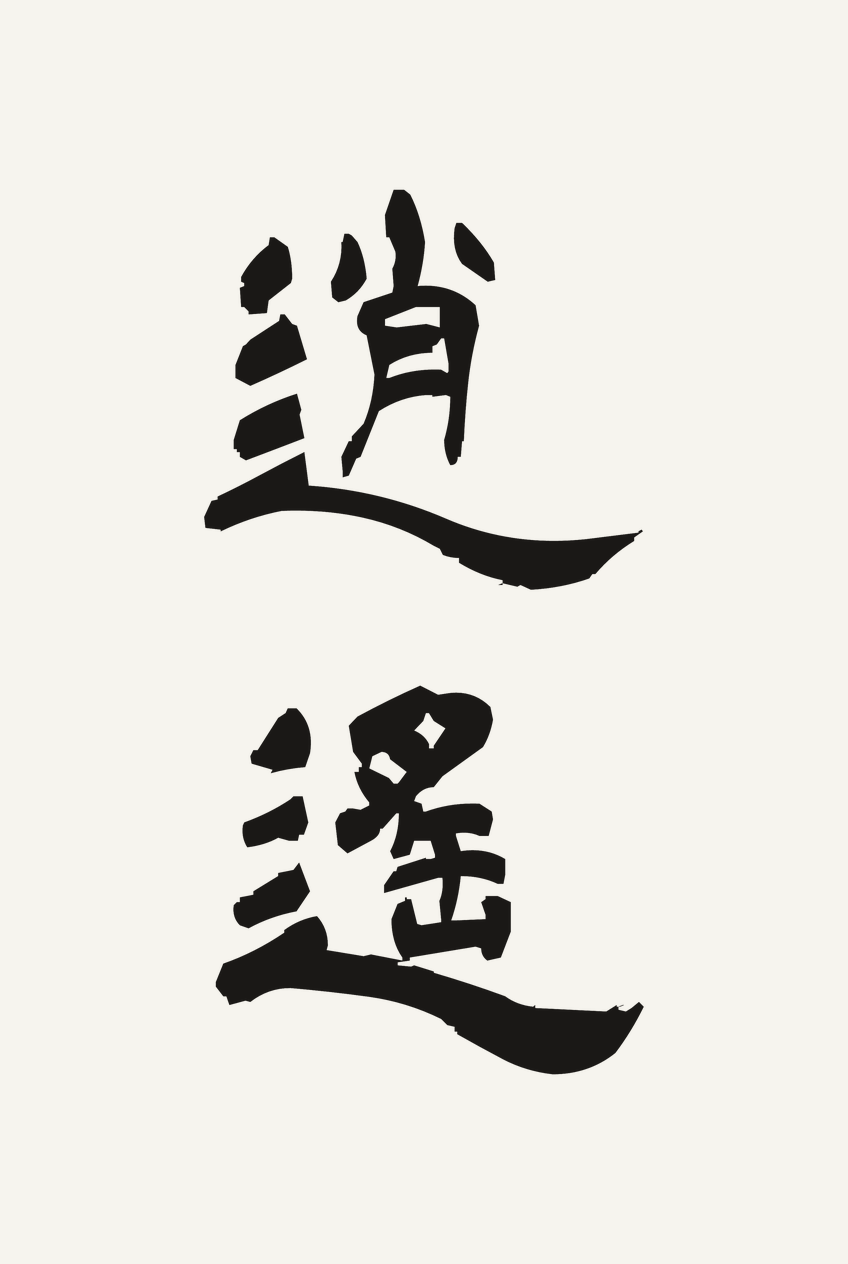
逍遥 · Xiāo Yáo
Free Wandering
Series: Single-Character Zen · Design #39
Style: two characters, vertical column · clerical script (lishu, traditional form 逍遙) · small-to-medium
Form: 文字
The Name
The word appears in the Book of Odes as plain loitering by a river; Zhuangzi took it and built his opening chapter into a philosophy with it: 逍遙遊 — free and easy wandering. The giant Peng bird crosses nine thousand li on one wingbeat; the little quail laughs at it from the fence post. Zhuangzi refuses to fully referee. 逍遥 is the state of needing no verdict: neither the scale of the flight nor the opinion of the quail sets your price.
这个词在《诗经》里只是河边散步;庄子把它拿走,用整整一章把它造成哲学:逍遙遊。大鹏一振翅九万里;篱笆下的斥鴳笑它飞那么高干什么。庄子拒绝完全当裁判。逍遥,是不再需要判决的状态:飞行的规模、小鸟的议论,都定不了你的价。
Source & Provenance
The word is attested pre-Zhuangzi in the Odes (鄭風·清人, 河上乎逍遙); the doctrine is Zhuangzi's opening chapter 逍遙遊 — both layers stated, the philosophy credited to the book that earned it. Inking note: this design adapts the classic line construction of the traditional motif and re-inks it as tattoo linework.
这个词早于《庄子》,见《诗经·郑风·清人》「河上乎逍遙」;教义在《庄子》开篇《逍遥遊》——两层如实分列,哲学记在配得上它的那本书名下。墨线转写:本设计以传统母题的经典线条造型为底,转写为纹身墨线。
Design Inspiration
Every form decision points to a recorded source, element by element. ① Two characters, one vertical column — both walk the 辵 radical: 逍遥 is the only pair in the shop where both characters arrive on foot. ② Clerical script, traditional form 逍遙 — the long level strokes read as stride. ③ Small-to-medium scale — 6–10 cm. ④ Black ink only — wandering light.
本设计的每一处形制决定都有出处可查,逐条对账。① 二字竖列——两个字都走辵旁:全店唯一一对「走着到场」的字。② 隶书、繁形「逍遙」——舒展的长横读作步幅。③ 小到中尺寸——6–10 厘米。④ 只用墨——游走的,光就够了。
The Story
Chapter one is a catalogue of sizes: the huge bird, the cicada, the tree too gnarled for any carpenter's rule, and finally the man who rides the truth of heaven and earth and rides out the weather of opinion — 至人無己. The freedom is not altitude; the quail at the fence is arguably free too. 逍遥 is the only freedom that survives comparison, because it has opted out of the league table entirely. It is also, notably, the word the modern language reaches for when it means "answerable to no schedule": 逍遥法外 notwithstanding, the word keeps its clean smell.
第一章是一部尺寸目录:巨鸟、蝉、弯到任何木匠的尺都量不了的树,最后是那个乘天地之正、御六气之辩、以游无穷的人——至人無己。那种自由不是海拔;篱下的斥鴳某种程度上也是自由的。逍遥是唯一一种经过比较还能活下来的自由,因为它整个退出了联赛。还有一层值得记下:现代汉语想表达「不看任何人的时间表」时,伸手拿的还是这个词——哪怕逍遥法外在那儿凑热闹,这个词身上始终是干净的气味。
What It Means
For the ones who have left the league table: the freelancer, the slow traveler, the person who sized their life to their own units. It is a passport stamp from a country with no borders and no queue.
给已经退出联赛的人:自由职业者、慢旅行者、用自己的单位丈量生活的人。它是一本护照的出境章,盖自一个没有国界、也不排队的国家。
Where It Sits
Two characters, one column: inner wrist, nape, sternum; 6–8 cm private, 10 cm stated; minimum 5 cm for the twin walk-radicals.
二字竖列:腕内侧、后颈、胸骨;6–8 厘米私人,10 厘米公开;双辵旁需 5 厘米起。
Before You Ink
Two characters are the whole design. ② Traditional form 逍遙. ③ Clerical script keeps the stride level. ④ Minimum 5 cm. ⑤ It only reads free on a person who stopped keeping score — the ink is not the exit; it is the souvenir of one.
两个字就是全部设计。 ② 繁形「逍遙」。 ③ 隶书保持步幅平展。 ④ 5 厘米起。 ⑤ 只有在真的停止计分的人身上它才读作自由——墨不是出口;是出口的纪念品。
Every character on this card was selected and checked stroke by stroke by a native reader of Chinese.



