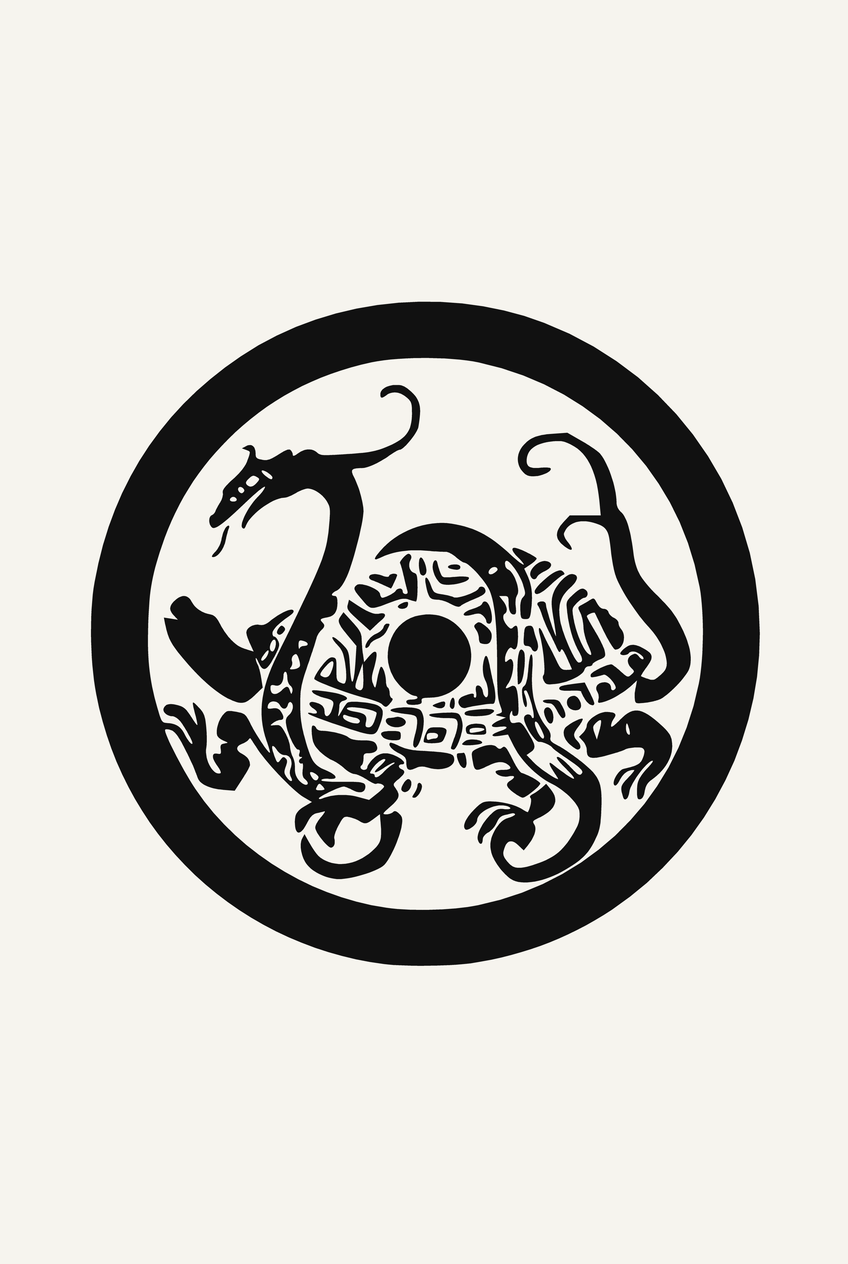
玄武 · Xuán Wǔ
The Dark Warrior of the North
Series: Pattern Symbols · Design #28
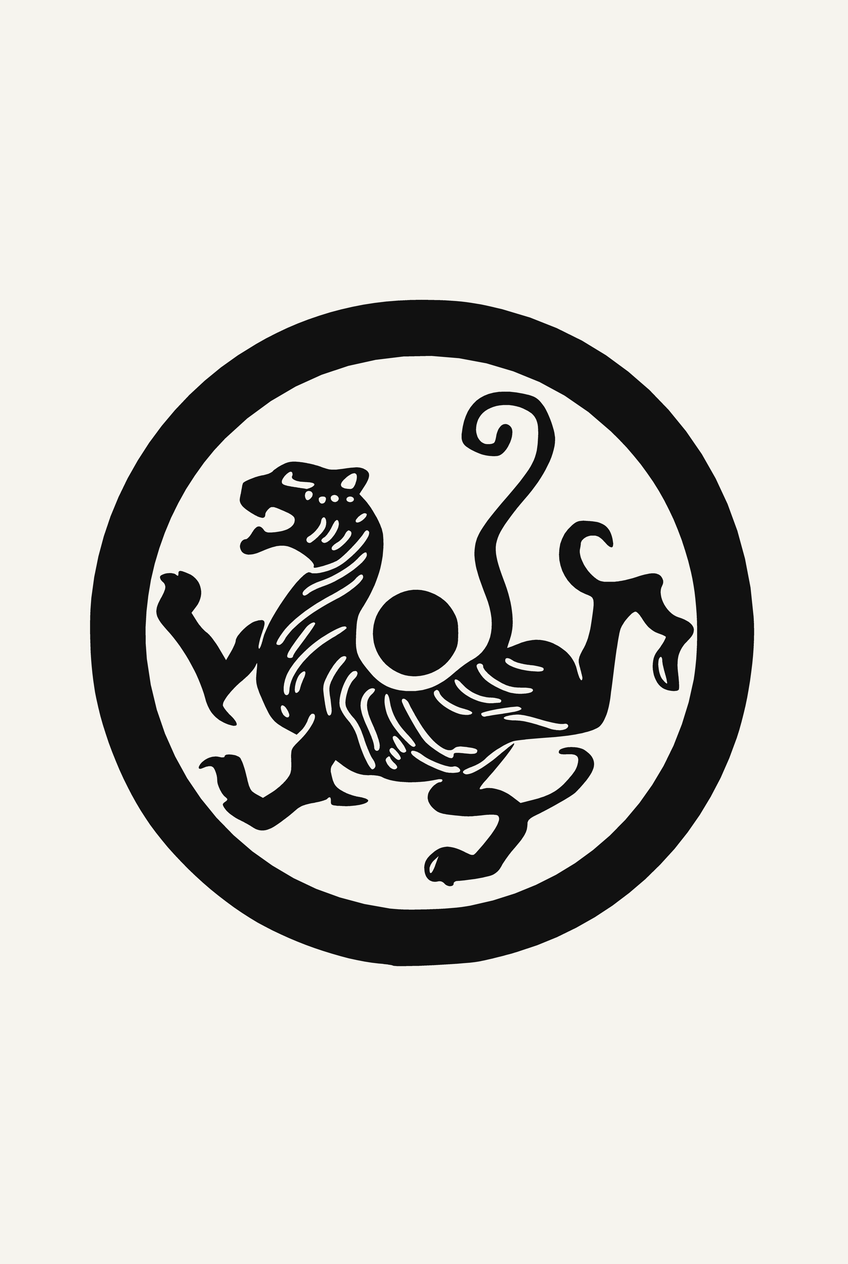
Style: circular roof-tile medallion · solid black with carved white lines · medium-to-large
Form: 图案
The Name
*Xuán wǔ* — the Dark Warrior, the guardian of the North. In the Han ordering of the heavens, the seven lunar mansions of the northern sky were read as one entwined pair — a tortoise and a snake, black, the color of water and of winter, the season of enduring. This design is that pair as the tile-makers of Chang'an cast them: inside the heavy ring of a Han roof-tile end, shell and serpent knotted around one another, holding.
玄武——北方之神。汉人排天上的星,北方七宿连读,是一对相缠的兽——龟与蛇,黑色,属水,属冬,是「熬」的那个季节的颜色。本设计就是长安制瓦人铸出来的他们:在汉代瓦当的粗环之内,甲与蛇绞成一结,彼此撑住。
Source & Provenance
The motif is the four-divinities roof-tile (四神瓦当) of the Western Han: the round end-cap of the pantile, molded in relief with one of the four directional beasts. The Sanfu Huangtu fixes the set — Azure Dragon east, White Tiger west, Vermilion Bird south, Dark Warrior north — "the four spirits of heaven, set to govern the four quarters," each with a season, an element, a color. The Dark Warrior presided over the north, water, winter; tiles bearing the tortoise-and-serpent have been excavated from the Han Chang'an city site. This tile face keeps the grammar of those examples: the heavy outer ring, the plain round boss at center, the shelled tortoise with geometric scutes and the long-bodied snake crossing the shell in a standing S. Inking note: this design adapts the classic line construction of the traditional motif and re-inks it as tattoo linework.
母题是西汉的四神瓦当:筒瓦端头的圆面,模印四方位神兽之一。《三辅黄图》定下这一组——青龙东、白虎西、朱雀南、玄武北,「天之四灵,以正四方」,各主一季、一行、一色。玄武主北方、水、冬;汉长安城遗址出土的瓦当中即有模印龟蛇者。本瓦当面保留出土品的语法:粗外环、当心素圆乳钉、带几何甲片的龟与以立起的 S 形横过龟背的长蛇。墨线转写:本设计以传统母题的经典线条造型为底,转写为纹身墨线。
Design Inspiration
Every form decision points to a recorded source, element by element. ① The heavy ring — the tile's own rim, the boundary the relief could not cross. ② The solid center boss — the round tile nut kept plain in the beast tiles. ③ Tortoise and snake as one figure — the paired form the excavated Han examples give: the tortoise planted on four clawed feet, shell filled with hooked geometric scute-patterns, the snake reared in a standing curve across the shell, heads at opposite ends. ④ Solid black with carved white lines — the rubbing's own language: the shell's armor reads as white carving inside the black mass.
本设计的每一处形制决定都有出处可查,逐条对账。① 粗外环——瓦当自己的边,浮雕出不去的界。② 当心素圆乳钉——兽面瓦里保留下来的当心圆。③ 龟蛇同体——出土汉瓦给他们的合体形:四足踏地的龟,甲面布满带钩的几何甲片纹,蛇以立起的弧线横过龟背,两头各在一端。④ 实黑加白雕线——拓片自己的语言:龟甲的甲胄感,读成墨面里的白色雕纹。
The Story
Every other guardian is a single animal. The Dark Warrior is two, and that is the whole point. A tortoise alone is patience without reach; a snake alone is reach without patience. Knotted together they cover each other's missing half — the shell that cannot chase, the serpent that cannot hide — and for the Han that complete creature stood for the north: winter, water, the deep of the year where nothing grows and everything survives.
The north was the direction you could not flatter. The sun never favored it; the armies that marched into it often did not come back; the Han emperors' tombs faced it anyway, because the north was also where you kept what you meant to keep forever. Around that fact the ancients built his character: he was the guardian you stationed over what must simply endure — the tomb, the well, the storehouse, the thing you would not check on for years and needed to be certain of. Later ages made him a general in his own right, armored, trampling turtle and snake under a war-god's boots — but the Han tile holds the older, quieter pair: no armor but the shell, no weapons but the hold. Two slow animals, certain of each other, outlasting everything that rushed.
别的守护者都是一只兽。玄武是两只——而这就是全部的重点。龟单独是「耐」而没有「及」;蛇单独是「及」而没有「耐」。绞成一结,他们补上彼此缺的那一半——追不动的壳,藏不住的身——汉人就让这只完整的兽代表北方:冬、水、一年的深处,那个什么都不生长、而一切都在熬的地方。
北方是没法讨好的那个方向。太阳从不偏向它;开进去的军队常常回不来;汉家皇帝的陵墓偏偏都朝向它——因为北方也是存放「打算永远留着的东西」的方位。围着这个事实,古人造出他的性格:他是派驻在「只需要熬住」的东西上方的那位守护者——陵墓、井、仓、那些你几年不会去看一眼、却必须确定无恙的东西。后来的朝代把他升成了自己的将军:披甲、踏龟蛇、一副战神的靴子——但汉瓦留住的是那对更老、更安静的组合:除了壳没有甲,除了「撑住」没有兵器。两只慢的动物,对彼此有把握,熬得过所有着急的东西。
What It Means
The strength of the pair that holds. North, winter, water — the Dark Warrior is the guardian of lasting through: the winter that must be waited out, the commitment that must simply be kept, the years that ask for endurance instead of heroics. He is for people mid-hold — the long study, the long repair, the promise being kept when no one is watching — and for anyone who knows that lasting is its own kind of fight. Two natures, one grip. Neither lets go.
「撑住」的力气。北方、冬、水——玄武是掌「熬过去」的神:必须等完的冬天、必须只是守住的承诺、那些要的不是英雄主义而是耐力的年份。他给正在「撑」的人——漫长的学业、漫长的修复、无人在看时仍在守的约定——也给每一个明白「熬得住」本身就是一种仗的人。两种天性,一个握法。谁都不撒手。
Where It Sits
The round medallion is built for the places that hold: the shoulder cap, the upper arm, the calf — the ring sitting true, the tortoise planted, the snake crossing the shell along the limb's own line. Medium-to-large; the scute-pattern needs room for its hooks to read.
圆形瓦当生来就属于「承重」的部位:肩头、上臂、小腿——环放得正,龟踏得稳,蛇沿肢体本身的线横过龟背。中到大;甲片纹的钩状细节需要余地才能读清。
Before You Ink
The ring is yours to keep or lose. The heavy outer circle is the tile's rim — keep it and you wear the complete medallion, a bold round frame that reads clean on shoulder, upper arm or calf; have your artist remove it and the pair holds alone. Both are correct; decide by placement, not by habit. ② The center boss stays. The solid round dot is the tile's heart — removing it empties the design. ③ Two heads, both kept. Tortoise and snake each have a head at their own end; merging them or dropping one breaks the figure. ④ Only ink. Black mass and white carved scute-lines are the rubbing's two tones — no color needed. ⑤ Mind the fine lines. The hooked scute-pattern needs at least 10 cm of finished size to hold its detail.
环,由你决定去留。 粗外环是瓦当的边——保留它,你带走的是完整的瓦当:肩头、上臂、小腿上一圈干脆的圆框;让纹身师去掉它,这一对就独自相守。两种都对,按部位定,不按习惯定。② 当心乳钉不能省。 当心那枚实心圆点是瓦当的心——去掉它,整件设计就空了。③ 两头都留。 龟和蛇各有一枚头,各在一端;并成一枚或去掉一枚,形就破了。④ 只用墨。 墨面与白色雕出的甲片纹是拓片的两色——不必上色。⑤ 细线要留量。 带钩的甲片纹至少要 10 厘米的成品尺寸才撑得住细节。
Every character on this card was selected and checked stroke by stroke by a native reader of Chinese.