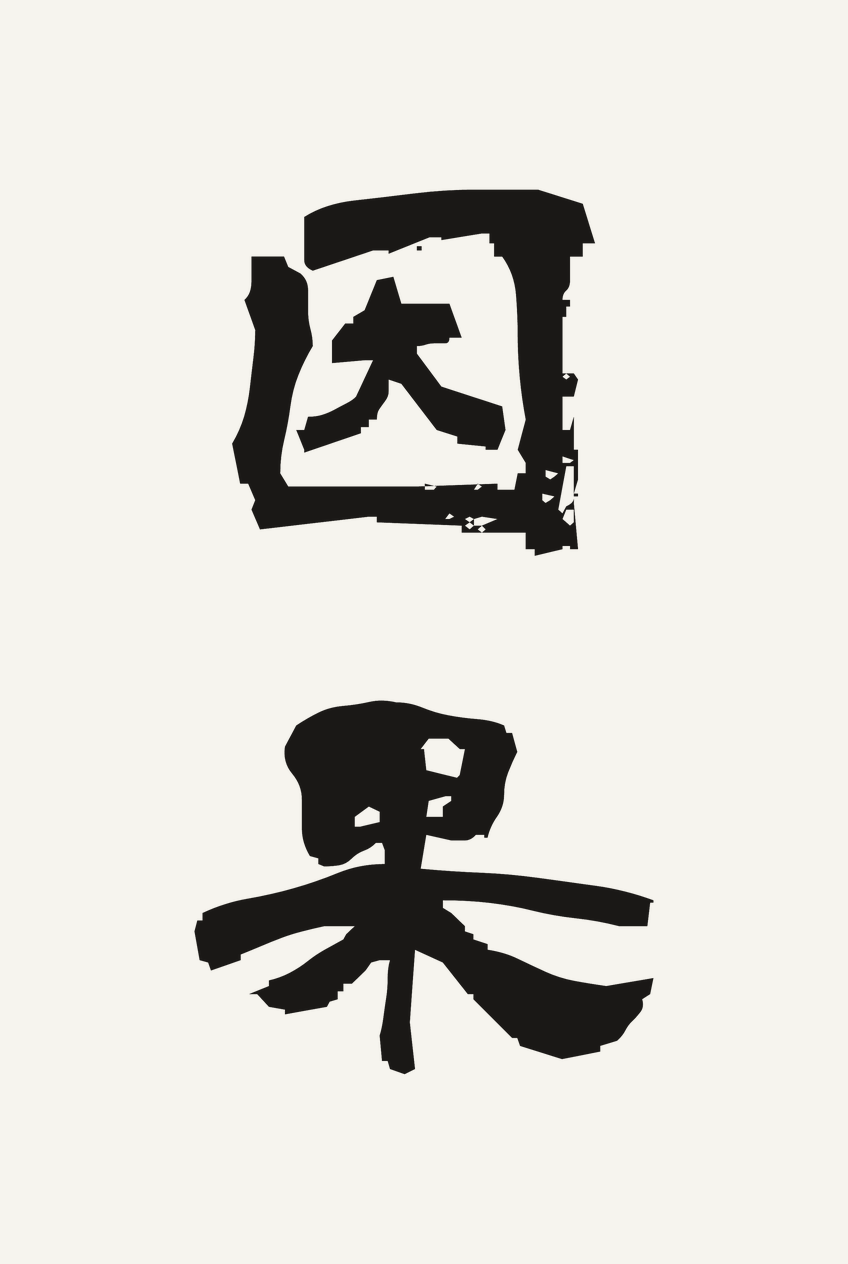
因果 · Yīn Guǒ
Cause and Fruit
Series: Single-Character Zen · Design #28
Style: two characters, vertical column · clerical script (lishu) · traditional form 因果 · small-to-medium
Form: 文字
The Name
Cause and fruit. Not cause and *effect* — the Buddhist image is agricultural: a seed does not punish or reward; it grows. 果 is fruit, result, and ripeness in one character. Every action is a seed with a gestation period, and the fruit always announces the seed. Karma is not a courtroom; it is an orchard. As a tattoo, 因果 is a person accepting authorship: the orchard is yours, the planting seasons were yours, and the harvest arriving now is also yours.
因与果。不是 cause and *effect*——佛教的意象是农业的:种子不惩罚也不奖赏;它生长。「果」一个字里装着果实、结果与成熟。每个行为都是一粒带孕期的种子,而果实永远报出种子的名字。业力不是法庭;它是果园。纹上因果,是一个人在认领作者身份:果园是你的,播种季是你的,现在抵达的收获也是你的。
Source & Provenance
Buddhist doctrine, entering Chinese with the sutra translations: the term appears throughout the āgama translations and later treatises (因果 as cause-fruit pairing, 因緣果報). The colloquial force is proverbial: 種瓜得瓜,種豆得豆 — plant melons, get melons. Inking note: this design adapts the classic line construction of the traditional motif and re-inks it as tattoo linework.
佛教义理,随佛经汉译进入汉语:术语遍见阿含经译本与后世论书(因果即「因—果」配对,因缘果报)。口语的力度在谚语里:種瓜得瓜,種豆得豆——种瓜得瓜,种豆得豆。墨线转写:本设计以传统母题的经典线条造型为底,转写为纹身墨线。
Design Inspiration
Every form decision points to a recorded source, element by element. ① Two characters, one vertical column — the seed (因) above, the fruit (果) below: the diagram of a stem. ② Clerical script, traditional form 因果 — 因's walled enclosure holds the seed; 果's canopy of grain over a tree makes the result visible from across the room. ③ Small-to-medium scale — 6–8 cm; the doctrine needs no advertising. ④ Black ink only — seeds and fruit are one cycle of one ink.
本设计的每一处形制决定都有出处可查,逐条对账。① 二字竖列——因(因)在上,果(果)在下:一张茎秆的图解。② 隶书、繁形「因果」——「因」的围合结构笼住种子;「果」的田上树下让结果隔着房间都能看见。③ 小到中尺寸——6–8 厘米;这个义理不需要广告位。④ 只用墨——种子和果实是同一种墨的一个循环。
The Story
The Buddha's most radical move was not metaphysical; it was agricultural. Where earlier thought blamed fate, gods, or chance, the sutras taught a quiet horror and a quiet mercy in one term: whatever stands in your field was planted — some of it by hands you no longer remember being yours. The horror: you cannot disown the crop. The mercy: you are planting now. Both halves are in the two characters stacked in a column — the seed over the fruit, cause writing result in the only direction a stem grows.
The tattoo's daily function is receipt-checking. The situation you are in is a fruit; trace it to its seed without flinching. The situation you are creating — with today's message, purchase, silence — is a seed; read the label before it goes into the ground. 因果 collapses the distance between who you were and who you are becoming into two syllables.
佛陀最激进的举动不在形而上;在农业。在早期思想归咎于命运、神明或偶然的地方,经文用一个词教了安静的恐惧与安静的慈悲:你田里站着的一切都是种出来的——其中一些出自你已经不记得是自己 hands 的手。恐惧:你无法与这季作物撇清。慈悲:你现在正在播种。两半都在竖列的两个字里——因在果上,因以茎秆生长的唯一方向书写着果。
这个纹身的日常功能是查收据。你身处的处境是一个果;别眨眼地溯源到它的种子。你正在制造的处境——今天的消息、这笔购买、这次沉默——是一粒种子;在它进土之前读一遍标签。因果把「你曾是谁」与「你正在成为谁」的距离压进两个音节。
What It Means
For anyone tempted to argue with their harvest — the career, the body, the relationships that are "just happening." It is a one-word audit: planted by you.
给每一个想与自己的收成争辩的人——那些「就这么发生了」的事业、身体、关系。它是一个单词的审计:你种的。
Where It Sits
Two characters, one plane: inner wrist, nape, sternum. 6–8 cm private, 10 cm stated; minimum 5 cm for 因's enclosure to stay open.
两个字,一个平面:腕内侧、后颈、胸骨。6–8 厘米私人,10 厘米公开;「因」的围合要打开需 5 厘米起。
Before You Ink
Two characters are the whole design. ② Traditional form 因果. ③ Clerical script stays level. ④ Minimum 5 cm. ⑤ Agriculture, not astrology. The doctrine assigns blame and credit to the planter, not the stars. If the tattoo becomes fatalism, it has been planted upside down.
两个字就是全部设计。 ② 繁形「因果」。 ③ 隶书保持平。 ④ 5 厘米起。 ⑤ 农业,不是占星。 这个义理把功过分给种植者,不给星象。如果纹身变成了宿命论,它是被倒着种下去的。
Every character on this card was selected and checked stroke by stroke by a native reader of Chinese.



