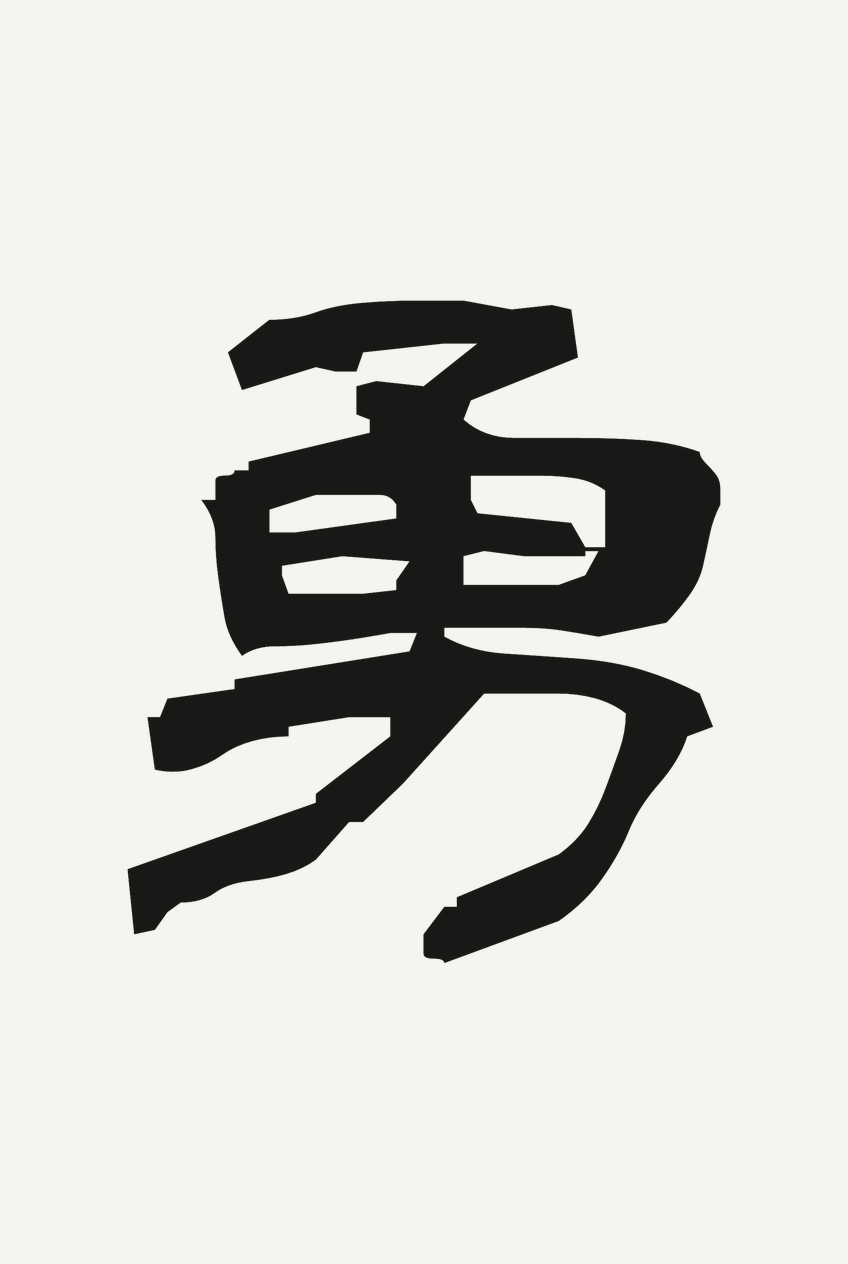
勇 · Yǒng
Courage
Series: Single-Character Zen · Design #09
Style: single character, large · clerical script (lishu) · same form 勇 · small-to-medium
Form: 文字
The Name
*Yǒng* — courage. The character's old body is 甬 over 力: a hand raising something heavy, effort made visible. Confucius, careful with this word, ranked it third of the three cardinal virtues — wisdom, humanity, courage — and immediately fenced it: without righteousness, courage is rebellion. The one character carries the fence with it. As a tattoo, it is not a roar; it is a signed consent to be afraid and act anyway.
勇——这个字的古体是「甬」上「力」:一只手把重物举起来,让用力这件事显形。孔子用这个词很谨慎,把它排在三达德之末——智、仁、勇——并且立刻加上围栏:没有义,勇是造反。纹这一个字,围栏也跟着纹上。它不是吼;是签署一份同意书——同意害怕,并且照样行动。
Source & Provenance
The Analects: 知者不惑,仁者不憂,勇者不懼 — "the wise are not perplexed, the humane are not anxious, the brave are not afraid" (9.29); and the fence, 見義不為,無勇也 — "to see what is right and not do it: that is want of courage" (2.24). The *Zhongyong* crowns the triad: 智仁勇三者,天下之達德也. Inking note: this design adapts the classic line construction of the traditional motif and re-inks it as tattoo linework.
《论语》:「知者不惑,仁者不憂,勇者不懼」(子罕);围栏在为政篇:「見義不為,無勇也」。《中庸》把三达德定名:「智仁勇三者,天下之達德也」。墨线转写:本设计以传统母题的经典线条造型为底,转写为纹身墨线。
Design Inspiration
Every form decision points to a recorded source, element by element. ① One character, alone, large — the single-character hanging: a word this load-bearing wants no neighbors. ② Clerical script, same form 勇 — lishu's pushed, weighted strokes are effort made permanent; the character means raising something heavy and is written like it. ③ Small-to-medium scale — 8 cm on the wrist reads as a worn key; 12 cm on the forearm, a posted notice. ④ Black ink only — courage has no costume.
本设计的每一处形制决定都有出处可查,逐条对账。① 一字、独处、够大——单字悬挂:这么承重的词不需要邻居。② 隶书、同形「勇」——隶书推进、承重的笔画,是把「用力」做成长久;这个字的意思是举起重物,写法也像举重物。③ 小到中尺寸——腕上 8 厘米读作随身的钥匙;小臂 12 厘米读作张贴的告示。④ 只用墨——勇气没有戏服。
The Story
Confucius's fence matters because the word was dangerous. His era's strongmen robed cruelty in valor; 子路, his most fearless student, died trying to right a wrong the state had already abandoned — buttoning his fallen cap as the blades came, dying correct. Confucius mourned him and kept teaching the fence anyway: courage without 义 (rightness) is not a virtue but a vector — it magnifies whatever aims it. The discipline is the pairing. Ask what the act is for, then stop asking, then move.
The Zen tradition added the quietest form of the word: the courage of the cushion — to sit still with your own mind, unmedicated, unentertained, for hours. Warriors and monks agreed on the ranking: running toward the enemy is common; sitting with yourself is rare. 勇 covers both. The tattoo earns its keep in the second kind, which no one ever applauds.
孔子的围栏要紧,因为这个词危险。他那时代的强人把残忍裹在勇武里;子路,他最无畏的学生,死在试图纠正一桩国家已经放弃的错事上——刀锋临身时还在系正被打落的冠缨,死得端正。孔子哀恸,却仍坚持教那道围栏:没有义的勇不是德性,是矢量——它放大一切瞄准它的东西。功夫在配对:先问这一举是为了什么,然后不再问,然后动。
禅门给这个词补上最安静的一种形式:坐垫上的勇——带着自己的心静坐,不用药,不找消遣,数小时。武人与僧人在排序上一致:冲向敌人是常事;陪自己坐住是稀罕事。勇两个字都管。这个纹身真正起作用的,是没人鼓掌的第二种。
What It Means
For the afraid who act anyway: the diagnosis-holders, the first-day employees, the ones boarding. One character does not promise the tremor stops; it registers, permanently, that you consented to carry the weight with the shakes included.
给害怕着却照样行动的人:拿到诊断书的、第一天上班的、登机登船的。一个字不保证颤抖停止;它永久登记的是——你签字同意带着抖动把重量举起来。
Where It Sits
One character, one plane: the nape, the inner wrist, the sternum. At 6–8 cm it reads as a worn key; at 10–12 cm, a posted notice. Centered placement suits the glyph's upright mass; avoid folding joints.
一个字,一个平面:后颈、腕内侧、胸骨。6–8 厘米读作随身的钥匙;10–12 厘米读作张贴的告示。居中位置最合这个字的直立体量;避开折叠的关节。
Before You Ink
One character is the whole design. The emptiness around it is the stillness before the lift. ② Same form 勇. ③ Clerical script stays weighted. The strokes push downward-then-out — a lifter's legs, not a sprinter's. ④ Minimum 5 cm for the internal detail to hold. ⑤ Keep the fence. 勇 without a purpose you can name in one sentence is the word's dark half. If you cannot finish the sentence "this tattoo is for the day I ___," wait.
一个字就是全部设计。 字四周的空,是举起之前的那一下静止。② 同形「勇」。 ③ 隶书保持承重。 笔画先向下再向外——是举重者的腿,不是短跑者的。④ 5 厘米起,字内细节才立得住。⑤ 留着围栏。 说不出一句话用途的勇,是这个字的暗面。如果你填不完「这个纹身是为了那一天我要 ___」这句话,等一等。
Every character on this card was selected and checked stroke by stroke by a native reader of Chinese.



