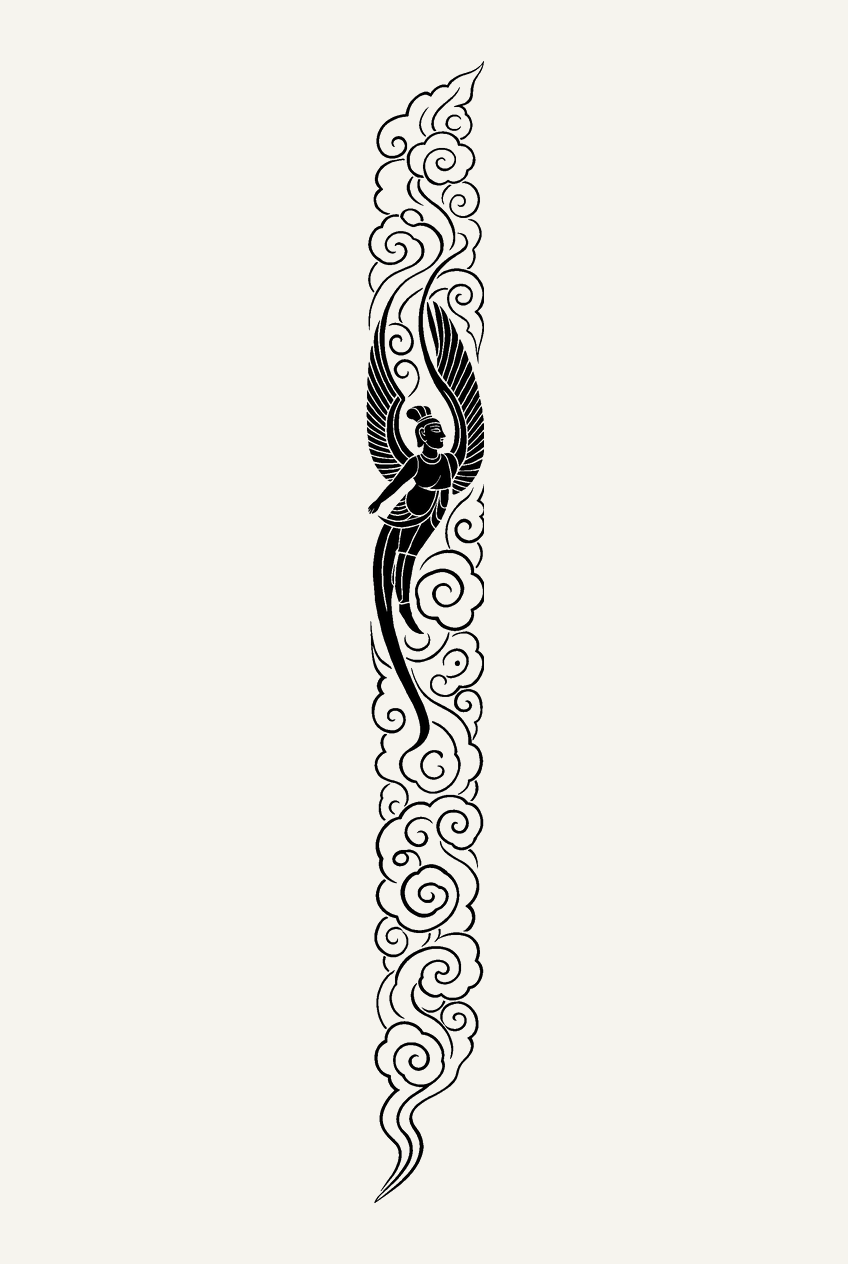
羽人带 · Yǔ Rén Dài
The Feathered Being
Series: Symbols & Patterns · Design #24
Style: Winged immortal vertical band · the feathered man in flight, cloud scrolls trailing · black-and-white block contrast · full arm-band or leg-band wrap · scalable 12–18 cm
Form: 图案
The Name
yǔ rén dài — the human who solved gravity with feathers. The *Shanhaijing*, China's oldest geography of the impossible, locates them precisely: 「羽民国……其为人长头,身生羽」 — the Land of the Feathered, whose people have long heads and feathers growing from their bodies. Han dynasty artists put them everywhere: on tomb walls and stone reliefs, winged figures glide among clouds beside the immortals, riding dragons, gathering the medicine of never dying. To the Han mind they were not monsters but graduates — humans who had finished with the ground.
羽人带(yǔ rén dài)——用羽毛解出重力的人。《山海经》,中国最古老的不可能地理志,把他们的位置标得很精确:「羽民国……其为人长头,身生羽。」汉代艺术家把他们画得到处都是:墓室壁与石刻画像上,生羽的人形在云端滑行,与仙人并列,骑龙、采不死之药。在汉代人眼里他们不是怪物,而是毕业生——已经修完「大地」这门课的人。
Source & Provenance
The yuren (feathered being) tradition: the *Shanhaijing*'s Feathered Land (「羽民国」,*Haiwai Nanjing* chapter) and its feathered citizens; Han dynasty stone reliefs and tomb murals — notably the Han pictorial stones of Nanyang and the murals of the Xi'an region — where winged figures attend the Queen Mother of the West among cloud scrolls, an iconography of the age's immortal-seeking culture. The term 羽化, "to sprout feathers," became the standard phrase for transcendence. Historical form reference: Han pictorial-stone feathered figures with cloud scrolls. Inking note: this design adapts the classic line construction of the traditional motif and re-inks it as tattoo linework.
羽人的传统:《山海经·海外南经》的羽民国与那里「身生羽」的居民;汉代石刻画像与墓室壁画——尤其南阳汉画像石与西安地区汉墓壁画——生羽人形在卷云间侍奉西王母,是这个时代求仙文化的图像志。「羽化」一词由此成为「超脱」的标准说法。形制参考:汉画像石上伴卷云的羽人。墨线转写:本设计以传统母题的经典线条造型为底,转写为纹身墨线。
Design Inspiration
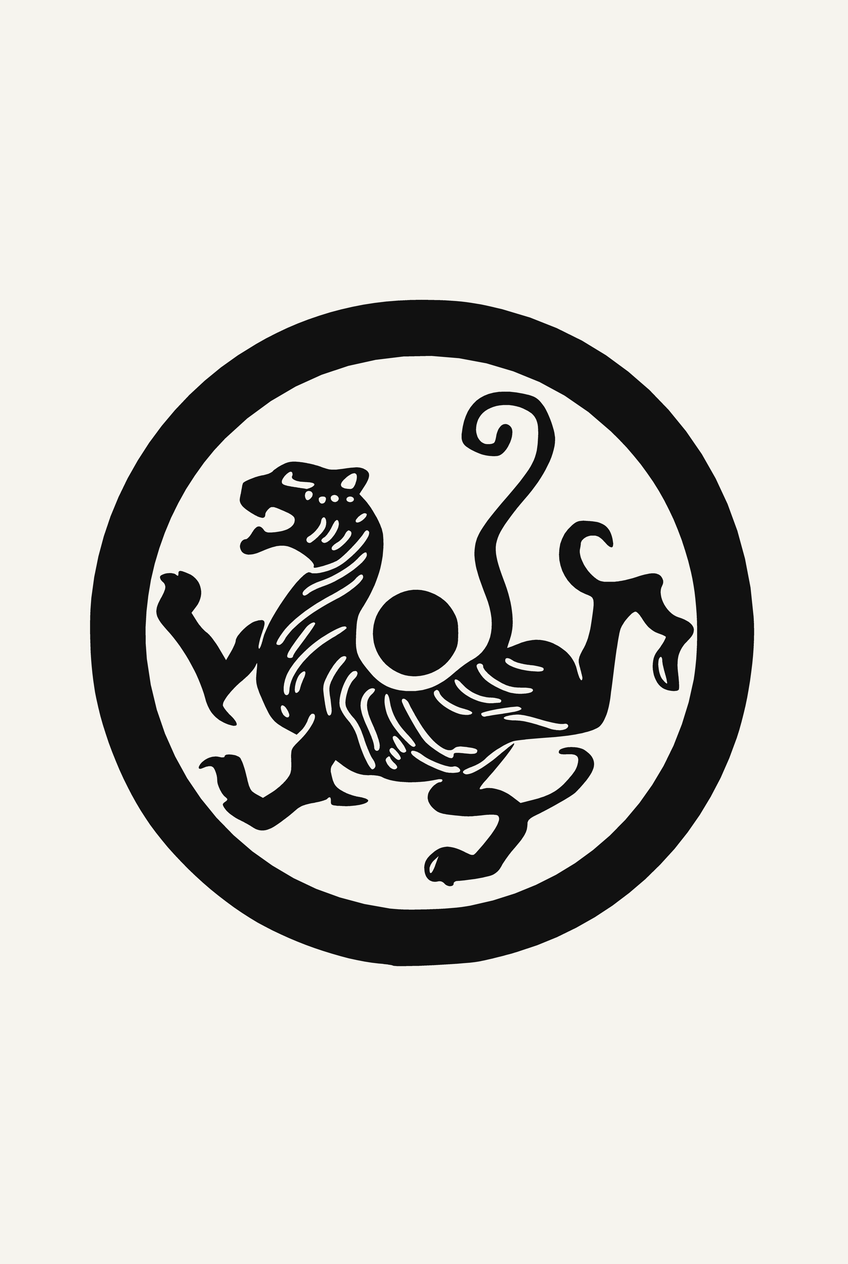
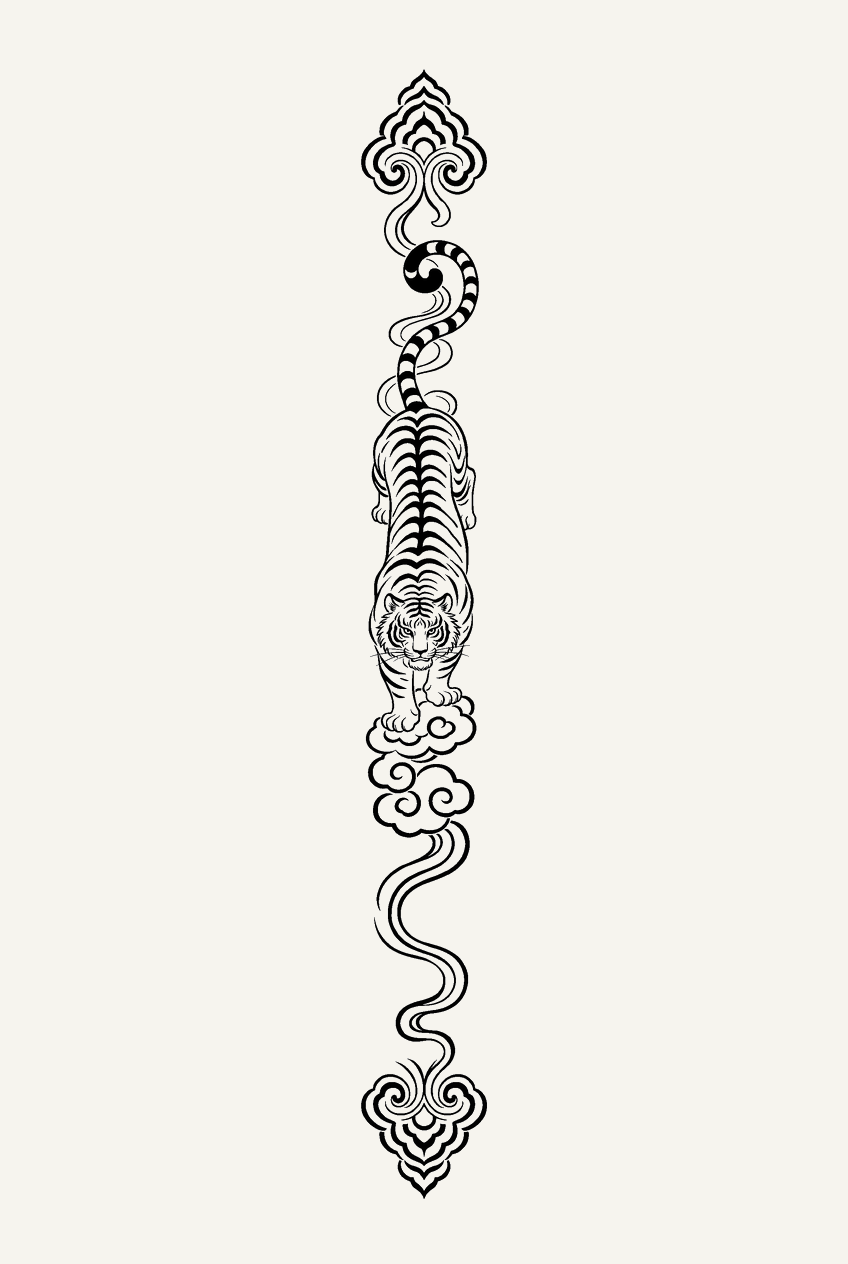
Every form decision on this design points to a recorded source, element by element. ① The feathered body — human frame with feather rows along the arms and shoulders, the Han relief anatomy. ② The long head profile — the Shanhaijing's 长头 detail preserved in the silhouette. ③ The flight posture — one leg trailing, arms spread into the wind, the gliding pose of the pictorial stones. ④ The trailing cloud scrolls — tight spirals behind the figure, the standard immortal-flight ground of Han art.
本版每一处形制决定都有出处可查,逐条对账。① 生羽之身——人的骨架、臂肩生羽行,汉代画像的解剖。② 长头侧影——《山海经》「长头」的细节保留在轮廓里。③ 飞行的姿态——一腿后拖、双臂张进风里,画像石上的滑行式。④ 尾随卷云——身后紧螺旋成串,汉代仙飞题材的标准地纹。
The Story
Every culture imagines flight, but the Han version is the most practical on record: they didn't invent wings for the human, they reported finding humans who already had them. The *Shanhaijing* treats the Feathered Land as geography — a place past the where-the-maps-end line, with citizens who are long-headed and feathered, and the tone is not mythology but field survey. The Han took the report seriously enough to draw the graduates everywhere: gliding beside the Queen Mother of the West, serving the elixir, riding the clouds with the casual posture of commuters.
The deeper story is in the word they left behind. 羽化 — "to feather" — became the Chinese word for the whole project of self-transformation: the alchemist's art, the poet's ascent, the Taoist's exit from the ordinary. The Books of Changes' line about the flying dragon got a folk appendix: it is not enough for the dragon to fly; the point is that a person can learn to.
This band freezes one of those graduates mid-glide: feathers along the arms, one knee trailing, clouds streaming behind like the wake of something that has decided never to land. Around the arm it reads as a promise kept at eye level — the ground is temporary; some part of you already has feathers.
每种文化都想飞,但汉代版本是记载里最务实的:他们没有给人发明翅膀,而是「报道发现了本来就有翅膀的人」。《山海经》把羽民国当成地理来写——地图尽头线之外的某处,居民长头生羽,语气不是神话而是田野调查。汉代把这份报告当了真,把毕业生画得到处都是:在西王母身边滑行、捧着不死药、以通勤者的松弛姿态骑云。
更深的故事在留下的那个词里。羽化——「长出羽毛」——成了中文里「自我转化」整个工程的标准说法:方士的丹、诗人的登、道家的出离。飞龙在天的那句易经古义,得了民间注脚:龙会飞不算什么;要紧的是人可以学。
这条带把其中一位毕业生定格在滑行途中:羽顺臂生、一膝后拖,云在身后拖成尾迹——某种决定永不降落的东西的尾迹。绕在臂上,它在视线高度兑现一句承诺:地面是暂时的;你身上已有一部分,长出了羽毛。
What It Means
The exit is possible. The yuren is transcendence drawn as a person, not a symbol: proof-of-concept for leaving the ground — ambition with feathers on. For anyone mid-transformation, carrying a life from one level to the next, this is the emblem of the stage between here and there.
出口存在。羽人是把「超脱」画成人形而非符号:离开地面的概念验证——长着羽毛的志向。给正在转化中途、把生活从一层搬到下一层的人:这是「此地与此处之间」那一程的徽记。
Where It Sits
Full arm band on the upper arm or forearm, 3–5 cm wide, the figure gliding around the limb with clouds trailing. As a leg band it wraps the calf in the same gliding line. The figure should face the direction of travel — upward along the limb.
上臂或前臂整圈臂环,宽 3–5 厘米,人形绕肢滑行、云在后。小腿腿环同一条滑行线绕小腿。人形朝行进方向——沿肢体向上。
Before You Ink
The figure is small-scale anatomy: pick an artist who can hold human proportion inside a 3–5 cm band — a mushed yuren loses the whole story. ② Feather rows are fine white-on-black lines: minimum 3 cm width or they close. ③ Wrap direction: the glide must follow the limb's line, clouds trailing behind the figure, never ahead. ④ Ink-only by design: the black figure against paper ground carries the flight. ⑤ Forearm placements flex — schedule the first review early.
人形是小尺度解剖:选能在 3–5 厘米带宽里守住人体比例的纹身师——羽人一糊,故事全糊。② 羽行是黑地白细线:至少 3 厘米宽,否则并线。③ 环绕方向:滑行必须顺肢体线,云拖在人形之后,绝不在前面。④ 只宜墨线:纸地上的人形就是飞行本身。⑤ 前臂位活动多——第一次复查排早些。
Every character on this card was selected and checked stroke by stroke by a native reader of Chinese.