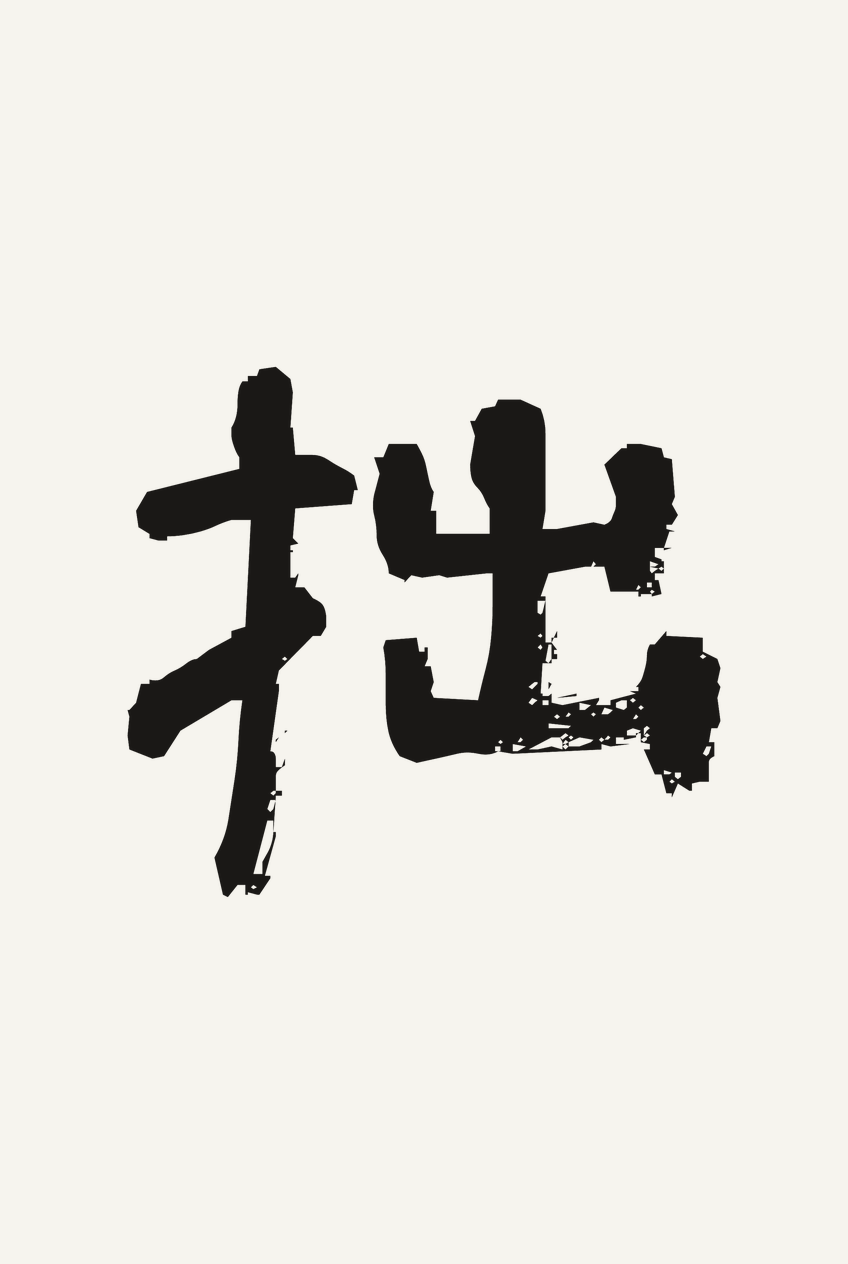
拙 · Zhuō
Unpolished
Series: Single-Character Zen · Design #38
Style: single character · clerical script (lishu) · traditional form 拙 · small-to-medium
Form: 文字
The Name
Unpolished — clumsy on purpose. 拙's parts tell the story: hand-radical (扌) over 出 (emerge): what the hand puts out, raw. Daodejing forty-five makes it doctrine: 大巧若拙 — "great skill looks clumsy": the highest craft has removed every trace of showing off, and what remains looks almost artless. Great skill looks clumsy — as the Italians would say, exquisite simplicity that looks like it cost nothing. As a tattoo, 拙 is a commitment to the un-performable: skill so settled it has stopped waving.
拙——故意的笨。字的部分自己讲故事:手旁(扌)加「出」:手伸出去的东西,是生的。《道德经》第四十五章把它变成教义:大巧若拙——「最大的巧看起来像笨」:最高的手艺删掉了每一处炫技的痕迹,剩下的几乎不像艺术。作为纹身,拙是对「不可表演」的承诺:技艺稳到不再挥手。
Source & Provenance
Daodejing 45, original text: 大直若屈,大巧若拙,大辯若訥 — "great straightness seems bent; great skill seems clumsy; great eloquence seems stammering." Tao Yuanming supplies the life application: 守拙歸園田 — "keeping to my clumsiness, I return to garden and field" (《歸園田居》其一). Inking note: this design adapts the classic line construction of the traditional motif and re-inks it as tattoo linework.
《道德经》第四十五章原文:大直若屈,大巧若拙,大辯若訥——「大直好像弯,大巧好像拙,大辩好像讷。」陶渊明提供生活方式的注脚:守拙歸園田——「守着这份拙,回到园田」(归园田居其一)。墨线转写:本设计以传统母题的经典线条造型为底,转写为纹身墨线。
Design Inspiration
Every form decision points to a recorded source, element by element. ① One character, centered — the hand-radical on the left holds the emerging 出 on the right: output drawn raw. ② Clerical script, traditional form 拙 — the strokes keep honest weight, no flourish: a polished rendition of an anti-polish word, which is the paradox the doctrine lives in. ③ Small-to-medium scale — 4–6 cm. ④ Black ink only — no color to perform with.
本设计的每一处形制决定都有出处可查,逐条对账。① 单字居中——手旁在左,托着「出」:产出被画成生的。② 隶书、繁形「拙」——笔画保持诚实的分量、不加花:给一个反打磨的词做了一个打磨过的呈现——这个悖论正是义理的住处。③ 小到中尺寸——4–6 厘米。④ 只用墨——没有可供表演的颜色。
The Story
Laozi's chapter forty-five reads like a collector's appraisal inverted: the straightest thing looks bent; the most skilled looks clumsy; the most eloquent sounds halting. This is not modesty — it is a description of mastery's final stage. The beginner performs; the intermediate refines; the master disappears from the work. Calligraphy supplies the standard example: the student's brush is self-conscious, the expert's brush is fluent — and the great master's brush is again stiff, a little awkward, deliberately beside its own point. 大巧若拙 is fluency that has chosen to lumber.
Tao Yuanming made the word a biography: a magistrate for nineteen days, then resignation — 守拙歸園田, keeping to his own clumsiness, he went home to farm. His poems are plain almost to rude — no ornament, no allusion stacking — and they became the most imitated poems in the language. The lesson stacks: the clumsy thing, done without performance, outlives everything polished around it.
老子第四十五章读起来像一份倒着写的鉴宝报告:最直的东西看着弯;最高明的看着笨拙;最雄辩的说得结巴。这不是谦虚——这是对精通之终点的描述。初学者表演;中段打磨;大师从作品里消失。书法是标准例子:学生的笔有自我意识,行家的笔流畅——而大师的笔又硬了回去,带一点笨拙,故意不在自己的点上。大巧若拙,是选择了跌撞的流畅。
陶渊明把这个词活成了传记:做了八十天县令(注:任彭泽令约八十余日)就辞职——守拙歸園田,守着拙,回家种地。他的诗朴素得近乎无礼——不装饰、不堆典——却成了这门语言里被模仿最多的诗。教训一层层叠上去:不表演的笨东西,比它周围所有打磨过的东西活得都久。
What It Means
For the over-polishers — the ones whose drafts die of refinement, whose talent is being spent on seeming effortless. It is permission to ship the raw hand.
给过度打磨的人——草稿死于 refining 的那种、把才华花在「显得毫不费力」上的那种。它是许可:把生的那只手交出去。
Where It Sits
One character: inner wrist, nape, sternum. 4–6 cm private, 7 cm stated; minimum 4 cm for the hand-radical and 出 to stay distinct.
一个字:腕内侧、后颈、胸骨。4–6 厘米私人,7 厘米公开;手旁与「出」要分得开需 4 厘米起。
Before You Ink
One character is the whole design. ② Traditional form 拙. ③ Clerical script, honest weight — polished strokes for an anti-polish doctrine: the paradox is deliberate. ④ Minimum 4 cm. ⑤ Clumsy is the result, not the goal. 大巧若拙 requires the 巧 first: the master's stiffness is earned. Skipping practice and calling it 拙 is not the Dao; it is just skipping practice.
一个字就是全部设计。 ② 繁形「拙」。 ③ 隶书、诚实的分量——给反打磨的义理配打磨过的笔画:悖论是故意的。④ 4 厘米起。 ⑤ 笨是结果,不是目标。 大巧若拙的前提是先有「巧」:大师的僵硬是挣来的。跳过练习然后自称「拙」,那不是道;那只是跳过了练习。
Every character on this card was selected and checked stroke by stroke by a native reader of Chinese.



